


 July 04, 2017, 01:31 PM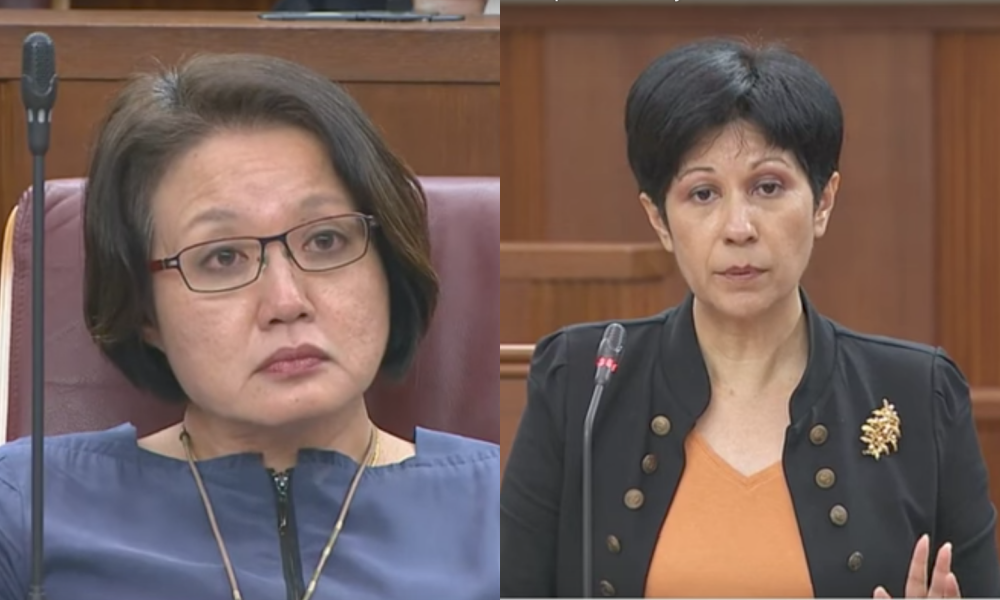

A packed Parliament heard Prime Minister Lee Hsien Loong delivered his ministerial statement and 26 Members of Parliament (MP) spoke out on the Oxley Road saga on July 3.
Rounding off the debate in Parliament, Senior Minister of State for Law and Finance Indranee Rajah responded to questions, in particular by Workers' Party MPs Sylvia Lim and Secretary-General Low Thia Khiang.
WP MPs raised concerns on a potential conflict of interest by the Attorney-General Lucien Wong, given that he was PM Lee's personal lawyer -- a point that was not addressed in PM Lee Hsien Loong's statement.
This was a point that Lee Hsien Yang had first alluded to in his joint public statement with his sister, Lee Wei Ling on June 14.
A summary: What Indranee said about Wong's appointment
- Wong is “widely acknowledged as a top legal mind (and) consistently recognised as one of Singapore’s best (lawyers)”.
- He was appointed “after a thorough and rigorous” process. PM Lee had consulted Chief Justice Sundaresh Menon, Public Service Commission chairman Eddie Teo and then AG V K Rajah before arriving at the decision.
- The Council of Presidential Advisers had advised President Tony Tan to concur with the appointment while President Tan, acting in his discretion, also supported it.
- Wong will not be involved in matters where conflicts of interest may arise, including 38 Oxley Road, she added.
“As a lawyer of almost 40 years’ standing, Mr Wong would have had thousands of clients. There is no reason why this should be an excuse for us to pass him over, and choose a less qualified candidate."
For those who were following the debate, it sounded more or less like a circular exchange when both sides were not engaging each other.
Indranee addressed the issue from a process perspective, while Lim was seeking answers on the perception of conflict of interests.
We produced the exchange between both on the issue. It really sounded like they were speaking on parallel tracks.
Indranee vs Sylvia Lim
Sylvia Lim: Thank you, Deputy Speaker, I have three clarifications for the senior minister of state.
First point is that she told the house that the AG and the Deputy AG have been observing the conflict rules in their functions, I’d like to ask her categorically whether she’s saying that the AG and the deputy AG Mr (Hri) Kumar are not involved in advising the government and the matters concerning the Lee estate. That’s the first clarification.
The second clarification is, she mentioned the fact that they have been friends of ministers who had been appointed to various organs of state, and I think she mentioned Judiciary as one of them, but does she not agree really that for the AGC what we’re faced now with is not the judiciary where the security of tenure where judges are appointed secure to 65, but we have an AG now who is on a short-term contract which is only three years. That puts a very different complexion on things.
Third clarification is does she agree or not agree that it is desirable to have distance between the AGC leadership and the government which was what believed by some former ministers including Professor Jayakumar, or have standards changed.
Indranee: On the first question, the short answer is that the Attorney General and the Deputy Attorney General are not advising the government on any matters in which they have previously been involved. In other words, whatever it is that they may, in private practice, have advised people on if when they come into the AGC, if it impacts into those areas then they won’t advise on it.
(Note: Deputy AG Hri Kumar Nair was a former People’s Action Party Member of Parliament)
So, if your question is, for example, is Mr Lucien Wong wrong advising the Ministerial Committee on 38 Oxley Road the answer is no, for the very simple reason that in AGC there are other offices.
So, this is not a difficult thing. All lawyers know this. If you have acted on something, and you happen to change organisation or go somewhere else, and there is a conflict, you recuse yourself.
It’s very simple. It’s not a difficult thing to do and lawyers do it in practice all the time and the Attorney General and the Deputy Attorney General are observing these rules.
So, I can assure Ms Sylvia Lim that the rules of conflict are being observed.
On the second point, Ms Sylvia Lim said it is different from the bench where there is security of tenure but in AGC there is no security of tenure which puts a different complexion on things.
It does not put a different complexion on things. All lawyers, good lawyers understand their duty which is simply this: if you’re in a position of conflict, you do not act, you recuse yourself. And as to whether it is desirable to have distance, the correct question really is: Are the members or other officers of AGC do they act independently? In other words, if there is a conflict, they stand aside? Do they apply their minds without fear or favour? Do they do their duty? And the answer to those questions is yes.
They do act independently, they apply their minds, and they carry out their duties without fear of either. So in short, in short, the offices in the AGC, whether it’s the Attorney General, the Deputy Attorney General or anyone down along the line, all observe proper rules of conduct.
Sylvia Lim: Thank you sir. Two follow up clarifications for Senior Minister of State. Is she saying that the Deputy AG, because he may not have acted on the Lee estate in some capacity in private practice is now free to advise the government on such matters from the government perspective, is that what she’s saying?
And the second clarification is that she didn’t answer directly, said I asked the wrong question about whether there should be distance between the AGC and the government, because the critical question to her was whether the officers act professionally and independently but this is really quite a different take from even (former Law Minister) Professor Jayakumar because if you read what his interview goes into he says that he may occasionally have lunch, working lunches with the AGC, but it is important to have the appearance of distance.
You know you cannot get too close to these people because people might assume that there will be some compromise so I think it is the appearance itself is also important not just in fact whether people think they are able to act independently but the appearance of when you’re too close to somebody it doesn’t create a good feeling.
Indranee: Mr Deputy Speaker, I’ve already answered the question. If there is any matter, on which the Attorney General or the Deputy Attorney General have acted on when they were in private practice, and if that same matter comes up when they’re in AGC, they obviously cannot advise on it, and they will not do so with respect to the other matters, I’ve already explained. There have been instances before when either the Attorney General or judges may have been close friends with ministers or anyone else but that has not deterred them from doing their duty. I understand what Ms Lim is saying. She’s saying actual conflict and sort of appearances. In terms of any actual conflict, I’ve already stated the position quite clearly. They know their duty, and they will carry out their duty. They will not act where there is any conflict of interest. And as far as appearances goes, if she has any specific allegation of that, please highlight it. Because as far as I can see there has been no form of impropriety, appearance or otherwise.
The end.
Top photo from YouTube



If you like what you read, follow us on Facebook, Instagram, Twitter and Telegram to get the latest updates.