


 November 04, 2019, 07:28 PM
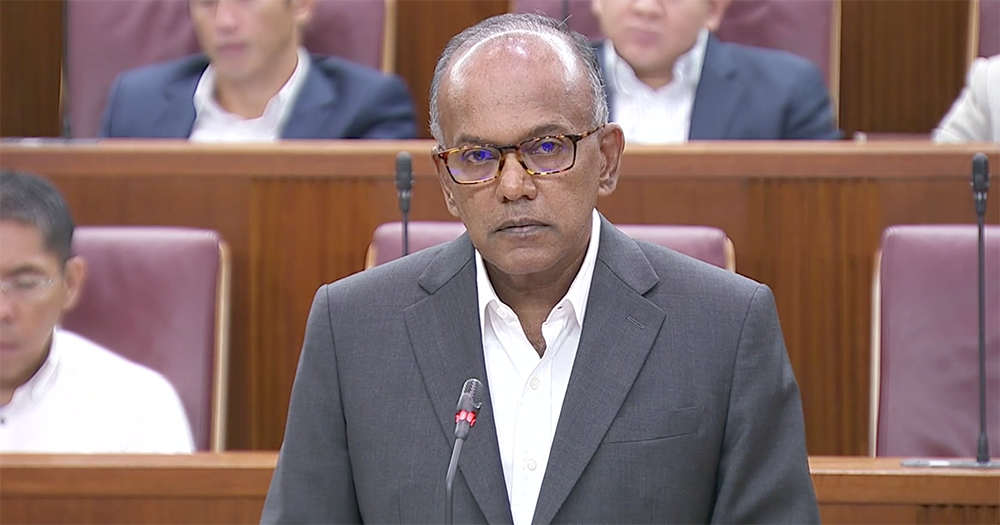

It is "absurd" to publish a list of Singaporeans and entities who are potentially subject to foreign influences, Minister for Law and Home Affairs K Shanmugam said in Parliament on Nov. 4.
How should one compile such a list?
Shanmugam was responding to a question filed by Nominated Member of Parliament (NMP) Anthea Ong, who asked about the criteria in determining which Singaporeans or local entities were at risk of being subject to foreign influence, and whether a list of such parties might be published.
"I am a little perplexed by the question, because how do you make a comprehensive list of all people who may potentially be recruited by foreign agencies, or be subject to foreign influence? When I put it in those terms, you can see that the point is quite absurd."
Shanmugam pointed out that if government action was necessary, then the case will be made public, unless there are questions of national security.
Identify areas that are vectors for foreign influence instead
Referring to his earlier remarks on controlling foreign employment in media organisations, Shanmugam said the issue had to be looked at from a broader perspective.
Certain factors had to be considered, such as the government's ability to identify foreign influence, and the nature of such organisations.
Only then can a particular approach be settled on to manage the risks.
How foreign influence is conducted has no specific criteria
Clarifying his point, Shanmugam spelled out the baseline for foreign interference:
"Say you push a foreign country’s or a specific party’s agenda, to subvert your own country, the position is clear. You are acting against Singapore’s national interests."
As to how foreign influence could be carried out however, the minister added that he was unsure if this could be identified according to specific criteria.
"Often this is done for money, sometimes, for other reasons. I am not sure you can do this or identify this by specific criteria. It really depends on what is actually done, what actually happens."
The cases of Eastern Sun and Singapore Herald
Shanmugam highlighted that the media is a commonly used vector for foreign interference.
Here, he cited past cases involving the now-defunct Eastern Sun and Singapore Herald as instances of foreign influence operations via the media.
Eastern Sun: Black ops front for Communist China
Shanmugam noted that the Eastern Sun's founder, Aw Kow, son of one of the Tiger Balm brothers, approached senior officials of a Chinese state-owned news agency in Hong Kong for money.
However, these officials were also undercover intelligence officers of Communist China.
When the Eastern Sun faced financial difficulties, the officers provided money on the condition that Aw appoint their representative as an advisor.
The paper then undertook non-journalistic functions at the behest of the Chinese government, such as providing support and cover for Chinese intelligence officers.
The paper was subsequently exposed in May 1971 as a case of black ops, resulting in the mass resignation of its senior editorial staff and its cessation of operations a few days later.
Singapore Herald: American intelligence operation for anti-communist sentiment
As for the Singapore Herald, Shanmugam said that it was an operation by the U.S. to foster anti-communist sentiment in the region.
He noted that the paper often played up sensitive issues, such as calling for the abolishment of National Service.
One of the paper's stakeholders was a Hong Kong businesswoman named Aw Sian.
During a meeting with Lee Kuan Yew and former Foreign Minister S. Rajaratnam, Shanmugam said Aw claimed to have no control or knowledge of the paper's financial standing, despite providing S$500,000 in funds.
"So Mr Lee asked her, if you know nothing about the paper and if you don't know how it is doing, how come you're sending money in, if it was your money, a veteran businessperson?"
It was discovered, related the minister, that the Singaporean branch of American bank Chase Manhattan provided an overdraft despite a standing rule of not lending money to newspapers.
"Our intelligence agencies concluded that American intelligence had a significant role in these operations and that this was a foreign influence operation and the motive was to create a weapon that would shape public opinion as a pressure point."
Both cases highlighted how accepting money from overseas was no simple matter.
He added, "You can't say we need to interact with people from overseas, and therefore it's okay to take money to run a foreign country's agenda in Singapore."
Related stories:
Top image screenshot from CNA video


If you like what you read, follow us on Facebook, Instagram, Twitter and Telegram to get the latest updates.