


 July 25, 2019, 05:45 PM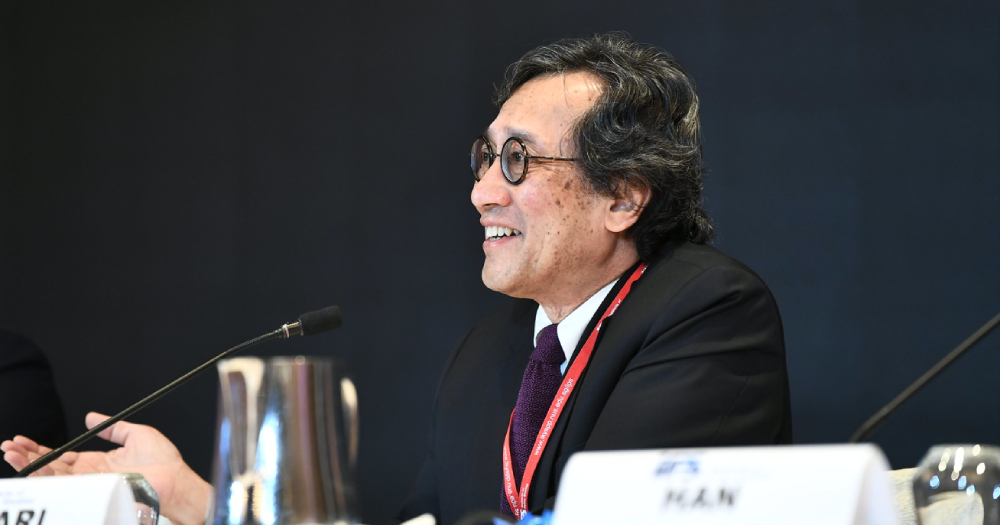

The greatest challenge for Singapore is maintaining its social cohesion in this era of "greater assertion of identities globally", retired diplomat Bilahari Kausikan said on Wednesday, July 24 at a panel discussion.
His remarks were in response to a question by the panel's moderator, The Straits Times Editor-at-Large, Han Fook Kwang.
Han asked about the possibility of the city-state becoming organised according to ethnic or religious hierarchy and where the greatest danger to Singapore is coming from.
The panel, which discussed the role of religion and politics in the region, was part of the Forum on Religion, Extremism and Identity Politics, which was jointly organised by think tank Institute of Policy Studies (IPS) and the Ministry of Home Affairs (MHA).
Bilahari then gave examples of what he thinks are the three main threats to social cohesion in Singapore.
1. Arabisation of Islam
The first threat is what he calls the "Arabisation of Islam", which is a phenomenon he said is not peculiar to Singapore.
While traditional Islam in Southeast Asia was very Sufi and syncretic, it is gone, and cannot be put back together, he opined.
But gulf countries like Saudi Arabia are not entirely to be blamed for this trend, even though they are a contributing factor due to the money they give, he said.
Singapore does not allow itself to receive money from Saudi Arabia, but such a trend can still be seen in the country, he added.
He also pointed out that it is now very common to see Muslim women in Singapore cover their heads, when it was rare last time when he was young.
And such a phenomenon is due to a certain lack of self-confidence among Southeast Asian Muslims, he said, while admitting that this view is slightly "controversial".
He then gave an example of his own, saying he likes to conduct "naughty experiments" by pretending not to know the name of the headscarf a Muslim woman is wearing, and then asking her about it.
For about "half the time", they replied by calling it a "hijab", instead of a "tudung", he claimed.
"You've got a good Malay word for this thing, called 'tudung', why must you use an Arab word?"
Furthermore, he said he noticed that more Muslims in Singapore are using the phrase "Eid Mubarak" instead of the "good Malay phrase, Selamat Hari Raya".
He attributed this trend to a certain "lack of cultural confidence" among all Southeast Asian Muslims.
"Because the language of the Quran is Arabic, and therefore, anything coming from that part of the world has a certain uncritical acceptance as authentic," he argued.
2. Identity as a state policy
The second reason is the "attempts by states to use identity as an instrument of state policy".
He raised the example of the expulsion of an American diplomat from Singapore in the 1980s who was said to have been attempting to impose a "western political identity" on the country.
Bilahari has also written on Chinese influence operations, publicising how they try to impose a "Chinese identity" on multiracial Singapore.
The dangers of that are quite self-evident, he said.
However, he does not think a "western political identity" is attractive to a large number of Singaporeans.
"There will be a thin strata, but it is intrinsically self-limiting."
But when it comes to the idea of Singapore as a Chinese country, he cannot say it is completely unattractive to all his ethnic Chinese compatriots.
While he does not know how many Singaporean Chinese find this idea attractive, he is sure some do, for one reason or the other.
3. Evangelical Christianity
Bilahari also said certain strands of evangelical Christianity have quite a profound influence on Christianity in Singapore.
He added that various strands of evangelical Christianity are probably the fastest growing religion in Singapore.
To illustrate why he thinks this is a threat, he raised an example of how one of his researchers received threats from an "evangelical Christian group" as they did not like what he wrote about the Middle East.
Despite it being a legitimate view, and not an "extreme" one, it was an opinion that went against these people's beliefs, Bilahari said.
He added that the issue of the anonymous online threat is currently being investigated by the police.
Tying his points together, Bilahari said the danger posed to Singapore these days comes from the notions that the Arab form of Islam, the Chinese identity and the western political identity, are much more authentic than the ones already in place here.
Top image via Jacky Ho, for the Institute of Policy Studies, NUS
https://mothership.sg/2019/07/bilahari-kausikan-singapore-unique-southeast-asia-multiracial-meritocracy/?fbclid=IwAR1nbDibvA1NftqaYh-ucNZRblbd8FX6CfDUOKeYkPHiu3HEiNRtoP2HZ6o


If you like what you read, follow us on Facebook, Instagram, Twitter and Telegram to get the latest updates.