


 June 07, 2019, 11:26 AM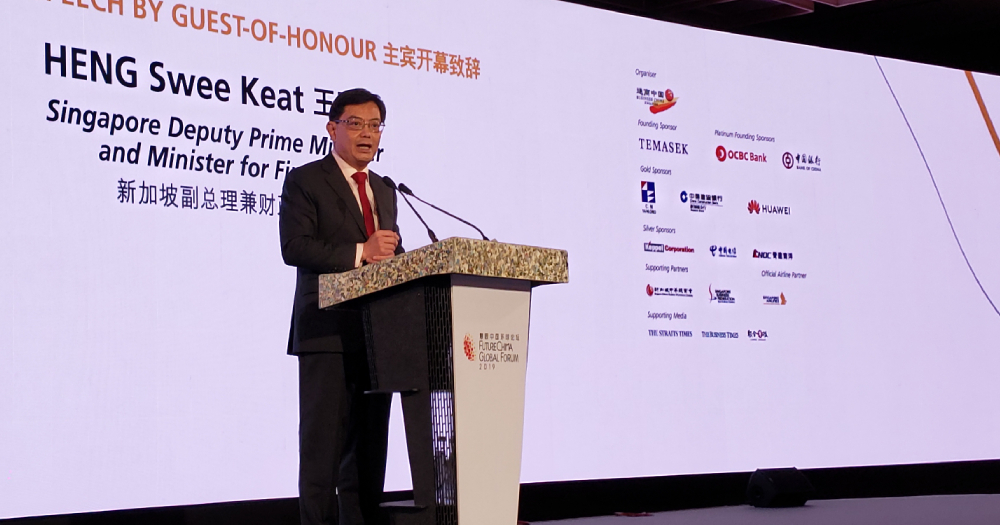

Youths in Singapore and China play a vital role in continuing the efforts to achieve sustainable development and in creating a sustainable future, deputy prime minister and finance minister Heng Swee Keat said.
Heng was the guest-of-honour and keynote speaker at the FutureChina Global Forum held on June 7, 2019, organised by non-profit organisation Business China.
He said governments and businesses "must invest the necessary resources to nurture our future leaders now".
The theme of the forum, "Sustainable Development in a Dynamic World Order”, is timely, as the world is facing major challenges in sustainable development, Heng also said.
Like many of his speeches, Heng provided three key points, or "three ways in which we can work towards a more sustainable future".
Three ways for a more sustainable future
1. Form and deepen international collaborations and partnerships
Firstly, Heng said that cooperation among countries and cities will help to strengthen connectivity and achieve longer term environmental, economic and infrastructural sustainability.
Heng noted that China has the largest population in the world, and its development will have a significant
impact on the global environment.
Hence, he was glad that China has put in serious efforts towards achieving sustainable development, citing the example of the Belt and Road Initiative International Green Development Coalition (BRIGC).
Singapore’s Minister for the Environment and Water Resources, Masagos Zulkifli is a co-chair of the BRIGC, a collaborative platform for governments, enterprise, research institutes and the civil society to shape a green Belt and Road.
Heng added that the Paris Agreement, which commits countries around the world to take concrete action to combat climate change, is another example to achieve sustainable development.
He noted that China has played an instrumental role in the lead up to the Paris Agreement, and said that Singapore was ranked among the 15 best-performing countries in carbon intensity.
2. Enable government, businesses, and individuals to work together to achieve sustainable development
Secondly, Heng provided three examples of how government, businesses, and individuals can work together to achieve sustainable development.
The government, Heng said, has earmarked S$900 million from the National Research Foundation to pursue new green growth initiatives.
The government has also implemented a carbon tax this year.
From the business front, Heng observed an encouraging development, noting the growth of private capital for green financing.
He said that DBS Bank and the UN Environment on Green Finance Opportunities in Asean estimated that US$200 billion dollars of green investment is needed annually up till 2030 in this region alone.
Heng said that individuals also have a part to play, noting that Singapore has designated 2019 as the Year Towards Zero Waste.
Heng said that Singapore is "adopting a circular economy approach", to keep our resources in use for as long as possible, with an aim to become a Zero Waste Nation.
3. Develop next-generation talents and leaders
Lastly, Heng said that we need to develop next-generation talents and leaders committed to building a more sustainable and brighter future for our societies.
Heng highlighted the importance to "inculcate in our young leaders a sense of shared responsibility towards sustainable development", noting that there is already a growing awareness among the younger generation that sustainability is critical to the world.
Heng noted that Business China has been emphasising developing youths and next-generation talents, and will be launching the inaugural Business China Youth Forum to bring together young leaders from Singapore and China together, to build new ties and form new partnerships.
Top photo by Emily Lo


If you like what you read, follow us on Facebook, Instagram, Twitter and Telegram to get the latest updates.