


 May 30, 2019, 11:19 PM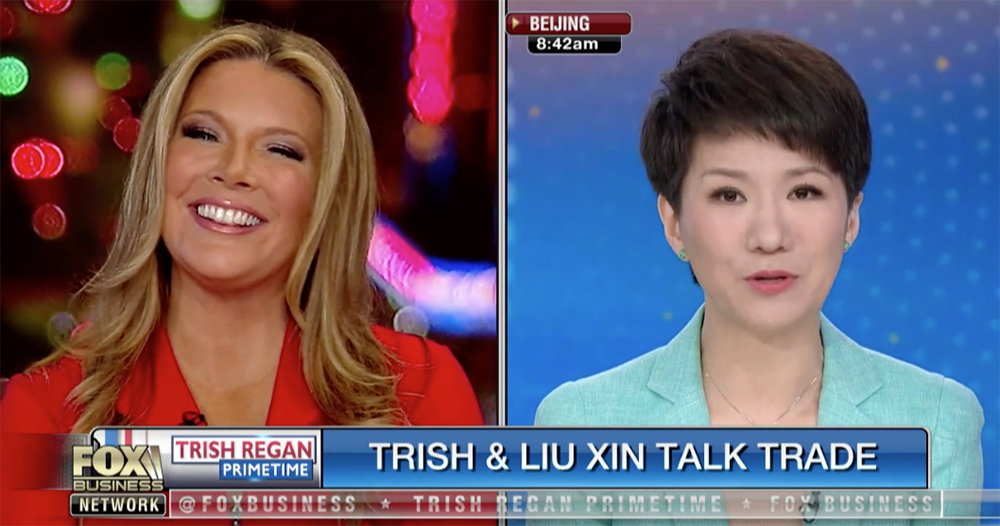

The ongoing trade war between the United States and China is in full swing.
Nationalist rhetoric on both sides have been heating up, and a TV debate that took place on Thursday, May 30 was slated to take things up a few extra notches.
Fox News attack on China gets rebutted by Chinese state media
On May 14, Fox News Business host Trish Regan spoke out on her show, Trish Regan Primetime, and published an op-ed attacking China for supposedly stealing around US$600 billion in intellectual property (IP) from the U.S. annually.
"From logos to software -- you name it, the Chinese have stolen it -- and they’ll keep stealing it, if left unchecked."
She also asserted that the U.S. had the upper hand in the tensions, adding that it was imperative for President Donald Trump to be willing to fight this "economic war".
This prompted a rebuttal from Chinese state media, Chinese Global Television Network (CGTN), on May 22.
One of its broadcasters, Liu Xin, slammed Regan for her purported use of harsh rhetoric against China over the ongoing trade war with the U.S.
Liu accused Regan of playing the victim card for the U.S., calling out her criticism of China as "all emotion and accusation supported with little substance".
She also dismissed Regan's figure of US$600 billion as inaccurate, saying Regan needed a better research team.
Regan challenges Liu to a debate
This provoked a response from Regan on Twitter, where she challenged Liu to a debate on the issue.
Hey #China State TV - let’s have an HONEST debate on #trade. You accuse me of being ‘emotional’ and not knowing my facts - wrong! You name the time and place, and I’ll be there! #TrishRegan pic.twitter.com/D0QMp0cIz4
— Trish Regan (@trish_regan) May 24, 2019
Regan also published another article on the Fox News Business website on May 23, accusing China of waging an information war against the U.S. and her.
Liu accepted the challenge -- on the condition that there will be no mudslinging.
I hear you. Will get back to you very soon. But I don't want to play any mud throwing game, if that's what you prepare to do. https://t.co/ytXZN5Lk2m
— LIU Xin (@LiuXininBeijing) May 24, 2019
Suffice to say, the stage appeared set for a fiery clash, which set China's internet abuzz.
Various media reported hashtags used by posts on the clashing tweets between the two anchors received millions of views by the evening of May 23 on Weibo.
Don’t worry—I don’t sling mud, I sling FACTS.
— Trish Regan (@trish_regan) May 24, 2019
So, let’s find a date.
This is a meaningful debate to have. #TrishRegan #ChinaTrade https://t.co/zTrMuQHHEr
Debate becomes interview
However, the actual 15-minute debate, which took place on Thursday, ended up being far more civil.
In fact, we'd go as far as to say it was effectively an interview Regan did with Liu.
And it was arguably a win for Liu, who found a rare opportunity to articulate China's position on the trade war on America's leading conservatively-inclined news channel.
Liu answered Regan's questions on intellectual property (IP) theft, Huawei, and China's system of state-led capitalism.
Liu "not a member of the Communist Party of China (CCP)"
The "debate" began with Regan introducing Liu as a member of the Communist Party of China (CCP).
Liu replied she was neither a member of the CCP, nor spoke for the party, over Regan's attempts to point out that CGTN was part of the CCP.
Liu stated:
"Trish, I have to get it straight, I am not a member of the Communist Party of China. This is on the record. So please don't assume I'm a member and I speak for the Communist Party of China, and I'm here, for today, speaking for myself, as Liu Xin, a journalist working with CGTN."
Regan did not press the matter.
Liu: IP theft "a common practice in every part" of the world
Regan asked Liu how American companies could operate in China with the risk of having their property, ideas and hard work stolen.
Liu responded that she did not deny there were issues of IP infringement, and theft of commercial secrets.
She added that within China, there was a consensus that this issue needed to be dealt with as countries and individuals would not be able to develop without IP protection.
Liu then further argued that while IP theft was "a common practice in every part of the world", one could not take individual cases and make blanket statements such as "America is stealing, or China is stealing, or the Chinese people are stealing".
What if Huawei were allowed into the U.S.?
Regan then asked Liu how China would react if Huawei were allowed into the U.S. in exchange for sharing its technological advances, likely in reference to its 5G technology.
Liu replied that if the sharing was done through cooperation and paying for the IP for the use of Huawei's technology, then it would be "absolutely fine" as everyone would prosper.
Picking up on Liu's point of paying for the acquisition of IP, Regan said everyone had to abide by a common set of laws if there was to be trust in the current global economic order.
Defining Chinese state capitalism
Liu was then asked to define Chinese state capitalism, which she said was "socialism with Chinese characteristics" where market forces are expected to play the dominating role in the allocation of resources.
She claimed that not everything was state-owned in China, and added that 80 percent of Chinese employees were privately employed and that 65 percent of technological innovations were produced by private companies.
The debate then abruptly concluded with Regan stating that being open was the direction to pursue, to which Liu quipped, "Absolutely."
How to understand this debate-turned-interview
Liu's replies to Regan can perhaps be seen as an extension of China's stance on the trade war.
On IP theft, Chinese state-owned People's Daily previously argued that IP was a "political tool" deployed by the U.S. to contain the development of other countries and a cover for bullying the world.
Liu's criticism of Regan having made a blanket statement about China being responsible for a vast swathe of IP theft can be seen as an extension of this argument, as it implies that Regan's accusation is part of this political bullying.
Another argument advanced by People's Daily also asserts that China has become a leader in IP rights.
This ties in with what Liu said in the debate, which is that China has a consensus that IP theft is an issue that needs to be dealt with and is a global problem.
And finally, Liu's definition of Chinese state capitalism as "socialism with Chinese characteristics" ties in with the type of socialism Deng Xiaoping opted to pursue back in 1978.
According to Inkstone News, Deng had argued that socialist countries can plausibly have market economies.
And in 2017, Chinese President Xi Jinping declared that more market reforms would be introduced, to allow a greater flow of private capital into state-run sectors.
Liu's appearance on Fox News, therefore, could well be seen as a rare chance for millions of Americans to understand China's perception of its own position in the trade war with the U.S.
Or a debate that clearly lacked fireworks.
Top image: screenshot from Fox News Business video


If you like what you read, follow us on Facebook, Instagram, Twitter and Telegram to get the latest updates.