


 September 02, 2017, 03:43 PM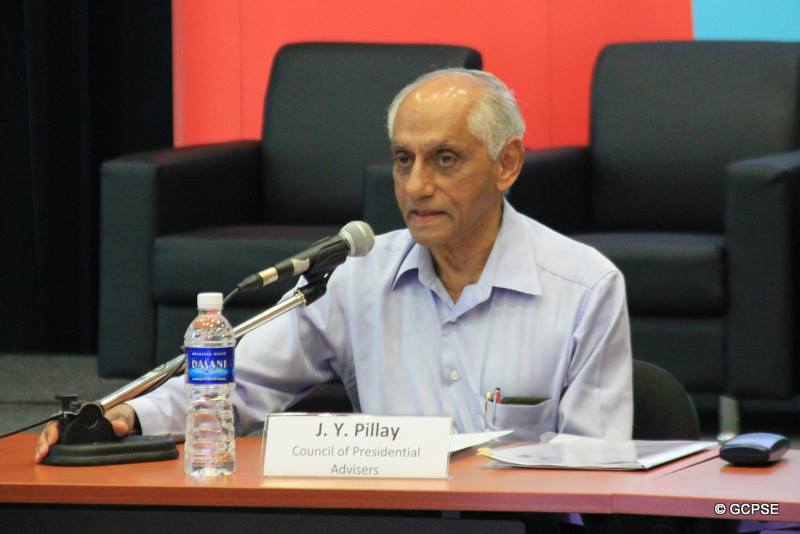

Chairman of the Council of Presidential Advisers (CPA), J. Y. Pillay, has been appointed as acting president from Sept. 1, until a new head of state is sworn in.
Pillay, 83, took over from Tony Tan Keng Yam, who completed his six-year term on Aug. 31, 2017.
He will fill in as president until after Polling Day on Sept. 23, when a candidate is elected, or after Nomination Day on Sept. 13, if a candidate is elected unopposed.
First time since 1991
This is the first time since the elected presidency was introduced in 1991 that the office has fallen vacant.
When the office of president is vacant, the first in line to exercise its powers is the CPA chairman, followed by the Speaker of Parliament.
Pillay's stints as acting president
Pillay is not unfamiliar with exercising the powers of the president though.
As the CPA chairman since 2005, he has been the acting president each time the president is away from Singapore.
For example, in May this year, he acted as president when Tan made state visits to Europe.
According to The Straits Times, during the late S R Nathan's presidency, Pillay served more than 60 such "stints", with the longest being 16 days in April and May 2007.
Past contributions
The veteran civil servant's most significant contribution was building Singapore Airlines (SIA) into a world-class carrier.
As the founding chairman of SIA, he grew a small fleet of just 12 aircrafts in 1972 into one of the world's top airlines by the time he stepped down in 1996.
Pillay was also chairman of the Singapore Exchange and Development Bank of Singapore (DBS), and managing director of Government Investment Corporation of Singapore (GIC) and the Monetary Authority of Singapore (MAS).
He has also managed and led Temasek Holdings, Neptune Orient Lines, and Singapore Technologies Holdings.
Other contributions
According to the National Library Board's Singapore Infopedia, this is a list of other contributions made by Pillay:
- 1961: Joins the Ministry of Finance in Singapore, and becomes deputy secretary of the Economic Planning Unit
- 1968: Appointed acting permanent secretary, Ministry of Finance
- 1971: Appointed chairman, Malaysia-Singapore Airlines
- 1972: Appointed permanent secretary, Ministry of Finance, Revenue Division
- 1979–1996: Director, Singapore Symphony Orchestra
- 1989–30 Mar 1995: Permanent secretary, Ministry of National Development
- 1991–1996: Chairman, Singapore Indian Development Association executive committee
- Oct 1995–Jun 1998: Director, board of Oversea-Chinese Banking Corporation
- 1996–1999: High commissioner to Britain and ambassador to Ireland
- 1 Dec 1999: Appointed non-executive chairman, SGX
- 2000–2002: Rejoins OCBC as non-executive director
- Aug 2001: Appointed chairman, SGX
- Aug 2002–2007: Appointed chairman, Council on Corporate Disclosure and Governance
- 2008: Honorary member of Securities Investors Association of Singapore (SIAS)
- 2014: Joined board of Vatican's Financial Information Authority
Additionally, he also held these appointments:
- Member of the Investment Community of the United Nations Pension Fund Board
- Chairman of the Commonwealth Africa Investment Finance Company
- Member of the board of governors, Asia-Europe Foundation
- Member of the Financial Sector Development Fund Advisory Committee, Monetary Authority of Singapore
- Life trustee of the Singapore Indian Development Association
- Chairman, Council of Presidential Advisers, Securities Industry Council
[related_story]
The late founding Prime Minister Lee Kuan Yew once said that he was "equal to the best brains in America".
Emeritus Senior Minister Goh Chok Tong had also described him as a "civil servant able to stand up to his Prime Minister".
Pillay, however, remains modest about his achievements, noting that it was a "simpler environment then".
He also quipped: "We would do nothing and the economy would grow by 5 to 7 percent. Now we struggle to get 2 to 3 percent, and the electorate is much better educated."
Top image via here
Here are some totally unrelated but equally interesting stories:
Quiz: What kind of Singaporean will you be in a crisis?
Big shot bosses share the real reasons why they would hire someone



If you like what you read, follow us on Facebook, Instagram, Twitter and Telegram to get the latest updates.