


 October 23, 2016, 12:54 PM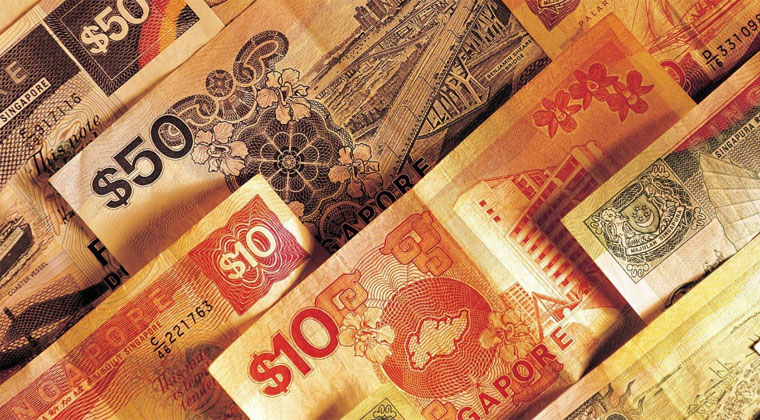

It appears that whoever told you money cannot buy happiness, is starting to look like they are lying.
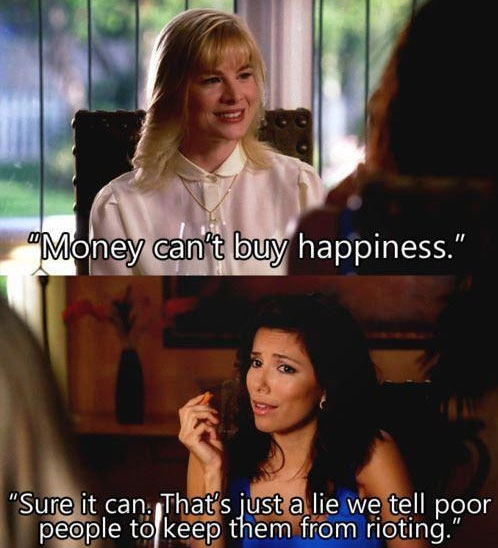
Or trying to keep poor people from rioting, as Gabrielle Solis once said.
Statisticians at the UK’s Office for National Statistics have come to the conclusion that money can indeed buy happiness, after they combined data from surveys on household wealth and personal well-being.
Even though this finding is not new, as the ONS said so in a paper last September 2015, interest in the topic grew when the Financial Times re-reported it over the weekend.
Here are four aspects of the study you can take away with you, and maybe, work towards a new life goal of trying to amass greater amounts of fungible resources:
1. Highly fungible, liquid money is the best
Only one very specific type of money has the strongest relationship with well-being: Net financial wealth.
This could be in the form of stocks and shares, savings in the banks or money tucked away in a biscuit tin or under the mattress.
2. Owning expensive stuff doesn't matter
The other types of wealth that did not buy as much happiness: Increasing property or personal pension wealth did not result in a measurable increase in well-being.
Levels of household income were also far less strongly related.
Physical assets such as antiques or cars have no relation to levels of personal well-being.
Mad stacks is king.
3. The relationship between more money, more happy is not random
The statistical model used by the ONS controlled for variables such as gender or ethnicity.
The purpose is to see what impact wealth or income had on an otherwise alike individual.
This is why the ONS is confident the relationships it describe are statistically significant.
For net financial wealth, for example, those in the bottom 20 percent scored themselves lower than those in the middle 20 percent -- on average 0.4 points.
4. Relative wealth might be less important than absolute wealth.
Other economists had previously tried and failed to find evidence to support the idea that what matters for well-being is how you compare with those around you. So, doing okay in terms of relative wealth is not all that is cut out to be. Being absolutely rich, probably would.
They also found that countries experienced greater growth in well-being when they enjoyed faster economic growth, on average.
Top photo via
If you like what you read, follow us on Facebook and Twitter to get the latest updates.


If you like what you read, follow us on Facebook, Instagram, Twitter and Telegram to get the latest updates.