


 February 07, 2023, 07:16 PM

Follow us on Telegram for the latest updates: https://t.me/mothershipsg
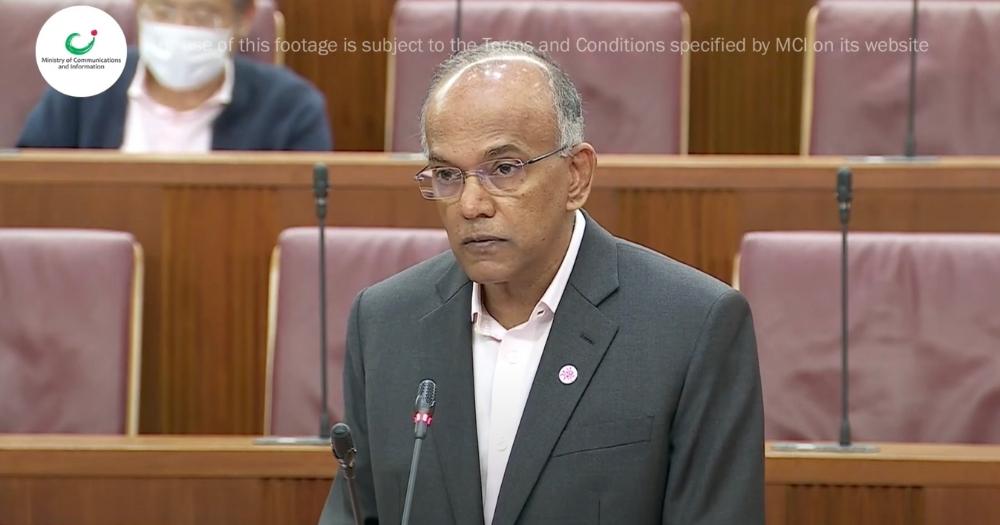
The government has concerns pertaining to the judgment delivered by the High Court, on a case in which a man sued the Singapore Police Force (SPF) for unlawful arrest and was awarded S$20,000 in damages, Home Affairs Minister K Shanmugam said in Parliament on Feb. 7.
"Our concern is that the court's findings may adversely impact the police's ability to detain persons under the provisions of MHCTA (Mental Health (Care and Treatment) Act) as they stand," he said.
Ministry of Home Affairs studying court judgement
Shanmugam, who is also Minister for Law, was responding to questions raised in Parliament by PAP Members of Parliament Saktiandi Supaat and Ang Wei Neng about whether a review of the police's procedures is either being considered or has begun in light of the High Court's finding.
His response also covered a question from PSP's Non-Constituency MP Leong Mun Wai about any supposed "lapses" involved in the case, and actions taken by the Singapore Police Force.
Shanmugam replied that the Ministry of Home Affairs (MHA) is currently studying comments that the court has made in its judgement "carefully".
The ministry will then decide whether to file an application for permission to appeal or make changes to the law as necessary to address any gaps that may have arisen between the policy intent and the position in law.
Shanmugam added:
"If we reach the conclusion that the court's findings are, in fact, as advised by AGC (Attorney-General's Chambers) reasonable and correct, then we will have to internalise that and make sure the key points are made clear to our officers so that they understand the situation better.
Right now, the sense amongst the police officers is one of concern on what liability may befall them for actions which they may take in the discharge of their duties."
What were the High Court's comments?
Shanmugam noted the court found that the man who was detained, Mah Kiat Seng, had "unusual" behaviour but these did not qualify as symptoms of a person with a mental disorder.
However, the police officer was just "equally" observing and had to make decisions on the ground, he said.
In addition, the court said the officer took a dislike to the detained person and that the officer had made up observations about him.
"We are looking closely at the court's reasons for reaching these conclusions," he said and added that the police had informed him that they take a different view of the matter.
"Police and AGC will look at these points and decide whether the court's decision should be appealed," he reiterated.
The minister elaborated:
"In deciding what to do we have to bear in mind that decisions and individual cases, court decisions, can have a much larger and unintended effect of negatively impacting how officers react in future to such situations."
The minister also highlighted some comments which the court had made about several issues in law, such as what the word danger in the MHCTA must entail on the ground, and whether the powers of the police to "apprehend someone" under the MHCTA and "arrest someone" under the Criminal Procedure Code (CPC) are the same.
"These comments might have an impact on how the police can exercise their powers and may have adverse public safety implications," Shanmugam said.
Shanmugam: Public trust in the SPF is high, there are checks on the police
Shanmugam cited a 2021 survey by the SPF on public perception which indicated that public trust in the police is at 96 per cent.
The same survey also indicated that 98 per cent of respondents would provide assistance and information to the police if there was a need.
Such figures would not be possible without the "high levels" of trust in the SPF, on top of their competence built up over the years, he added.
Shanmugam pointed out that the framework Singapore has in place, to ensure the police behaves in accordance with the law, has helped to maintain standards and trust.
Framework to ensure the police act in accordance with the law
This framework consists of the police themselves as the first layer, with a process to investigate any abuse of power. In addition, the government will also take action against errant officers.
"Patrol officers wear body worn cameras, officers' actions can be assessed and actions taken," he said.
The next layer is the convening of an independent review panel (IRP), if necessary.
This panel consists of former judges, former senior public officers and other individuals with significant standing in society, and provides an independent assessment of whether the internal investigations were fair and thorough.
Courts as part of the safeguards
Should there potentially be the disclosure of criminal offences, the government will recommend court prosecution and the matter will be left to the courts, he said.
"The courts thus provide a third layer of safeguards. The supervision of the courts is an integral part of ensuring that our system functions properly," the minister highlighted.
On the number of police officers who have been disciplined, Shanmugam said that over the past three years, an average of 78 police officers have been subject to disciplinary proceedings annually, and about 10 police officers have been charged in court each year, for the past three years, for criminal offences.
Shanmugam said, "We will not hesitate to take action when there is an infraction. And that is essential to maintain trust with the public, and discipline within the force."
Police work in a "high-stress" environment, must be given "sufficient" latitude
Shanmugam then brought up his next point:
"At the same time, while we have to be strict about upholding the highest standards for police, we have to ensure that our analysis of officers’ ground judgments is reasonable and fair.
Police officers work in high-stress and dynamic environments. They often have to make split-second decisions and take decisive action, based on the limited information that they have."
It is therefore not realistic to critique their every move with the benefit of hindsight, removed from the conditions on the ground, the minister added.
Police officers must be given "sufficient" latitude to make swift ground assessments and decisions, as long as they have acted in good faith.
Shanmugam elaborated:
"An environment in which police actions are unfairly critiqued, will inevitably undermine public trust in the police. It will also lead to defensive policing, where the ground officers will try to do the least possible.
They will fear that everything they do will be over-analysed and picked apart unfairly. It would be easier, in such situations, to not do anything. Defensive policing is, essentially, no policing.
And that can have a detrimental effect on our safety and security. And an unfair characterisation of the force will eventually also lead to the public thinking of the police as the enemy, and viewing the police with suspicion."
Related story:
Top screenshot via MCI Singapore/ YouTube


If you like what you read, follow us on Facebook, Instagram, Twitter and Telegram to get the latest updates.