


 December 20, 2022, 02:19 PM

Follow us on Telegram for the latest updates: https://t.me/mothershipsg
Despite Singapore's enhanced climate pledge to reduce emissions to 60 MtCO2e by 2030 and reach net zero by 2050, its goals have been assessed to be "critically insufficient" by Climate Action Tracker (CAT), an independent scientific analysis that tracks government climate action.
The analysis by CAT measures government climate action against the globally agreed Paris Agreement's aim of to keep global temperature increase to well below 2oC, while taking measures to limit the increase to 1.5oC.
The analysis at CAT is performed by research organisations, Climate Analytics and NewClimate Institute, both of which are based in Germany, alongside their collaborators.
CAT methodology
Under CAT's analysis framework, each country is assigned ratings for four categories:
- policies and action
- "domestic target"
- "fair share target"
- climate finance
The ratings for each of these categories are then combined to derive an overall rating, ranging from "1.5oC Paris Agreement compatible" to "highly insufficient".
To evaluate how aligned a country's policies and actions are with the Paris Agreement goals, two modelled pathways are used for comparison: a modelled domestic pathway and a fair share target pathway.
The former looks at what a country needs to do domestically to attain the Paris target, based on climate models.
The latter assess whether domestic targets and, if relevant, the financing of action abroad represent a fair contribution to global efforts.
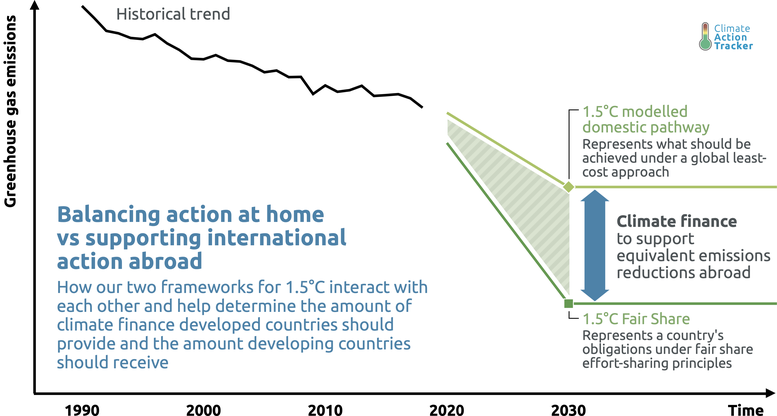 Image via Climate Action Tracker.
CAT then compares a country's projected trajectory based on its prevailing policies and actions against these two pathways.
Policies and actions "highly insufficient"
According to CAT, Singapore's policies and actions are "highly insufficient", which means that if all countries followed Singapore's approach, warming could reach over 3oC and up to 4oC.
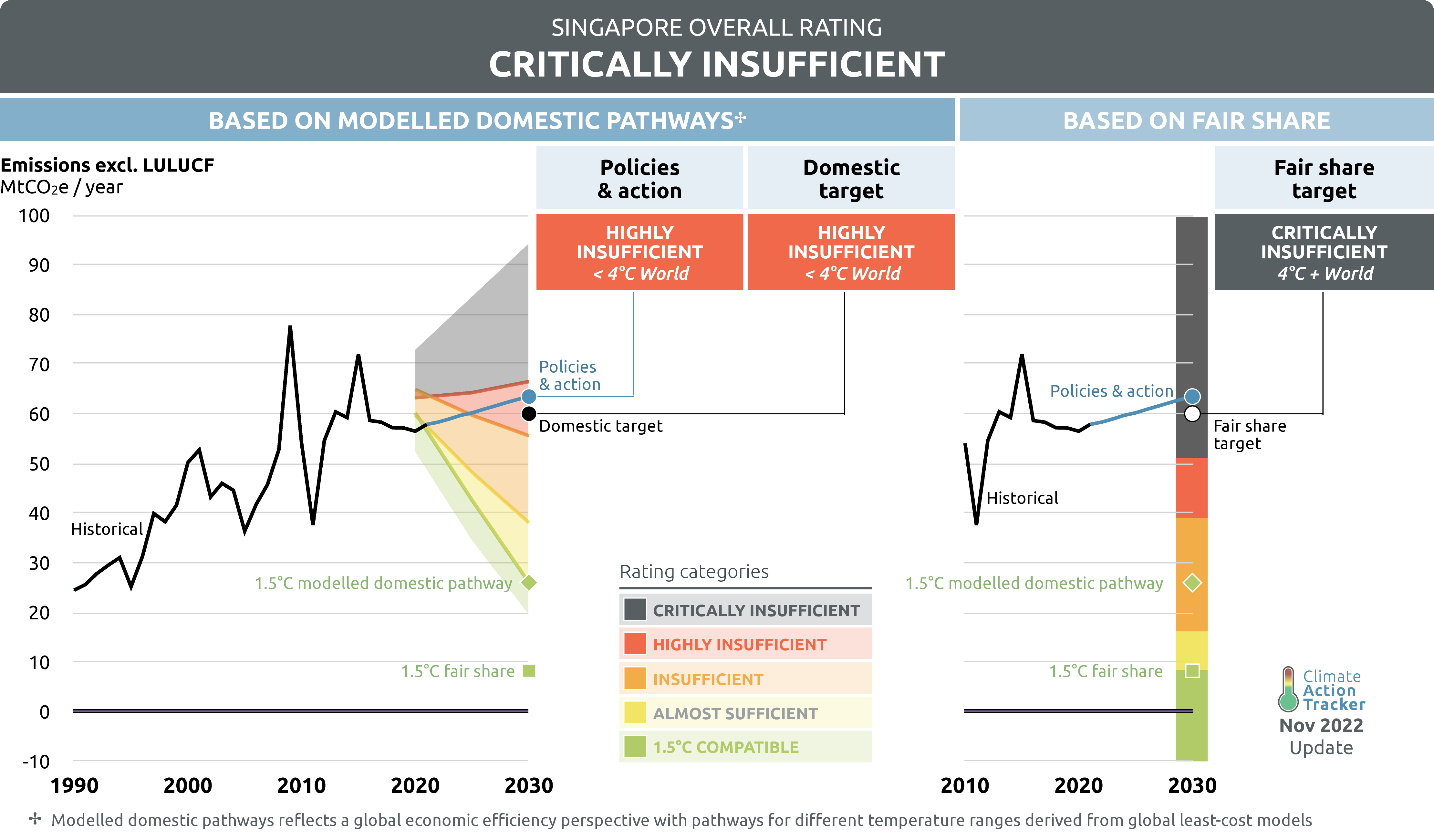 The blue line projects Singapore's carbon emissions in 2030 based on its current policies. Image via CAT.
Other countries that were in the same categories include Thailand, Vietnam and Russia.
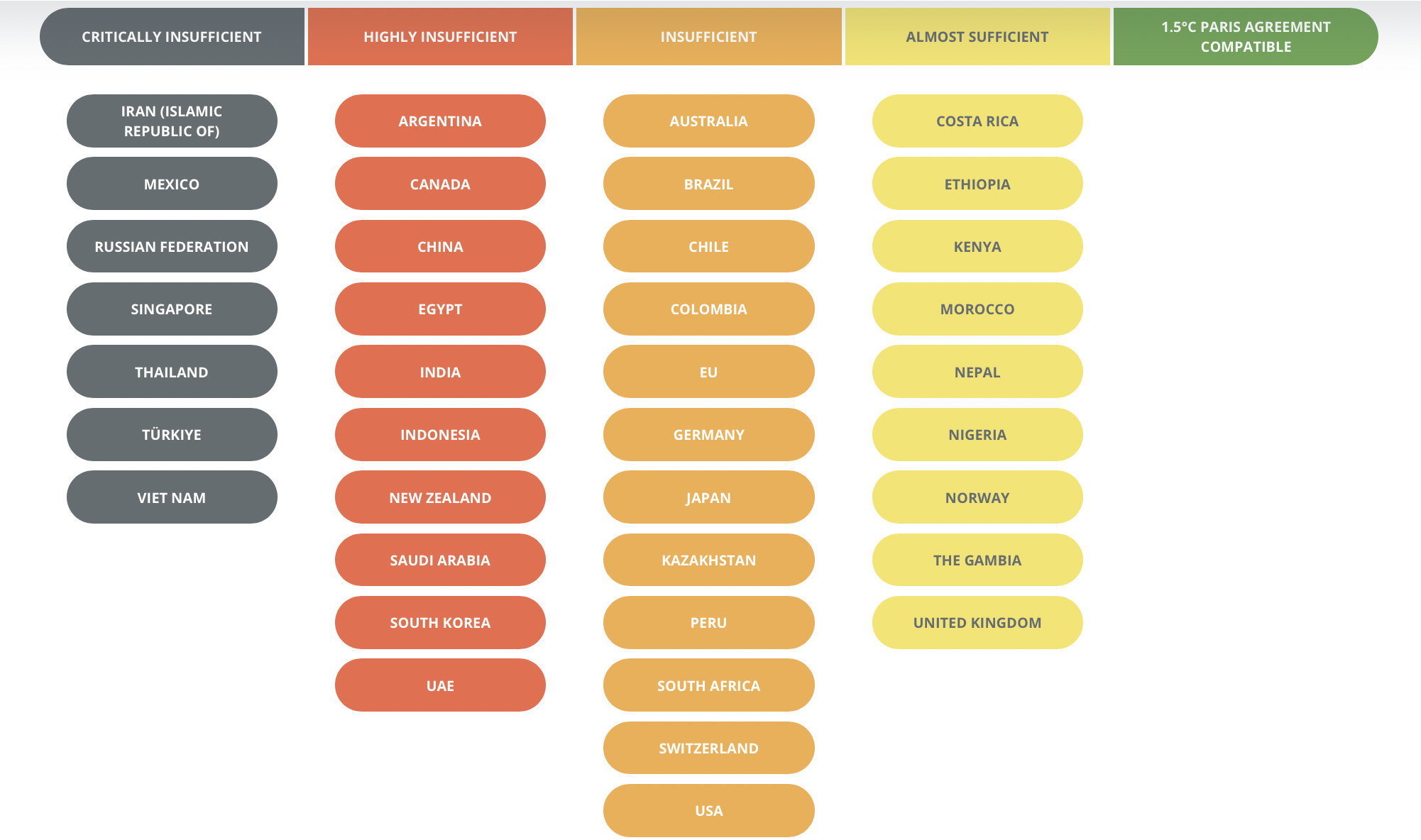 Image from Climate Action Tracker.
The analysis cited the following reasons for Singapore's ratings:
Carbon tax
Singapore's carbon tax, even with its planned increases, is "too low" and more is required to encourage a "significant shift to decarbonise the power sector".
It also noted that the current coverage by the carbon tax represents "approximately 43 per cent of emissions".
Natural gas
The analysis also noted Singapore's heavy dependence on natural gas, which accounts for "96 per cent of electricity generation".
On this, it considered Singapore's continued investments in the liquified natural gas industry as well as how it is "growing its business line to sell 'other' fuels" like biofuel and maritime fuel.
"Fossil gas will need to be phased out quickly under a Paris-compatible pathway", CAT wrote.
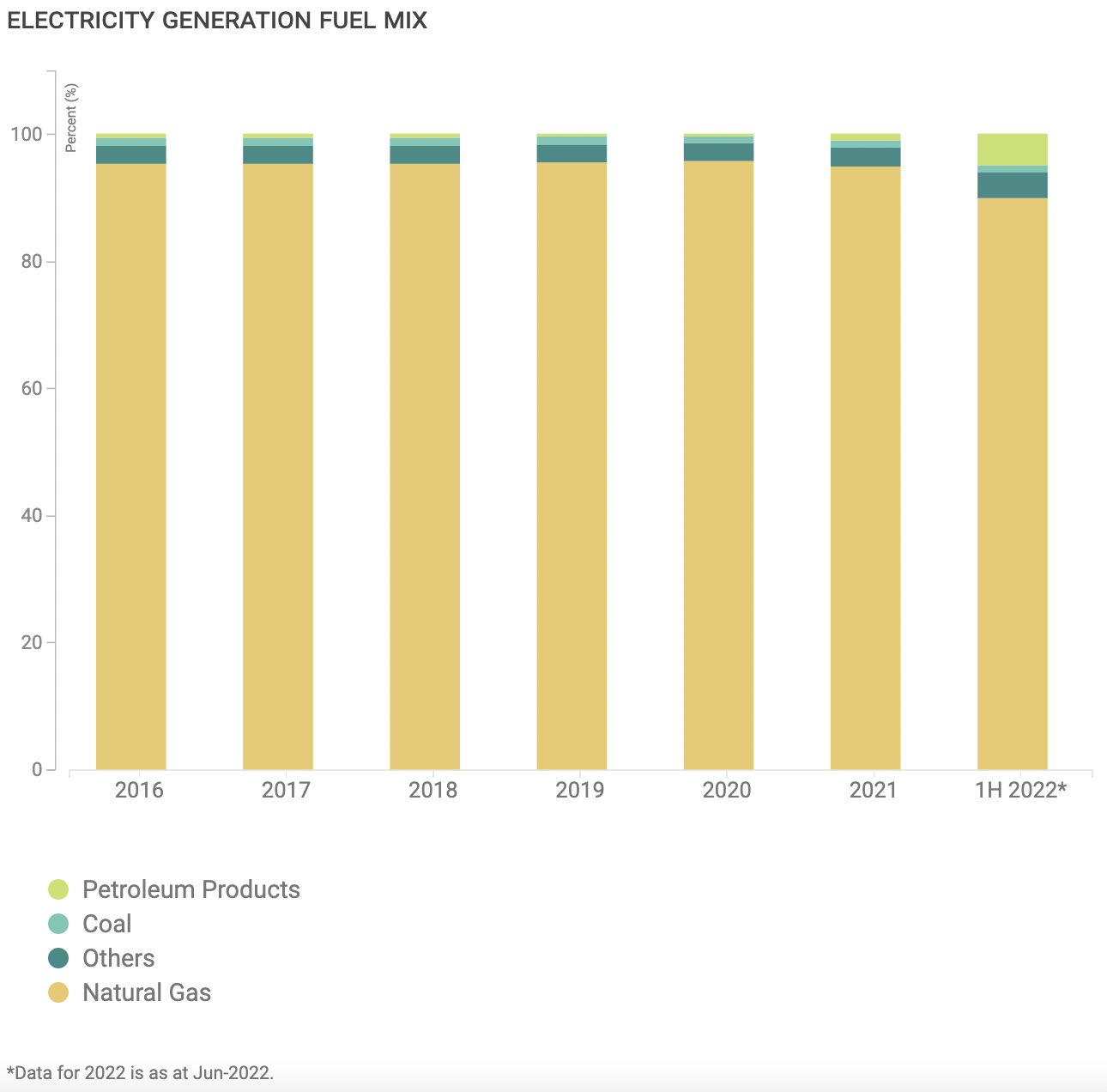 Image via Energy Market Authority.
Energy efficiency
CAT noted that improving energy efficiency is "the backbone of Singapore's mitigation strategy".
However, it expressed that due to the significance of natural gas in Singapore's energy mix, improvements in energy efficiency "is limited and does not compensate for the overall increase in energy demand".
Furthermore, it wrote that while Singapore has now committed to peaking emissions before 2030, it did not clarify "the exact peaking year".
As a whole, CAT noted that Singapore's emission in 2030 is likely to be 63 MtCO2e, missing the target laid out in its nationally determined contribution.
Net zero target "poor"
On Singapore's new Long-Term Low-Emissions Development Strategy (LT-LEDS) to reach net zero by 2050, CAT gave it a rating of "poor".
While the country has outlined sector-specific policies and measures, it neither provided the details the "mitigation potential" of these measures nor the extent to which carbon capture, utilisation and storage technology will be deployed to achieve the net zero target.
Can do more locally and globally
Domestically, CAT recognised Singapore's constraints in adopting mitigating policies due to factors like limits to renewables.
However, it wrote that a more ambitious mitigation target, like shifting to clean energy supply through low-carbon energy imports would "demonstrate the government’s commitment to contributing its fair share to global climate change mitigation".
Separately, Singapore's "fair share target" was rated as "critically insufficient".
The “Critically insufficient” rating indicates that Singapore’s fair share target in 2030 reflects minimal to no action and is not at all consistent with limiting warming to 1.5°C. Singapore’s target is not in line with any interpretation of a fair approach to meeting the 1.5°C temperature limit.
On the Climate Analytics website, it wrote that "Singapore can further reduce emissions overseas by providing support to other countries, for example, through climate finance".
"Puzzling" results: NCCS spokesperson
A spokesperson for the National Climate Change Secretariat (NCCS) told Mothership that it is "puzzling" that Singapore's enhanced climate targets and "concrete plans" did not translate to a better rating since CAT's previous country analysis on Sep. 15, 2021.
The spokesperson noted that CAT's updated assessment of Singapore's climate targets and policies were made despite their acknowledgement on their website of our national circumstances, refreshed nationally-determined contribution and LT-LEDS as well as new plans and actions.
Regarding Singapore's "fair share target", no changes were made by CAT despite its acknowledgement of Singapore's national circumstances, including a limit to renewables.
"It would appear that CAT’s application of its “fair share target” assessment framework is not consistent with Article 4.10 of the UNFCCC, which explicitly recognises such constraints faced by Singapore", the spokesperson commented.
Article 4.10 of the UNFCCC states that the implementation of climate commitments should consider the circumstances of countries, particularly that of developing countries, countries whose economic income are dependent on fossil fuel production, consumption and sale and have difficulties switching to alternatives.
On these, NCCS is seeking clarifications from CAT, the spokesperson shared.
In 2021, Minister for Sustainability and Environment Grace Fu had explained in Parliament on Oct. 5 that the CAT assessment did not account for Singapore's challenges as a small, densely populated city-state with limited access to alternative energy sources.
Additionally, the spokesperson pointed out that Singapore's current carbon tax covers about 80 per cent of Singapore's total greenhouse gas emissions, which includes manufacturing, power, waste and water sectors.
"In addition, with fuel excise duties that incentivise reduction of transport emissions, which have an implied carbon price higher than our carbon tax, it brings the overall coverage to more than 90 per cent", the spokesperson added.
This is contrary to CAT's suggested 43 per cent.
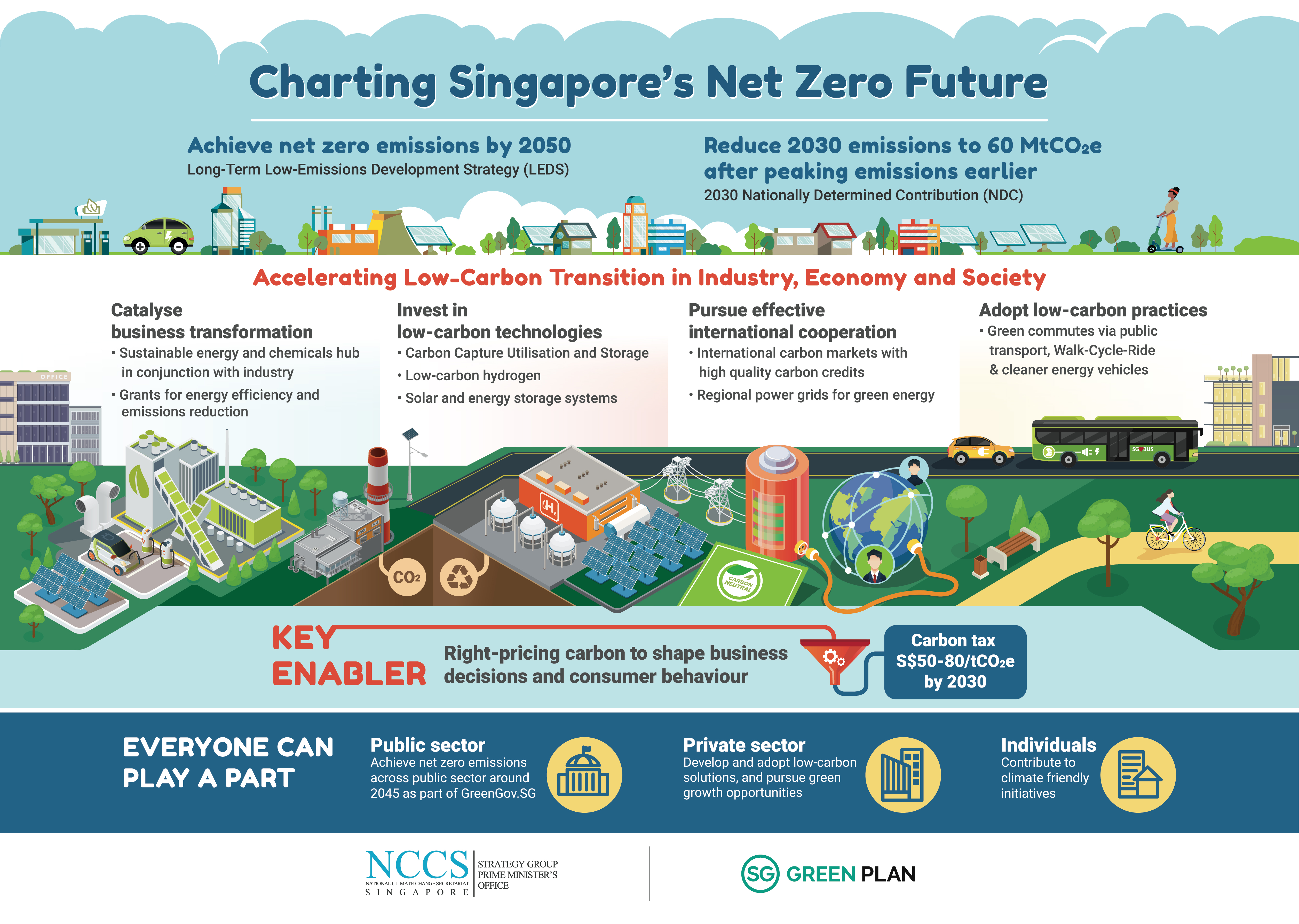 Image via NCCS.
Singapore's country status
CAT's analysis appears to suggest that Singapore ought to contribute more internationally to finance climate solutions.
Under the UNFCCC, countries bear common but differentiated responsibilities in tackling climate change.
Developed countries are called on to take the lead in terms of providing technical or financial assistance to developing countries, on top of cutting its own emissions.
Singapore is a non-Annex I country, which is a category of countries conventionally considered to be developing countries which are vulnerable to the impacts of climate change, including its economic impacts.
As such, Singapore is not expected to provide climate financing.
When asked if Singapore is ready to accept a "developed country" status, Fu told Eco-Business that Singapore will find other more effective ways to provide climate funding.
“Those [actions] will be more impactful than being a donor country and putting [money] into a fund that we may not have the necessary line-of-sight to,” Fu said, Eco-Business wrote.
At COP27 this year, some parties like the European Union pushed for wealthier countries like Singapore to be listed as contributors rather than as recipients in the loss and damage fund.
On this, Fu said that Singapore will participate in the "right spirit of co-operation", and that it was already contributing to regional climate risk insurance funds, CNA reported.
Whether its contributions come as an Annex I country will have to be considered in the context of what it means for its status as a non-Annex I country, Fu added, according to The Straits Times.
Top image via JTC


If you like what you read, follow us on Facebook, Instagram, Twitter and Telegram to get the latest updates.