


 October 01, 2020, 06:04 PM
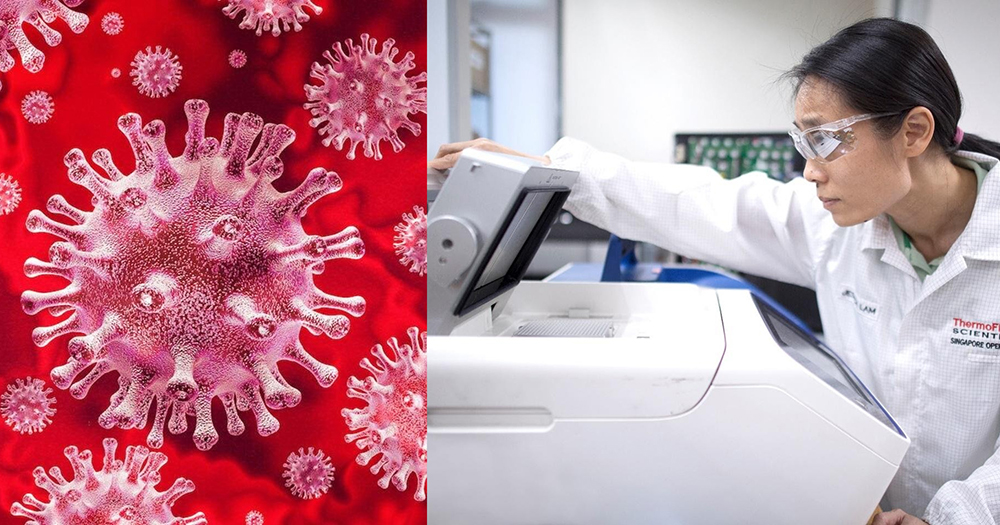

From the 300,000 plus migrant workers residing in dormitories here, to students and staff in schools, to Changi Airport, usage of the nasal swab test has now become a ubiquitous part in the fight against Covid-19.
As such, it is easy to take for granted the availability of such a test.
A test which is due in no small part to the efforts of Thermo Fisher Scientific, one of the world’s largest life sciences companies that set up shop in Singapore, about 20 years ago.
Speaking to Mothership, the company’s Sr. Director of Research and Development in Singapore, Dr James Green, broke down the various components that go into creating the Covid-19 diagnostic test and how the company has been involved at length in almost every step of the fight against the virus.
Collecting the virus sample
James began by highlighting the importance of the first step – collecting the sample, either from a nasal swab or saliva, and transporting it to the lab where testing takes place.
Should the sample taken potentially have the virus, the collection tube containing viral transport media (VTM) preserves it at room temperature, so that it will arrive safely at a laboratory without going through complicated cold chain logistics.
This ensures that the virus does not degrade, therefore reducing the chances of a false negative and giving patients and their providers confidence in the test result.
Currently, about a million of these collection tubes containing VTM are manufactured by Thermo Fisher globally on a daily basis.
Extracting the virus
In addition, Thermo Fisher Scientific also manufactures a piece of equipment in Singapore known as the Kingfisher, which is required for the second step of the process: extracting the virus from the sample.
James added that this is done via a process called nucleic acid extraction, in which the Ribonucleic acid (RNA) genome of the virus is extracted from the complicated sample matrix that is preserved in the viral transport media.
For those of you not in the know, the RNA is where the genetic information of a particular type of virus, such as Covid-19, is stored.
Once the sample is extracted, the final stage in which the swab test derives its name from is conducted -- the Polymerase Chain Reaction (PCR) test.
Here, James explained that the term PCR essentially means the method in which the virus RNA is translated into Deoxyribonucleic acid (DNA) and duplicated repeatedly over many cycles, until it can be physically seen by excitation with a fluorescent light and captured by an imaging sensor.
In addition, the PCR instruments that are used for this stage of the test are designed, developed and manufactured in Singapore.
“And that’s only the diagnostic paradigm,” he further stated.
Therapeutics: the interactions of drugs with the virus
Another front which James raised was the area of therapeutics -- the interaction of drugs with Covid-19.
Here, Thermo Fisher Scientific’s involvement takes the form of developing electron microscopes and distributing them around the world to various universities and organisations for the study of Covid-19’s structure and its interaction with different drugs.
James added that other technologies from Thermo Fisher such as Next-Generation Sequencing (NGS) are also being used to further our understanding at a population level.
“This helps with epidemiological studies so we can understand if the virus is changing over time and over different geographies.”
In addition, the company is also providing cryo storage facilities and specimen banks to its various partners and collaborators to help facilitate research.
Bullish about a vaccine
This brought us to the topic of the company’s involvement in the development of a vaccine against Covid-19.
On this matter, James stated that Thermo Fisher was producing kits and reagents to help researchers in this effort, serving a variety of purposes.
The company also has a pharmaceutical services group, which provides expert capabilities and facilities for vaccine research and manufacturing.
When asked about his own thoughts on the development of a vaccine, James replied that he was “bullish” as the data coming out regarding vaccines in either Phase II or Phase III trials is “compelling.”
He elaborated that the data had shown that there had been an immune response to several of the vaccines available, although the response varied in strength and he added:
“I will say that early indications suggest that some of those vaccines have produced something called a neutralising antibody response, which is a very good sign for extended protection. “
This is not the first outbreak that the company has been involved in combating, however.
Other outbreaks include Zika, MERS, SARS and Ebola.
With regard to Ebola, James noted that the virus had emerged in a particularly undeveloped part of the world, West Africa, in 2014.
In painting the severity of the virus, he stated “frankly, there isn’t a compelling business case for Ebola diagnostics . Even so, we are proud to support countries in need and worked tirelessly to send NGS instruments to Sierra Leone and establish remote testing laboratories with the University of Cambridge.”
In this case, James stated that the rationale for doing so was as such, “Working at Thermo Fisher isn’t just about satisfying our shareholders, it really is about making the world healthier, cleaner and safer.”
The company is hiring
The good news is that Thermo Fisher Scientific is hiring.
As a result of research and development investments amidst the ongoing Covid-19 pandemic, the company is now seeking for people for its Genetic Sciences Division, with open roles in Operations, Research & Development and Sales.
Those with an interest can find out more here.
This sponsored article made the author more appreciative of certain features that we now take for granted as part of the pandemic’s backdrop.
Top image collage from Thermo Fisher Scientific


If you like what you read, follow us on Facebook, Instagram, Twitter and Telegram to get the latest updates.