


 September 01, 2020, 07:17 PM
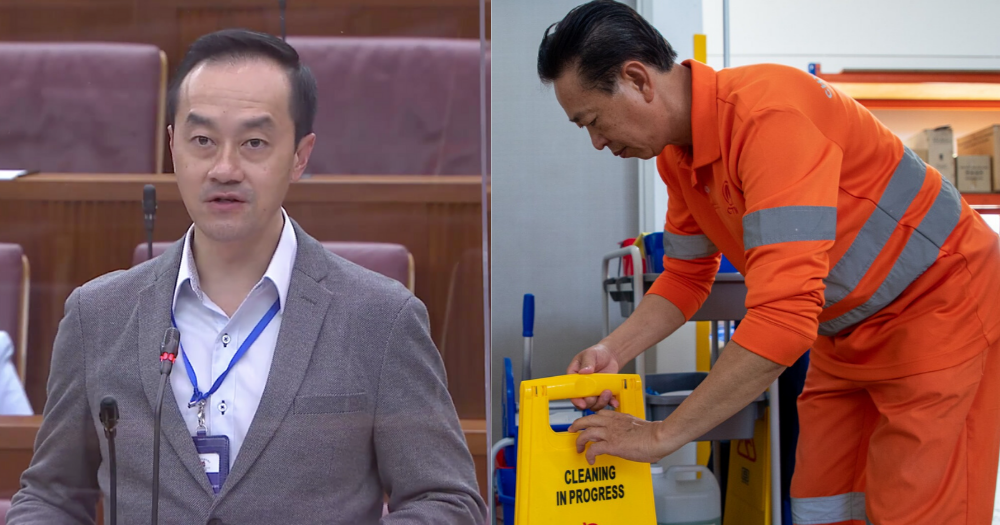

On the second day of debate on the President's Address, Senior Minister of State in the Ministry of Health Koh Poh Koon focused on the government's approach to lifting the wages of lower income earners.
Koh, who previously served as the Senior Minister of State for Trade and Industry, explained that the government's way of uplifting lower wage workers is through the "triple uplift formula". This comprises of the Progressive Wage Model (PWM), Workfare Income Supplement, and recommendations from the National Wages Council.
He said that this formula has enabled the wages of the lowest 20th percentile to see an annual growth of 4.4 per cent from 2014 to 2019, as compared to 2.3 per cent in the preceding five years.
Can be better
However, Koh said that the current policies can be improved.
He said that SkillsFuture Singapore has already mapped out the skills framework for many job roles. "Leveraging on these skills ladders, we should now move towards a universal PWM across all the low paying jobs."
"If we truly want to build a more inclusive society, and narrow the income gap, the pace of PWM implementation in more sectors must quicken," he added.
Koh suggested that a first step towards such a policy might be to leverage occupational wage survey data to set wage benchmarks in sectors where there are currently no regulatory levers to mandate a PWM.
Timing is important
However, Koh acknowledged that timing is important when it comes to implementing such a policy.
Koh said: "Understandably, it is not the best time to raise wages, during a global health [and] economic crisis."
Minister for Manpower Josephine Teo also addressed this in her speech today.
She pointed out that the PWM has worked to lift wages of low income earners, and that expansion of the model to more sectors is one out of four prongs in the government's approach to uplift workers who earn less.
But she also acknowledged that the real question surrounds the timing of the expansion of the PWM.
Some sectors — like security — are recruiting less, and hence workers might still face an overall decrease in pay because they get fewer assignments, or they get displaced.
Teo said: “Businesses are still trying to find a firmer footing. Therefore, any moves to expand PWM into new sectors immediately, in the midst of great uncertainty in the labour market, therefore carries higher risk.”
“Given our overriding priority to preserve jobs, we should proceed with care,” she added.
PWM Mark
Teo said that the government intends to introduce a “PWM Mark”, where companies can voluntarily implement a progressive wage model (PWM), and get recognised for it.
“Companies that voluntarily pay progressive wages and provide job progression pathways to their lower-income workers will be recognised with this PWM Mark,” said Teo.
However, she added that for the PWM mark to work, society must play a part too.
She said that as consumers, we must be willing to pay slightly more for goods and services, to support companies who carry out these good practices.
Teo said: “This will spur more companies to be progressive and adopt the PWM Mark, which in turn will benefit our lower-income workers.”
Koh also addressed this point in his speech. He said: "We need more progressive service buyers, to start awarding contracts fairly to companies, based on performance and quality, instead of just looking at price alone."
He added: "In this way, we can truly recognise the importance and the value of the work performed by many of our essential service workers."
Related story:
Totally unrelated but follow and listen to our podcast here
Top image adapted from CNA video and NEA/FB.


If you like what you read, follow us on Facebook, Instagram, Twitter and Telegram to get the latest updates.