


 September 01, 2020, 12:30 PM
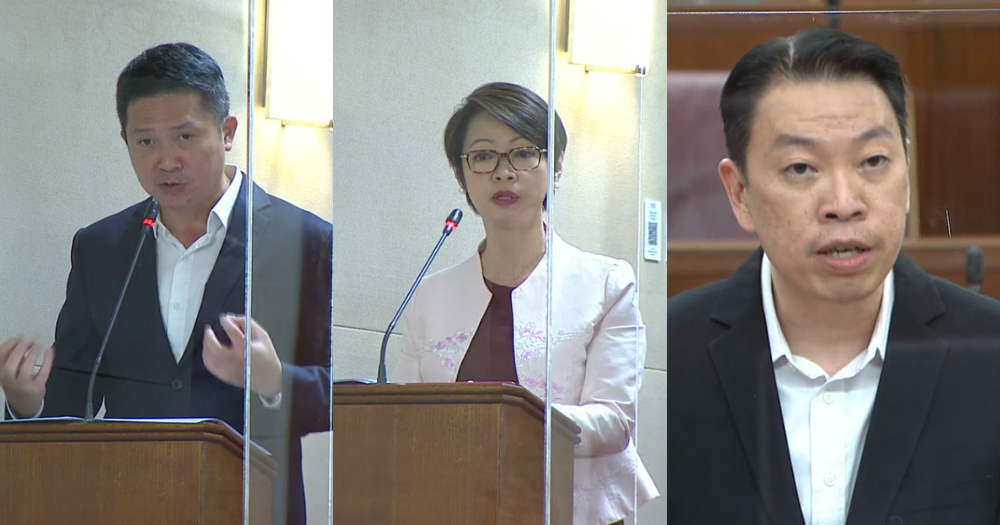

The first debate of the 14th Parliament on the President's Address was held on Aug. 31, 2020.
Several members of Parliament made their speech on topics that were mentioned in the President's Address.
One topic that popped out pretty often was the subject of Employment Pass (EP).
On Aug. 27, Manpower Minister Josephine Teo announced that adjustments will be made to foreign worker policies.
This includes the increase of the minimum salary requirement from S$3,900 to S$4,500 for new EP applicants.
While most have welcomed this change which will be implemented from Sep. 1, 2020 onwards, some also shared their thoughts and suggestions regarding the new measures.
Foo Mee Har, Member of Parliament for West Coast GRC
At the Parliament, Foo said that while the new measures "represent steps in the right direction", she does not think these measures "go far enough".
One of the measures Foo had suggested to strengthen Singapore' employment framework includes the implementation of dependency ratio or quota for EPs, with differentiated ceilings and salary levels for different sectors.
Foo also asked for 'complete transparency' in selection requirements besides requiring the job vacancy to be posted for 28 days.
"The employer’s final hiring decision must stand up to the scrutiny of others - including the firms’ own employees as well as the authorities - for having best satisfied these clear selection criteria, in order to foster a sense of fair play."
Additionally, she said that the senior management must be held accountable for employment offers to EP holders, suggesting to require the most senior executive to sign off on these offers and include a declaration that the firm has complied with all requirements of hiring EP holders.
According to her, this will galvanise the necessary action on the part of employers and reduce reliance on foreigners.
"The current negative sentiment against foreigners will ease when Singaporeans believe that the system takes care of their interests and it means something to be a Singaporean, when applying for a job."
She also called for for Singaporeans to be given priority for jobs that they can do.
"In other words, between two equally qualified candidates, employers should be obliged to pick the Singaporean over the foreigner."
Henry Kwek, Member of Parliament for Kebun Baru SMC
Kwek questioned how Singaporeans can be assured that there is diversity in companies' hiring and remuneration policy if EP holders are dominated by one particular country despite Singapore's "very diverse" expatriate workforce.
He also asked whether Singaporeans will trust if such companies have the genuine intention to build up a "Singapore core".
Therefore, he suggested companies with more than 200 staff, of which more than 25 per cent are EP holders, declare the country of origin of their EP holders.
He suggested for this to be mandated along four annual remuneration bands:
- From S$60,000 to S$120,000
- From S$120,000 to S$250,000
- From S$250,000 to S$500,000
- From Beyond S$500,000
He understands that there are some legitimate reasons why high-paying EP jobs may go to expatriates.
"For example, an international company like Samsung, with their regional headquarters in Singapore, would likely have a high number of Korean nationals at senior level."
However, given the talent and ability of Singaporeans, he believes that companies can build up a stronger Singapore core.
Melvin Yong, Member of Parliament for Radin Mas SMC
While Yong welcomed the adjustments made to EP and S Pass qualifying salaries, he also had several questions in mind.
"Will our Work Pass and Employment Pass system continue to be relevant when companies no longer need employees to be physically based in one location to perform the work? Can Singapore continue to compete for investments and bring in the best companies? Can Singaporeans continue to compete for good jobs?"
He added that the PMETs (Professionals, Managers, Executives and Technicians) in their 40s and 50s whom he met have told him that it is not easy to juggle the responsibilities they shoulder every day as the sandwich generation.
This includes taking care of their young children and elderly parents on top of setting aside funds for their own retirement needs.
As such, he is hoping that the government will recognise the struggles and look into how they can better support and alleviate these burdens.
Top image screenshot from Channel NewsAsia.


If you like what you read, follow us on Facebook, Instagram, Twitter and Telegram to get the latest updates.