


 August 24, 2020, 04:44 PM
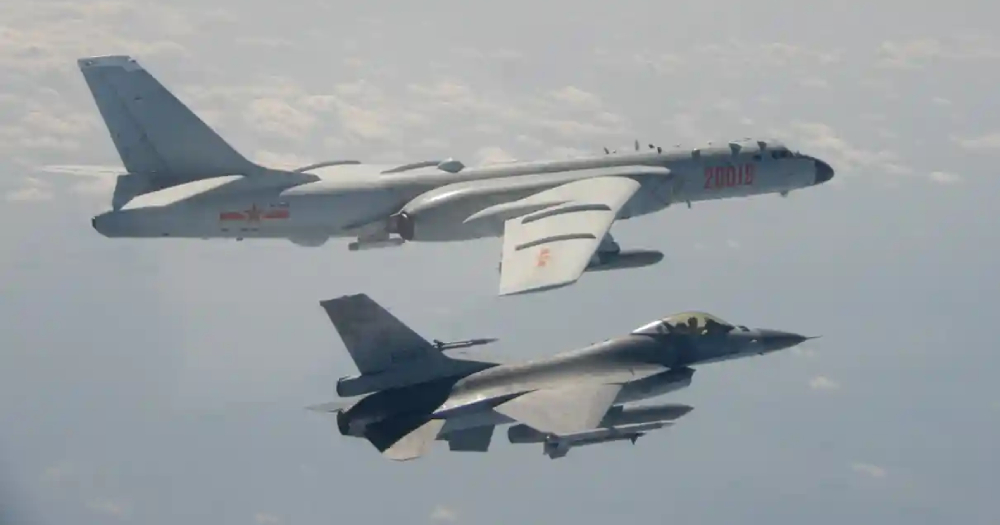

China could launch a takeover of Taiwan and complete it in just three days, an essay published by private, non-profit military association U.S. Naval Institute posited.
The possible scenario was put forth by former deputy director of the United States' Central Intelligence Agency Michael Morell and retired U.S. Navy admiral James Winnefeld.
Very important: Our article is NOT a prediction. It is simply one scenario of how we could lose Taiwan. It is meant to make the point that how a war starts matters greatly to how it ends. https://t.co/gUJu0SYeqI
— Michael Morell (@MichaelJMorell) August 17, 2020
Beijing views Taiwan as a renegade island that needs to reunite with the "motherland", by force if necessary.
Hypothetical attack would begin as early as mid-January 2021
The hypothetical attack to bring Taiwan back into the mainland fold, which the authors named "Operation Red Province", would begin on the evening of Jan. 18, 2021 before the U.S. presidential inauguration.
Prior to that, China would have escalated tensions with Taiwan in the previous month, conducting a major military exercise meant to send a signal to Taiwan.
The act was perceived as mere saber-rattling by the U.S., which was distracted by its election drama and the ongoing pandemic, the authors wrote.
The attack on Taiwan would hypothetically begin with a series of moves meant to exert control over the island, and prevent other nations from stepping in to help.
Chinese operatives would already be present in Taiwan and proceed to take over key facilities, with cyberattacks launched to choke Taiwan's public media and cripple the island's power grid, the authors imagined.
Chinese forces would also forcefully take over several islands, including Kinmen, Matsu and the Penghus, after facing fierce resistance from Taiwanese forces.
People's Liberation Army Navy (PLAN) would block off the entrances to the Taiwan strait, and prepare for potential conflict with U.S. Navy ships.
A sea and air blockade would be subsequently announced, which would aid the landing of PLA amphibious forces.
China's influence campaign to deter other nations from intervening
China's "wolf warrior" diplomats would be utilised in the operation as well, sending a message to other governments not to resist the move on Taiwan.
The authors highlighted Japan as a country that China would take extra care with, making it clear to the Shinzo Abe administration that any support given to the Americans to hinder the operation would be deemed as a hostile move against China.
A Chinese-led influence campaign would also be launched, targeting the peoples in different geographical regions with custom-designed messages.
Western audiences would see media articles or social media posts that include "condemnations of Taiwan's government".
East Asian audiences would see messages that say the U.S. is "powerless to intervene", and that China means "no harm to any regional nation that stays out of this".
As for the rest of the world, they would see messages that threaten repercussions of "reduced Chinese trade and investment" should they join in any international rebuke of China.
At the same time, Chinese media, using their English-language international outlets, would remind the world of the PLA's military superiority that can even strike the U.S. west coast.
The aftermath
China's move would be felt across the globe on the second day, with stock markets crashing and confusion setting within governments.
While the U.S. called for a United Nations Security Council meeting, no progress was made as veto-powers China and Russia made their objections clear.
International leaders, while waiting for U.S. response on the matter, were worried about Chinese threats as well.
By the third day, nothing could be done by the U.S. to salvage the situation.
Realising that more casualties would be sustained if she does not concede, Taiwan's President Tsai Ing Wen then accedes to Chinese President Xi Jinping's demands, expressing hope in a last-ditch attempt that Taiwanese people would still be able to retain some freedom.
She would then be replaced by a pro-Beijing politician by Xi.
Declaring that the "most important step" in achieving the "Chinese Dream" has now been fulfilled, Xi "welcomed the people of Taiwan home" in his triumphant address.
You can read the entire essay here.
China dismisses essay as "sensational projection"
In what appears to be an attempt to downplay tensions with Taiwan, Chinese state-controlled media Global Times said the country will not let the U.S. decide "when and how to reunify the island of Taiwan".
Calling the essay a "sensational projection", the article further said reunifying Taiwan by force is not an urgent task as the PLA has "an overwhelming advantage in the region".
Also, there is no need to do so urgently should Washington and the "separatist authority" in Taiwan not cross the red line set by the Anti-Secession Law, Global Times said.
Dismissing the time frame put forth by the authors, Lu Xiang, a research fellow at the Chinese Academy of Social Sciences, was quoted as saying China currently prioritises post-Covid-19 economic recovery, which makes the opportunity presented by the U.S. election unlikely for an attack to be launched.
China toning down its rhetoric
China has recently taken a more conciliatory approach towards the U.S.
While it has responded to the series of hostile moves from the U.S., such as closing the U.S. consulate in Chengdu after the Chinese consulate in Houston was forcefully shut down, China has sought to defuse tensions with the U.S.
Top Chinese diplomats have called for "peaceful coexistence" with the U.S.
China's Foreign Minister Wang Yi has said Beijing is open to talks with Washington "at any level, in any area and at any time", even though he had told his Russian counterpart just a few weeks ago that the U.S. had "lost its mind, morals and credibility".
Calls for the U.S. to take an unambiguous stand on Taiwan
Under the Taiwan Relations Act, the U.S. sells arms to the island despite the absence of formal diplomatic ties.
But the U.S. has never explicitly said it would come to Taiwan's defence in the event of a Chinese attack, choosing to maintain an ambiguous position on Taiwan.
With U.S.-China relations at a historic low, there have been increasing calls in Washington for the U.S. to revisit its approach to Taiwan, with proponents saying it is necessary in light of China's increasing military advantage.
Elbridge Colby, a former deputy assistant secretary of defence for strategy and force development, told The New York Times that the U.S. has to make clear on where they stand in order to end any ambiguity on how the country would react to "the use of force".
Shelley Rigger, a political scientist, said while the U.S. should "make clear its support for Taiwan", it should do so by strengthening Taiwan, instead of becoming more confrontational with China.
Top image of a Taiwanese F-16 fighter jet next to a Chinese H-6 bomber in Taiwan airspace via Taiwan's Ministry of National Defence
Related story:
Totally unrelated but follow and listen to our podcast here


If you like what you read, follow us on Facebook, Instagram, Twitter and Telegram to get the latest updates.