


 March 14, 2020, 05:17 PM
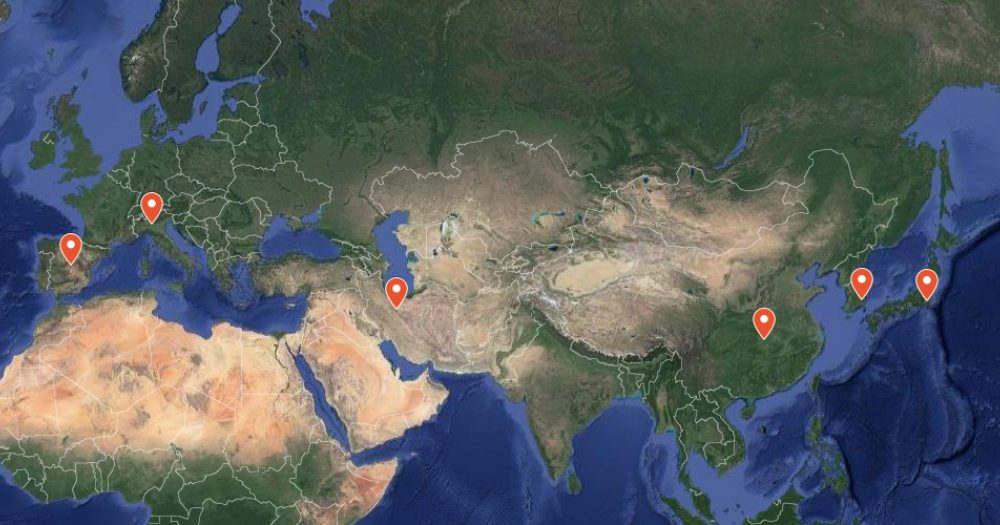

The places worst hit by Covid-19 currently are Wuhan, France, Italy, Iran, South Korea, Spain, and Germany.
Interestingly, as pointed out by this tweet, these places appear to sit along a narrow latitude band stretching from 30 to 50° N:
- Wuhan, China (30.5928° N)
- Tokyo, Japan (35.6762° N)
- Lombardy, Italy (45.4791° N)
- Qom, Iran (34.6416° N)
- Daegu, South Korea (35.8714° N)
- Madrid, Spain (40.4168° N)
A paper by researchers from the University of Maryland, the Shiraz University of Medical Sciences, and the Shahid Beheshti University of Medical Sciences also pointed out that Covid-19 has "established significant community spread in cities and regions only along a narrow east-west distribution roughly along the 30-50 N” corridor".
These places also have similar weather patterns (5-11°C and low specific and absolute humidity), prompting the researchers to posit that transmission of SARS-CoV-2, the virus that causes Covid-19, is affected by the weather.
Take this weather temperature map from November 2018 to March 2019. The black circles represent countries with significant community transmission (defined as more than six deaths as of Mar. 3, 2020)
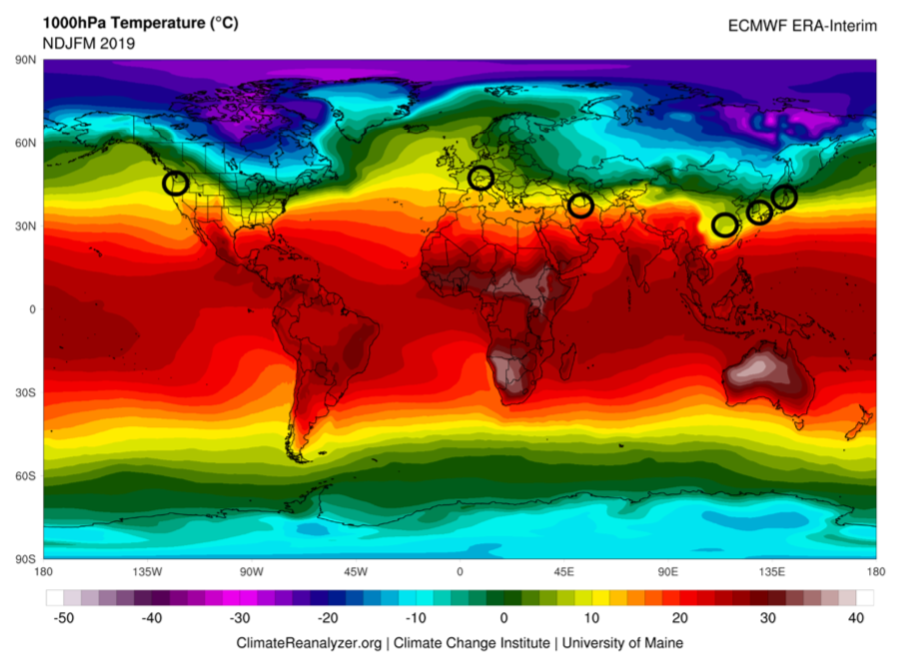
When the researchers compared Wuhan's average temperature in January 2020 with the average temperatures of other affected places in February 2020, they found "striking similarities":
Airport weather stations recorded average temperatures of 4-9°C while city temperatures were slightly higher at 5-11°C.
As such, the researchers predicted that several other places such as the British Isles and Central Europe might be at risk of community spread in March and April:
"Using 2019 temperature data for March and April, risk of community spread could be predicted to affect areas just north of the current areas at risk. These could include (from East to West) Manchuria, Central Asia, the Caucuses, Eastern Europe, Central Europe, the British Isles, the Northeastern and Midwestern United States, and British Columbia. However, this simplified analysis does not take into account the effect of warming temperatures. The marked drop in cases in Wuhan could well be linked to corresponding recent rising temperatures there."
Even the latest regions hit by Covid-19, like Washington, U.S. (47.7511° N), and North Rhine-Westphalia, Germany (51.4332° N) happen to sit within or near the 30-50° N band.
They are also experiencing temperatures that range between 4 and 11°C, according to Google.
While some speculate that the virus outbreak will not sustain past the summer, the study also pointed out that this is "increasingly unlikely" at the rate the cases are increasing.
The spread of Covid-19 depends on whether there is a "vital reservoir" of the coronavirus even when the weather turns warmer and that makes surveillance efforts important in these countries that have been affected the most.
And in case you're wondering, Singapore sits at 1.3521° N.
You can read the rest of the study here.
Top image via Google Maps.


If you like what you read, follow us on Facebook, Instagram, Twitter and Telegram to get the latest updates.