


 May 31, 2023, 11:23 AM

Follow us on Telegram for the latest updates: https://t.me/mothershipsg
Turkey's prime minister Recep Tayyip Erdogan has been re-elected as president, following a second round runoff on May 28.
Confident mandate
Singapore's president Halimah Yacob and Prime Minister Lee Hsien Loong have written congratulatory messages to Erdogan.
President Halimah extended "warmest congratulations" on Erdogan's re-election, saying that the people of Turkey have "given you a mandate that reflects their confidence in your leadership".
She reflected on Singapore and Turkey's "warm and broad-based" relations as well as strong economic links and cultural relations, and the historical linkages between Southeast Asia and the Ottoman Empire.
PM Lee likewise sent his congratulations, mentioning the two countries' "longstanding and warm relationship" that was underpinned by the Strategic Partnership and the Turkey-Singapore Free Trade Agreement, as well as close cooperation in economic, cultural, and people-to-people spheres.
He also said that Singapore supported Turkey in its efforts to further deepen engagement in the region under Asian Anew Initiative. He looks forward to meeting with Erdogan again soon, PM Lee added.
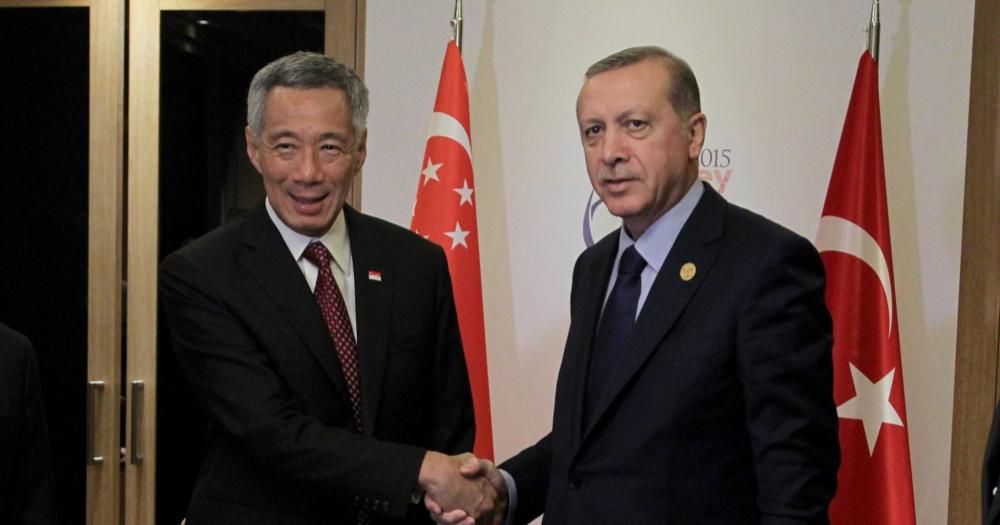
PM Lee met with Erdogan on the sidelines of 2015's G20 meeting.
Singapore also sent 68 SCFD personal to Turkey in March 2023 to help search and rescue efforts after a devastating earthquake that was estimated to have killed over 50,000 people.20 years
Erdogan has been president of Turkey since 2014, and was prime minister before that from 2003, and his victory extends his rule to over two decades.
Turkey operates a two-round presidential election, where unless a candidate gains more than 50 per cent of the vote in the first round, the top two candidates compete against each other in a second round two weeks later.
Erdogan's opposition consolidated behind the figure of Kemal Kilicdaroglu, who managed to prevent Erdogan from winning outright, but only by the slimmest of margins, Erdogan missed the mark by just over half a percentage point.
The challenge was to maintain support and try to vie for the support of the third candidate, Sinan Ogan, who received just over five per cent in the first round. Ogan would ultimately back Erdogan.
Erdogan ultimately managed to defeat Kilicdaroglu, 52.14 per cent to 47.86 per cent, according to Al Jazeera.
This result was very similar to his first round result during the previous 2018 election, where he also got just over 52 per cent of the vote, implying that that while the opposition was able to successfully coalesce, they were unable to convince any of Erdogan's supporters to cross over.
Comfortable margin
This result has come despite several challenges that Erdogan's government has faced in recent times, including what was criticised as a slow response to a devastating earthquake in February.
Al Jazeera also notes that inflation in Turkey was at 50.5 per cent in March, a figure that is dwarfed by the 85.6 per cent it was at in October 2022, while The Guardian reports that Turkey was undergoing a cost of living crisis.
The Guardian also reported that the Turkish Lira fell to a record low against the U.S. dollar, describing the economic policies of Erdogan committed to in his victory speech as "unorthodox".
Financial Times quoted an expert describing Erdogan's economic polices of "very low interest rates, very loose fiscal policy, and burning through... foreign currencies" as "unsustainable".
But analyst The Guardian spoke to believe that Erdogan will see his four per cent winning margin as "comfortable" and as encouragement to stay the course.
Related Stories
Top image via Lee Hsien Loong/Facebook


If you like what you read, follow us on Facebook, Instagram, Twitter and Telegram to get the latest updates.