


 August 05, 01:13 PM
 514 Chai Chee Lane 03-16, Singapore 469029
 You can hardly take a bus these days without catching a glimpse of the arresting 1965 movie poster. At bus stops all over the country, Lim Kay Tong, who plays Lee Kuan Yew in the film, can be found gazing impassively at you.
His moody, searching eyes seem to reflect a hundred simmering woes and worries, chief among them his acute disappointment at your continued, miserly refusal to cough up twelve dollars and go watch him on screen.
If you’re guiltily scrabbling around for a response to that reproachful stare (besides mumbling about how your mum really, really wanted to watch Tom Cruise in Mission Impossible instead) here’s one: 1965 doesn’t really feature Lim Kay Tong (and his LKY) all that much.
The film instead weaves a tale centred around Chinese-Malay tensions in 1965, and tells the story of fictional characters embroiled in the violence and suspicion of the period. Lim Kay Tong pops up at intervals with a brief speech or two amid the tensions (and of course we get to see the movie’s anticipated recreation of LKY shedding tears at the 1965 Separation press conference, which featured prominently in the trailer), but otherwise his time on screen is far shorter than his looming presence on the poster might make you believe.
In his scenes, Lim Kay Tong does capture some of Lee’s gravitas and certainly does a credible job with the man’s iconic inflections and diction, however, it remains hard to suspend one’s disbelief entirely for Lim’s portrayal, possibly because of the undeniable divide in ages (Lim Kay Tong is nearly two decades older than Lee was in 1965) and a lack of resemblance that is made pronounced by Lim’s more angular features and a hairline that recedes beyond the border of similarity.
There is, nevertheless, much to enjoy about the film; it’s certainly an intriguing experience to watch Singapore as it might have been in 1965, as the film takes care to believably immerse you in the Singapura of fifty years ago. Rickety-looking shophouses, bustling, cramped, grubby lanes and policemen in oversized khaki shorts abound.
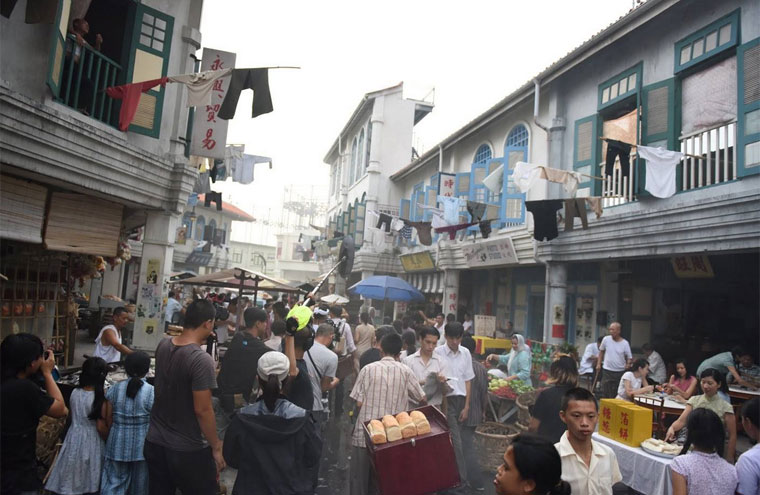 Source: 1965 Facebook
The acting is also generally first-rate. Deanna Yusoff ably plays Khatijah, a single mother who suffers a heartbreaking loss during a Chinese-Malay riot, her grief and pain constantly evident and deeply etched, but nonetheless measured and steering clear of over-the-top melodrama. Opposite her is the excellent Qi Yuwu, who plays a dedicated Police Inspector that Yusoff’s character accuses of inaction during the riots. Yuwu commendably displays ample range in his role, authoritative and steely-eyed in public as Police Inspector Cheng but sensitive and tender in private scenes with his family. James Seah and Joanne Peh also both excel in their respective roles as Inspector Cheng’s troublemaking brother Seng and coffee shop assistant Zhou Jun. Peh in particular merits praise for a nuanced performance as her early effervescent, chirpy optimism is eroded by the unpleasant events happening around her, as race relations worsen.
1965 also hands a substantial role to 2009 Singapore Idol Sezairi Sezali, who does a decent job playing a junior policeman caught between the wishes of Khatijah (his mother) and the Police Inspector. Interestingly, we also witness the acting debut of Nicole Seah, who contested GE2011 with the National Solidarity Party. Seah plays a relatively smaller role as Inspector Cheng’s wife, but does well enough here for one to suspect that we might well be seeing more of her in local productions.
Sadly, an impressively-bearded Mike Kasem doesn’t fare quite as well here as a Pakistani reporter, partially due to a rather indecisive-sounding accent that doesn’t seem traceable to any distinct geographical origin, but also because his entire character feels superfluous within the context of the film. Kasem’s character doesn’t drive the plot forward in any genuinely meaningful way and merely engages in a few wooden exchanges with other characters, ostensibly to discuss how events are unfolding from an outsider’s external point of view, but his lines and presence fail to provide any meaningful insight or depth into the looming racial tension.
In fact, this is perhaps typical of 1965’s recurring flaws; a lack of depth and focus arising from unnecessary inclusions and occasional over-simplifications. Rather than interrogating the root causes and psychological origins of our historical racial unease, or raising questions about the durability of race relations in the future, the film affixes blame for 1965’s unsavoury events a bit too simplistically onto external, larger forces causing strife in the period, like Konfrontasi, and finally merely reiterates the importance of harmony in the present day.
The film’s conclusion also includes what feels like a sincere but slightly incongruous tribute to Lee Kuan Yew’s efforts in creating the cohesion we enjoy today, with words of praise for his vision and deeds accompanied by swooping shots of modern, cosmopolitan Singapore. An admirable, timely sentiment, perhaps, but it feels slightly welded on to a different movie, disjointed and disparate from the prior, immersive tale of ordinary Singaporeans trapped in the tumult of 1965.
To be clear, such lapses don’t make 1965 a bad movie, although one is left feeling like it could have been a significantly better one.
Top photo via 1965 Facebook
If you like what you read, follow us on Facebook and Twitter to get the latest updates.


If you like what you read, follow us on Facebook, Instagram, Twitter and Telegram to get the latest updates.