


 August 03, 2023, 05:54 PM
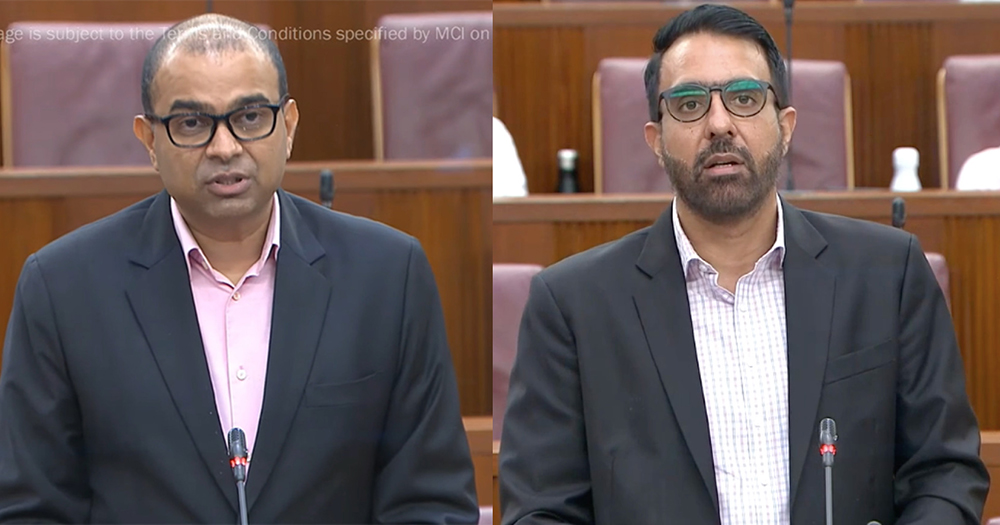



Leader of the Opposition Pritam Singh questioned the government in Parliament on its decision to require online news site Asia Sentinel to include a Protection from Online Falsehoods and Manipulation Act (POFMA) correction notice on both the article and the website's main page.
"Can there not be a question of overreach when you expect the correction direction to be on the main webpage as well?" Pritam asked. "It does sound like overreach when you potentially are almost forcing the site to shut down because you force them to actually put the clarification on the first page, which has nothing to do with the article."
The article in question, titled "Singapore Kills a Chicken to Scare the Monkeys", was published on May 24, 2023, and was written by co-founder and editor-in-chief of Asia Sentinel John Berthelsen.
The article made several allegations about the Singapore government's handling of the Covid-19 pandemic and multiple unrelated court cases, such as those involving Andy Wong Ming Jun, lawyer M Ravi, as well as Lee Hsien Yang and Lee Suet Fern.
Puthucheary: Intent is to have the correction notice reach as many people as possible
In his initial reply to Singh's original question, Senior Minister of State for Communications and Information Janil Puthucheary said the intent is to try to have the correction notice reach at least as large a readership as the original falsehood.
Puthucheary conceded that this is often difficult to achieve, however.
In the case of the Asia Sentinel, the inclusion of the POFMA correction notice on both the article and the main page is to try and achieve such an objective, he added.
In addition, Puthucheary explained that the Act also allows other orders to be made to bring the correction notice to the attention of readers who may have read the original falsehoods.
This prompted Singh to ask if there is a certain threshold where the government decides that the correction must not just be included in the article but on the main page of the website as well.
Singh also asked how many online sites have been issued directions which also required them to put up a correction notice for the entire website.
Puthucheary: You would only characterise this an overreach if you felt the correction was not necessary
In response, Puthucheary said that one would only characterise the move as overreach if one felt the correction of the falsehoods was unnecessary, in itself false, or inappropriate to be viewed by as many people as possible.
The minister then noted that Singhm, who himself had been part of the Select Committee that produced the white paper for the legislation for POFMA, would agree that it's easier for the false statement of fact, "a lie", to "travel faster than the truth".
Puthucheary then touched on the behaviour of people online, noting that people do not necessarily go back to the original article once they have read it.
Hence, he said it is necessary to put the correction "in place" so that as many readers of the original falsehood as possible will have that corrected, he added.
He said that ensuring the correction is visible depends on how the site is laid out, how the publisher manages the material, and propagates the site's material.
He added that each correction notice needs to take into account the notice and feed of the website.
Puthucheary then said that he would provide the details about specific correction directions to Singh as he did not have the information at the moment.
Singh: Singaporeans are denied the opportunity to read other articles which contain no false statements of fact
Singh questioned if the Asia Sentinel correction direction means the government is taking a stricter approach to issuing such notices.
Singh added that the consequence of such a direction is that Singaporeans are denied the opportunity to read other articles on the site that contain no false statements of fact.
Here, Puthucheary asked Singh for clarifications,
"I don't quite understand why the publication of a correction notice on its (Asia Sentinel's) main webpage should in any way impede readers from accessing other articles. Surely he would agree that if that correction notice is necessary to correct a falsehood, it should be seen by as many readers as possible."
Singh replied that he had no objection to the correction direction on the article itself and asked if there had been a past situation where Asia Sentinel did not adhere to directions, thereby leading the government to determine its present course of action.
He also reiterated his question about whether future correction directions would require websites to also place notices on their main webpage.
A matter of agreement over the government's approach
Puthucheary replied by saying that Singh did not quite address his clarification and added, "So I'm going to assume that he agrees with me that the publication of the correction notice on the main webpage does not in any way impede a reader from accessing all the other articles on Asia Sentinel's website."
Puthucheary also elaborated that the correction direction added further information and transparency for people to make up their own minds about the facts at hand and voiced his hope for Singh's agreement that no overreach was done by requiring Asia Sentinel to carry the notice.
Singh then clarified that he disagreed with such an approach but said he accepted that such an approach was fair in an instance of repeated egregious conduct and asked if this has been the case for Asia Sentinel or other online publications.
In thanking Singh for the explanation, Puthucheary explained that a correction notice on a website's main page should not be predicated on certain strikes as it is not a fixed threshold.
He said the site's design, ways in which links are made to other feeds, and content are taken into account.
As for past track records, Puthucheary pointed out that Asia Sentinel did not comply with the correction direction on May 26, so an access-blocking order was issued.
"We do give an opportunity for the sites to comply to provide information to the readers," he said.
When Singh asked about Asia Sentinel partially following the direction by putting up the notice only on its site, Puthucheary said the site was required to comply with the entire direction, including putting the notice at the top of its main page.
Left screenshot via MCI/YouTube, right screenshot via CNA


If you like what you read, follow us on Facebook, Instagram, Twitter and Telegram to get the latest updates.