


 July 05, 2023, 02:34 PM

Follow us on Telegram for the latest updates: https://t.me/mothershipsg
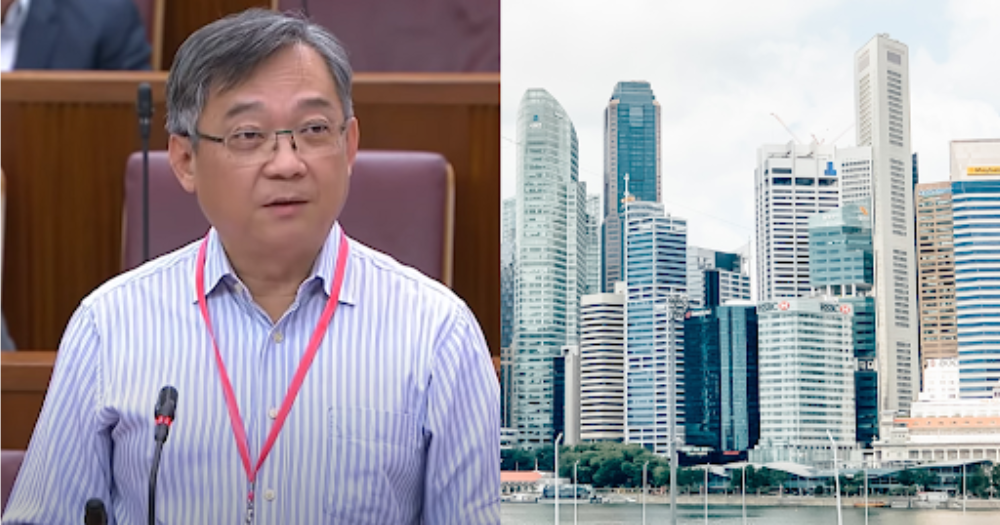
As Singapore’s non-oil domestic exports (NODX) declined for the eighth consecutive month, Minister for Trade and Industry (MTI) Gan Kim Yong described the country’s underlying economic competitiveness as remaining “intact”.
This included Singapore's status as both a manufacturing and trade hub.
Gan was responding to Parliamentary Questions filed by Member of Parliament Yip Hon Weng on Singapore’s plans to mitigate or reduce the risk of going into a technical recession amidst the challenging global economy.
In his written reply, Gan said that Singapore’s exports have declined because global demand has weakened significantly due to major economies' slowdown, and the global electronics industry is also in a deep and prolonged downturn.
The rising global interest rates to combat inflation also dampened the economic situation, he added.
Strong Singapore Dollar dampened effects of global price increase
As such, the Monetary Authority of Singapore has tightened its monetary policy to tackle high inflation.
In response to Yip’s question on the strengthening of the Singapore Dollar affecting the country’s competitiveness and exports, Gan highlighted that the appreciation of the Singapore dollar had dampened the effects of global price increases and eased cost pressures on businesses operating in Singapore, as well as on consumers.
He also shared that Singapore is ranked top in Asia and fourth globally in the latest IMD World Competitiveness Ranking and continues to do well in international trade and employment.
The country is also making gains in areas such as people and talent management, as well as productivity and efficiency, he added, and shared that investments also continue to flow into Singapore, including in the manufacturing sector, the country’s key export sector.
Economic and trade conditions to remain sluggish
That said, Gan said that the MTI expects economic and trade conditions to remain sluggish for the rest of the year.
He added that MTI expects Singapore’s economy to expand by 0.5 per cent to 2.5 per cent, with growth likely to come in at around the mid-point of the range, as previously published in May 2023.
While MTI does not expect a technical recession this year, Gan noted that the possibility could not be ruled out given increased downside risks to the global economy.
“Downside risks in the global economy have also risen, including the impact of recent banking stresses abroad on global financial and economic conditions,” he said.
However, the ongoing recovery of Singapore’s aviation- and tourism-related sectors, as well as the resilience of its consumer-facing sectors, will provide some support to the economy.
Near-term measures introduced to help businesses
As the global economic environment remains uncertain, Gan shared that the Government has introduced several near-term support measures to help businesses during Budget 2023.
Some of the measures include the enhancement of the Enterprise Financing Scheme and the Energy Efficiency Grant.
He reiterated that should the business environment deteriorate sharply, the Government will “recalibrate our measures to support businesses”.
Expanding FTAs, access to new markets and strengthening distribution capabilities to boose Singapore’s competitiveness
Gan also laid out measures to strengthen Singapore’s global trade competitiveness.
Singapore will continue to expand its network of Free Trade Agreements, as well as other economic agreements and partnerships, including digital and green economy trade agreements, he said.
He added that the Government is stepping up efforts to diversify and grow exports by helping local companies to access new markets, including those in Southeast Asia, Latin America, the Middle East and Africa.
“In particular, enterprises can tap on Enterprise Singapore’s 13 Market Readiness Assistance grant, as well as support from its network of 36 overseas centres and partners,” he said.
The government is also embedding Singapore more deeply into global supply chains by strengthening local companies’ regional distribution capabilities and improving the efficiency of its air and sea ports.
“As we tackle these near-term challenges, we must continue to upgrade our economy for the long-term,” he said.
“We recently refreshed most of our 23 Industry Transformation Maps (ITMs) – which cover around 80 per cent of our economy – to position Singapore and Singaporeans for our next bound of economic growth. We must implement these ITMs well so that our firms stay competitive and our workers continue to have good job prospects,” he added.
Top images via MCI YouTube and Polina Rytova on Unsplash


If you like what you read, follow us on Facebook, Instagram, Twitter and Telegram to get the latest updates.