


 April 11, 2016, 04:43 PM
 Flower Dome, Gardens by the Bay
 An article in Bloomberg Gadfly, their fast financial news commentary section, published an opinion piece calling for overpaid, multiple-directorship male board members in large publicly-traded companies in Singapore, to be defenestrated.
Titled "Singapore Boards Are Killing Value", the April 8 article drew attention to the recent woes of Singapore Post, a supposedly attractive e-commerce logistics company that has Alibaba as its second-largest shareholder just four months ago, but is now losing its shine, way and marbles.
The point being made is: Singapore Post is going nowhere (their CEO left and a special audit was carried out to probe possible governance lapses) because there isn't a dedicated boardroom of directors to steer the company onto a path of purpose.
Just last week, a board member, Professor Low Teck Seng, who is also the CEO of the National Research Foundation (NRF) and who was appointed by his fellow board members as Singapore Post's chairman-designate, declined the appointment.
His reason? Taking charge at Singapore Post would “demand more time and focus” than he would be able to give.
This particular case holds true in general
Worse, the greying men on this board, like other greying men on other boards in Singapore, are overpaid and hold too many company directorships, resulting in them not being able to remain dedicated.
According to Bloomberg:
The national average for the most thinly stretched directors at large Singaporean companies is 4.6 additional board duties. The busiest directors appear to be more distracted than their counterparts in the U.S. and Europe.
This means that board members in large publicly-traded companies with market values of at least US$1 billion (S$1.35 billion) in Singapore, hold, on average, 4.6 extra directorships, way more when compared to their counterparts in France (3.6), Britain (2.8) and the US (2.5).
Board members in Singapore are also paid a lot more money.
In Singapore, directors' annual compensation comes in at S$322,000 (US$239,000), at large companies that pay at least an average of S$135,000 (US$100,000) a year to board members, according to data compiled by Bloomberg.
And the equity they return for investors has been abysmal: Return on equity is just 0.5 percent over the past seven years at large companies for every thousand dollars paid to a director.
This is lower than France (0.7 percent), the US (0.8 percent), Britain (1.5 percent) and Germany (1.6 percent).
Hence, the glaring inverse correlation between directorships held and return on equity:
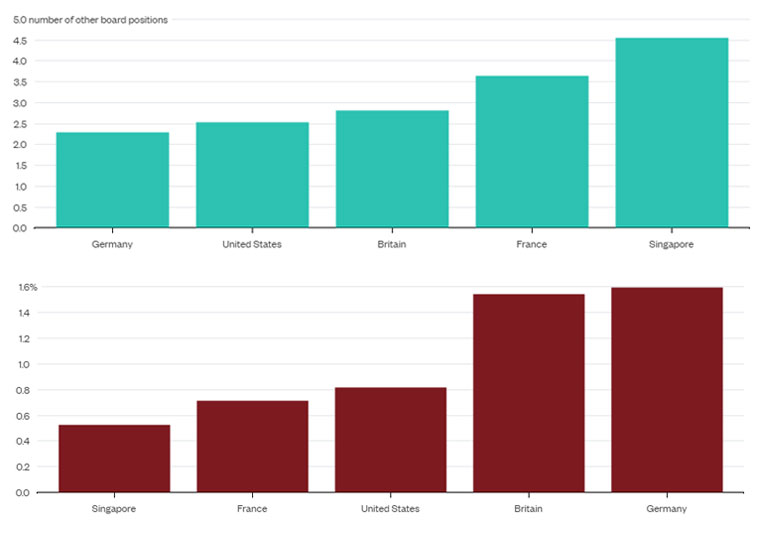 Inverse relationship: The more company directorships held, the lower the return on equity. (Source: Bloomberg)
There is also a gender inequality in boards: Only 9 percent are women in Singapore versus 29 percent in France.
Top photo via reynermedia Flickr
If you like what you read, follow us on Facebook and Twitter to get the latest updates.


If you like what you read, follow us on Facebook, Instagram, Twitter and Telegram to get the latest updates.