News


MINDEF, SAF open 1st solar farm at Sembawang Air Base, plan to roll out solar panels at other camps & bases
The current project serves as a "proof of concept", said Defence Minister Chan Chun Sing.
January 31, 2026, 05:22 PM


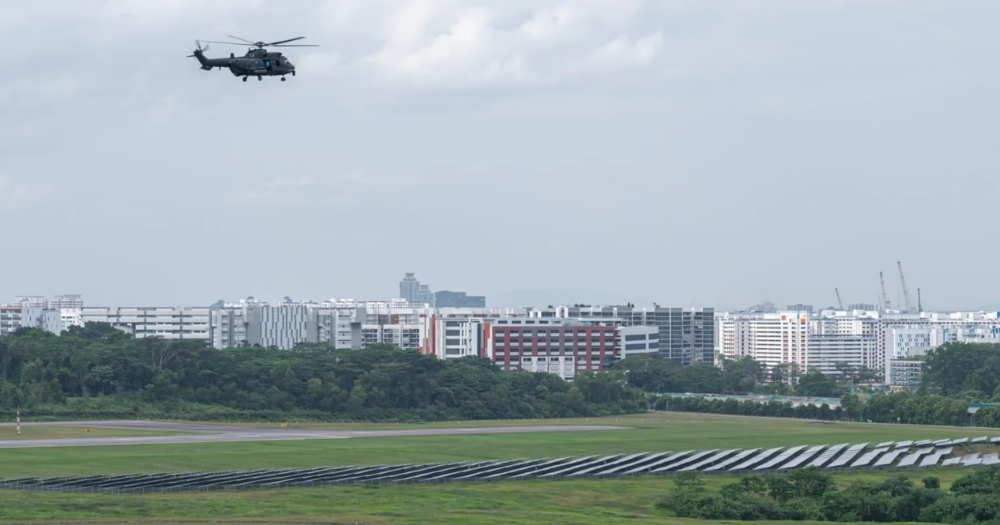
Singapore's first solar farm located within a military base was officially launched at Sembawang Air Base (SBAB) on Jan. 30
The project forms part of "a larger national drive for us to strengthen our energy resilience," said Defence Minister Chan Chun Sing, who officiated the opening.
Plans to continue installing more solar panels
 Photo from MINDEF.
The completion of the solar farm marked the Ministry of Defence's (MINDEF) and Singapore Armed Forces (SAF) successful achievement of their solar target of 50-megawatt peak.
The installation currently comprises 13.5-megawatt peak (MWp) solar photovoltaic (PV) systems deployed on land within SBAB.
MINDEF and SAF also have plans to install a further 4.5MWp of solar PV systems on rooftops of buildings by the end of 2026, bringing the total generation capacity at the base to 18MWp.
This is sufficient to power about 4,700 four-room Housing and Development Board (HDB) flats annually, and is expected to yield cost savings of around S$1.9 million each year.
MINDEF also said it plans to continue rolling out solar panels across other SAF camps and bases, with the aim of generating about 68MWp in solar energy by the end of 2027.
Challenges faced
 Photo from MINDEF.
Speaking at the launch, Chan described energy resilience as Singapore's next major national challenge, highlighting the need for both sustainable energy generation and careful demand management, CNA reported.
The current project serves as a "proof of concept", Chan said, demonstrating that solar panels could potentially be deployed at other airfields or air bases if safety, security and technical challenges are addressed.
He noted while some may argue that solar energy alone will not be able to meet the country's needs, he stressed the importance of diversifying Singapore's energy needs, adding that every effort to strengthen energy resilience counts.
Chan also shared that the idea was conceived a few years ago as the government explored ways to generate more energy while reducing reliance on fossil fuels, with airfields identified as one of the possible sites.
However, concerns such as glare and aviation safety had to be carefully managed.
Extensive studies, including glare and structural analyses, were conducted to ensure pilot safety and account for factors such as helicopter downwash.
Other sustainability initiatives
According to CNA, beyond solar power, Chan said the SAF is redesigning systems to reduce energy demand, improve energy distribution and storage, and adapt operations and training to climate change.
Other sustainability initiatives include the use of eco-asphalt for runway repairs and an automated helicopter wash system that cuts manpower needs by 80 per cent, shortens washing time and cuts water usage by 60 per cent.
Solar light tubes and energy-efficient LED lighting will also cut lighting energy consumption by half.
Top photo from MINDEF