Features


Vietnam President To Lam heads to S'pore for Shangri-La Dialogue; between China & US, where does he stand?
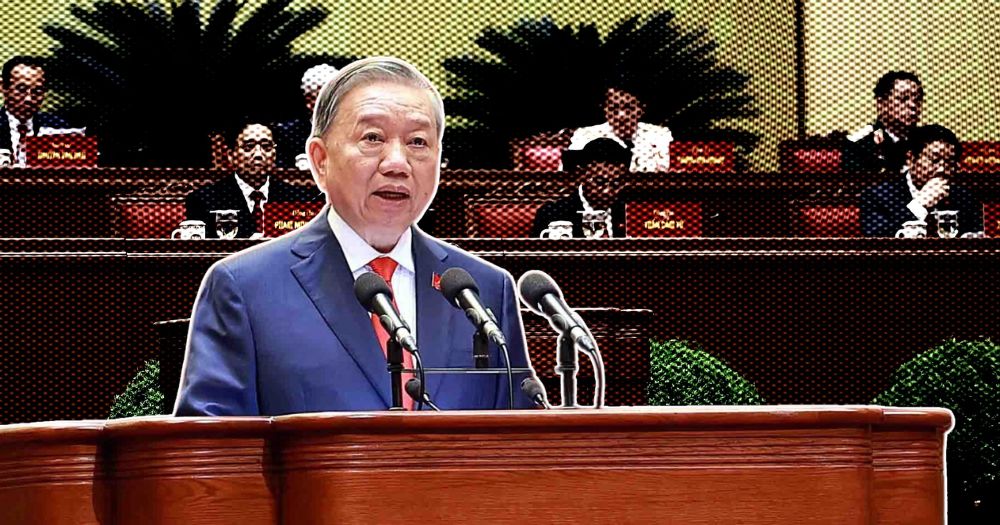
To Lam is Vietnam's president and the General Secretary of its communist party, the first man to hold both roles since Ho Chi Minh.
May 29, 2026, 10:16 AM
Image via AFP


Vietnam’s President and the General Secretary of the Communist Party of Vietnam, To Lam, will be delivering the 2026 Shangri-La Dialogue's keynote speech on the evening of May 29.
Vietnam sits at the crossroads between the U.S. and China and has carefully positioned itself as a key link in both countries' supply chains.
But who is To Lam, what is Vietnam’s strategic position, and how does it affect Singapore and the world at large?
Gold, beef, and salt
Keen observers of regional geopolitics will of course know who To Lam is, but if you’re a more casual observer, there’s still a very good chance that you might have heard of him.
In 2021, there was a wave of internet outrage over a video showing a Vietnamese minister being fed gold-flecked steak by Turkish chef and influencer Salt Bae (yeah, the salt sprinkling guy).
That minister was To Lam, who faced online criticism for what looked like an ostentatious meal that cost more than a minister's salary, taking place amidst a pandemic and an ongoing anti-corruption drive known as "blazing furnace".
We may never fully know how To Lam managed to emerge from the fires largely unscathed, but perhaps his post as Minister of Public Security then may have had something to do with it.
Pillars of eternity
Since then, the 68-year-old leader has gone from strength to strength from a relatively humble start as a police officer.
To Lam was elected as the Communist Party of Vietnam’s General Secretary in 2024, after the unexpected death of the incumbent Nguyen Phu Trong, thus making him the most powerful leader in Vietnam.
He has further consolidated his power this year, when in January he was unanimously elected the State President of Vietnam.
In so doing, he has become the first president to hold both offices permanently since Ho Chi Minh.
Vietnam has traditionally operated a consensus based leadership structure, known as the “four pillars”.
This split power between the General Secretary, the President, the Prime Minister, the Chairman of the National Assembly (think Speaker of Parliament), and the recently added “fifth pillar”: the Permanent Member of the Secretariat (described as the deputy General Secretary).
Man in a hurry
To Lam’s consolidation of the two highest positions of power allows him more or less direct control of Vietnam from within and without.
He has used this power to enact sweeping reforms, cutting the number of administrative regions in the country nearly in half, axing nearly 100,000 civil servants, and encouraging local government leaders to engage with foreign investment.
He is not coy as to what his ultimate goal is, having called the present time an era of national rising.
He aims to bring prosperity and advancement to Vietnam, making the country into a “high-income one". To that end he has instituted policy that is on the one hand pro-business, and on the other hand, reforming Vietnam’s powerful government to be leaner and more centralised.
A New York Times profile published in advance of his visit to the U.S. called him a “man in a hurry” and that his main call was a call to action.
Bamboo diplomacy
This approach is reflected in his approach to foreign policy.
In recent decades, especially in the post-Cold War years, Vietnam’s diplomacy has been described as "bamboo diplomacy", calling to mind the hardy vegetation that is sturdy and strong, and yet flexible.
An article in Fulcrum, published by think-tank ISEAS – Yusof Ishak Institute, describes it as embodying “Flexibility and pragmatism with independence and national interest as its basis".
Effectively, this meant that Vietnam strives to “remain independent and at equidistance from all major powers, maximising gains while hedging against strategic uncertainties.”
Simply put: Vietnam wants strategic autonomy, to maximise its ability to make it own decisions, in its own interests, for as long as it can.
But when China is your neighbour and also the traditional partner in economic prosperity, a country like Vietnam needs to be able to engage with the West as well, in order to ensure it is not boxed in when South China Sea disputes flare again.
While To Lam does not look to entirely discard this approach, he has said that he is seeking to enhance it with what he calls “fenceless diplomacy”, a more assertive and outward facing approach.
Bending bamboo
To this end, he has engaged with the leaders of the great powers, visiting and meeting with Xi Jinping twice since 2024, and once each with Donald Trump, Vladimir Putin, and Narendra Modi.
Vietnam has nearly doubled the number of Comprehensive Strategic Partnerships it has, including countries like Singapore, the U.S., Australia, India, Japan, and South Korea.
But there is undoubtedly irony in the timing, where Vietnam is choosing to turn decidedly towards international trade, at a time when the rules-based order is thought to be breaking down.
One of To Lam’s clearest diplomatic triumphs was negotiating with Trump to reduce Vietnam’s trade tariff down to 20 per cent, but this was only made possible because of Trump’s norm breaking “Liberation Day” tariffs.
Crossroads
Vietnam has also worked hard to position itself at the crossroads of geopolitics.
China’s workers once benefitted from outsourcing as international companies sought to outsource production to lower income countries, and now it does the same with Vietnam.
And as Western nations worry ever more about China’s influence, they seek to “friendshore” critical production, and Vietnam strives to be that friend.
But Vietnam also knows what it means to be in the crossfire of geopolitics, having fought wars with France, the U.S., and also China in successive decades in a bid to ensure that their "bamboo" had sovereign ground to take root.
On Friday, To Lam’s speech will hopefully shed some light on which way the bamboo will bend next.