News

Comment: Fear, reassurance & Asean as the old world order fades
Finding friends in troubled times.
April 10, 2025, 09:59 AM

 "Do not fear."
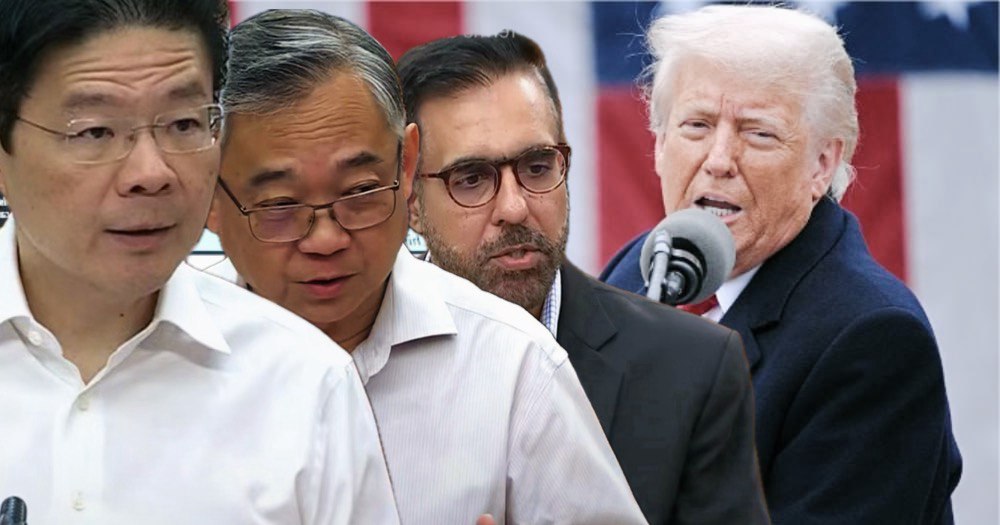
This was one of Prime Minister Lawrence Wong's key points in his Apr. 8, 2025 Ministerial Speech to parliament.
It has been over a week since the Trump administration announced sweeping tariffs on all U.S. trade partners.
Many in Asia were hit with unprecedented tariff rates, and China is now facing a combined 54 per cent tariff, or 104 per cent, depending on how you're counting.
PM Wong was unequivocal: the 10 per cent baseline tariff imposed on Singapore was the lowest possible rate announced by Trump, but was "not the act of a friend".
PM Wong responded to the tariff announcement on Apr. 4 on social media, and on Apr. 8 in parliament, he fleshed out all his previous points in full, unflinching detail.
Re-ordering
On Apr. 4, he said that a seismic change in the global order was coming, and in parliament, he explained what he meant.
Wong admitted that the rules of global trade were flawed.
Still, there were clear avenues and pathways for reform, notably through the World Trade Organization, a system and organisation that the U.S. itself had established, forming the cornerstone of the rules-based order it had spent decades upholding.
What the U.S. was doing was not reform, PM Wong said.
It was a rejection of the very system that the U.S. had created.
It was a re-ordering of the world and once started on, it would be nigh on impossible to recant.
Task Force Tariff
Singapore would need to prepare to steel itself.
On Apr. 4, Wong promised that the government would support workers and businesses through the inevitable tough times ahead.
In parliament, he revealed the formation of a task force to be led by Deputy Prime Minister and Minister for Trade & Industry Gan Kim Yong for that purpose, ensuring that both workers and businesses can adapt to the new reality.
PM Wong had said that Singapore's officials and diplomats would attempt to speak to their U.S. counterparts to lay out Singapore's positions, implying that there would be an attempt to change minds on the tariffs.
That was an ongoing effort, but he was direct and honest about the prospects of bringing any meaningful relief for Singapore: slim to none.
Recently, Trump's trade adviser Peter Navarro claimed Vietnam had offered to cut tariffs on the U.S. to zero, but this was not enough for the Trump Administration.
PM Wong sought to walk the line between rousing people to recognise danger, but not to panic them; to warn but reassure.
Agent: Singapore
For every mention of a potential recession in the offing was a reminder that support measures were already implemented (in the 2025 budget) and that the government stands by to do more if necessary.
But he also took a moment to reiterate the Singapore government's fundamental belief in the value of free and global trade.
Beyond the U.S., there are still opportunities for trade and cooperation in the world.
Singapore would redouble efforts to remain a key node in global economic flows, forging links with like-minded partners.
Without saying it aloud, he reminded Singaporeans of a fundamental point of our foreign policy, that even small countries had agency.
Avoiding the fallout of the Trump tariff trade war was impossible, but Singapore would not just lay down and wait to suffer; it would seek its own fortune.
To this end, Wong took pains to remind Singaporeans that the country's limited means were not limited; it had a strong economy, society, and institutions.
A strong social compact. And reserves.
Choosing Asean
Ironic survey
A not-unnoticed coincidence was that at the same time Trump's tariffs were being announced, the ISEAS Yusof Ishak Institute released its State of Southeast Asia survey report.
The survey had just named the U.S. as Asean's preferred partner of choice should the region be forced to choose between the U.S. and China.
The survey was conducted over the first six weeks of 2025, after Trump had been elected president, but before his March "Liberation Day" revelation.
But the question was based on a fantastic hypothetical situation where a stark choice could be made.
Digging into the survey's participants, drawn from government, academia, and similarly involved parties, as opposed to a survey of Asean's general population, indicated that their course of action was to once again choose neither.
Their preference was overwhelmingly for investing in Asean across the board.
Bloc party
This sentiment must have been a boon to PM Wong as he said that Singapore aimed to strengthen collaboration and integration within Asean.
He spoke to Malaysian Prime Minister Anwar Ibrahim earlier, notable because Malaysia is the 2025 Asean chair, and there would also be a special Asean economic ministers' meeting later in the week.
Asean's ministers would discuss ways the bloc could work together to strengthen intra-Asean trade, signal its commitment to regional economic integration, and strengthen links with like-minded partners.
It was not a statement that Asean could replace the U.S., but a reminder that Singapore is not alone in dealing with the problems in the region.
However, PM Wong was not the only one who saw promise in the prospect of Asean cooperation in the light of Trump's tariffs, and not just within the PAP.
The opposition Workers' Party generally voiced support for the PM's statement, and MP Jamus Lim asked how Singapore could work with its various trade blocs, Asean, RCEP, the CPTPP, to strengthen its negotiating position, pointing out that Asean was the world's fifth largest economy.
Diverse unity
The WP's stance is worth mentioning.
Singapore's foreign policy practitioners take pride in their consistent application of Singapore's foreign policy.
Singapore's politicians rightly pride themselves on the fact that politics in Singapore has traditionally stopped "at the water's edge."
The WP's questions in parliament and statements on social media showed one way that it intended to display unity with the government in foreign policy while still advocating for its traditional policy positions.
In parliament, Leader of the Opposition Pritam Singh said, "Unity in diversity, regardless of race or religion, is Singapore's best response to an unknown future."
Let's not mince words; he means diversity in political approach, too.
The WP released a longer statement on its social media accounts to flesh out its own position.
The WP highlighted points of agreement and unity.
It agreed that Singapore's economy would likely be negatively affected by the tariffs and once again mentioned its belief in more robust worker redundancy protection, to give but one example.
Meanwhile, Leong Mun Wai of the PSP also welcomed PM Wong's message and reiterated that on foreign policy, it supports the national interest.
Politics should just invest in beachfront property
It's unprecedented times, and the line between domestic and foreign policy will thin.
"Water's edge politics" will be a common and delicate feature of Singaporean politics for the foreseeable future
Vital to navigating in the political litorials is the faith that parties are operating in good faith, despite differences in beliefs.
But then, a trading nation with a 300 per cent trade-to-GDP to GDP ratio facing an unprecedented economic threat due to sweeping global tariffs by the U.S. probably isn't that hard an idea of coalesce around.
Related stories
Top image via Afp & MDDI/YouTube