News

Slower growth, fewer jobs but Budget 2025 measures will provide short-term support : PM Wong on US tariffs
Singapore was hit with a 10 per cent tariff, despite an existing free-trade agreement.
April 08, 2025, 02:06 PM
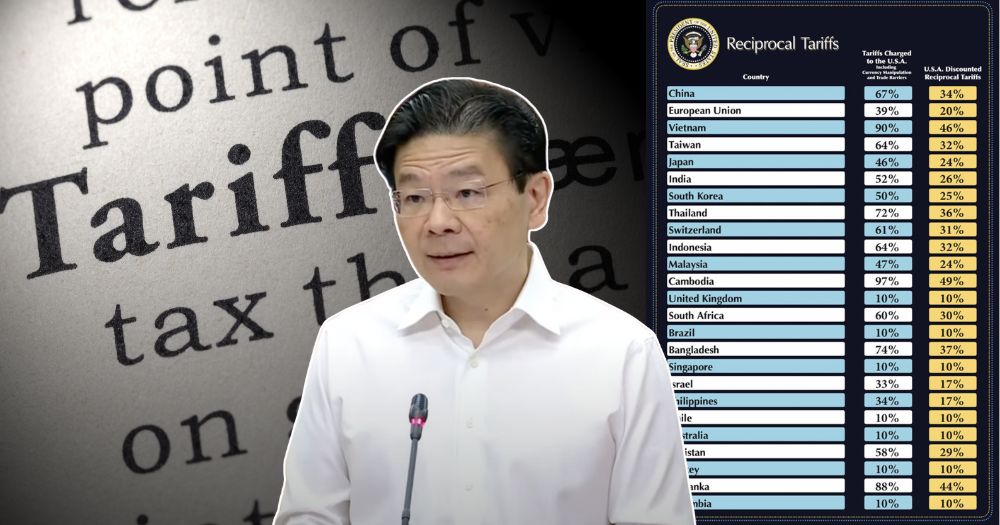


U.S. President Donald Trump announced a slew of tariffs on the country's trading partners on Apr. 2.
Singapore was hit with a 10 per cent tariff, despite an existing free-trade agreement intended to eliminate customs duties on imports from either country.
During a Parliament sitting on Apr. 8, Prime Minister Lawrence Wong made a ministerial statement on the tariffs and spoke about their wider implications on the global trading system and the world economy.
Fundamental rejection of WTO rules
Firstly, the “reciprocal” tariffs are a fundamental rejection of World Trade Organization (WTO) rules, PM Wong said.
He highlighted that one of the cornerstones of the WTO multilateral trading system is the Most Favoured Nation (MFN) principle.
This principle means that "every member must treat all other members equally", PM Wong explained.
"In other words, if a country extends more favourable terms or imposes additional restrictions to one trading partner, it must do the same to all other WTO members," he said.
While there are some exceptions to the MFN principle, it has "long been the bedrock of the multilateral trading system", PM Wong said.
"It ensures a level playing field, prevents discrimination, and enables countries – big or small – to compete fairly in global markets."
Calling the U.S. tariff regime "a complete repudiation of the MFN principle", he said it opens the door to "selective country-by-country trade relationships, based on unilateral preferences".
Smaller countries like Singapore, which have very limited bargaining power in one-on-one bilateral negotiations, will face greater pressure, he added.
"So the major powers will dictate the terms, and we risk being marginalised and sidelined."
Likelihood of a full-blown global trade war
PM Wong also remarked that the likelihood of a "full-blown global trade war" is growing.
While Singapore has decided not to impose retaliatory tariffs, as doing so will only lead to increased costs for Singaporeans, other countries may be guided by other considerations, he said.
He noted that China has already imposed recent retaliatory tariffs on U.S. goods while others, like the European Union, are considering their next steps.
While negotiations to lower the tariff rates may be possible before it takes effect, we have to be "realistic", PM Wong said.
"Once trade barriers go up, they tend to stay up. Rolling them back is much harder, even after the original rationale no longer applies."
Adding that the "uncertainty generated by such a drastic move will dampen global confidence and growth", he explained that it will be difficult to "restore the previous status quo".
He noted that the 10 per cent universal rate of tariffs did not appear to be "open for negotiation".
It seems to be the fixed minimum tariff, regardless of a country’s trade balance or existing trade arrangements, he said.
With other economies like European countries "eager to protect their critical industries", the tariff increases by the U.S. may be the beginning of more increases to come globally, PM Wong noted.
But what does all this mean for Singapore?
In the near term, Singapore can expect weaker global growth, which means external demand for our goods and services will fall, PM Wong said.
Sectors which are "outward-oriented"—like manufacturing, wholesale trade, transport, and finance—will be most impacted, he added.
"Singapore may or may not go into recession this year. But I have no doubt that our growth will be significantly impacted."
While the government had originally projected Gross Domestic Product (GDP) growth of 1 to 3 per cent for 2025, the Ministry of Trade and Industry (MTI) is reassessing the growth forecast and will likely revise it downwards, PM Wong shared.
Slower growth will also mean fewer job opportunities and smaller wage increases for workers, he added.
The impact on employment will be further exacerbated if more companies face difficulties or relocate their operations back to the U.S.
For now, the measures announced in Budget 2025 will provide support for "any short-term strain", PM Wong assured.
Top photos from MDDI/YouTube and Canva