Abroad


No more 'freeloading', China's delegation, war in an AI age: Shangri-La Dialogue 2026 shows why talking still matters
Observations from the 23rd Shangri-La Dialogue.
May 31, 2026, 11:18 PM
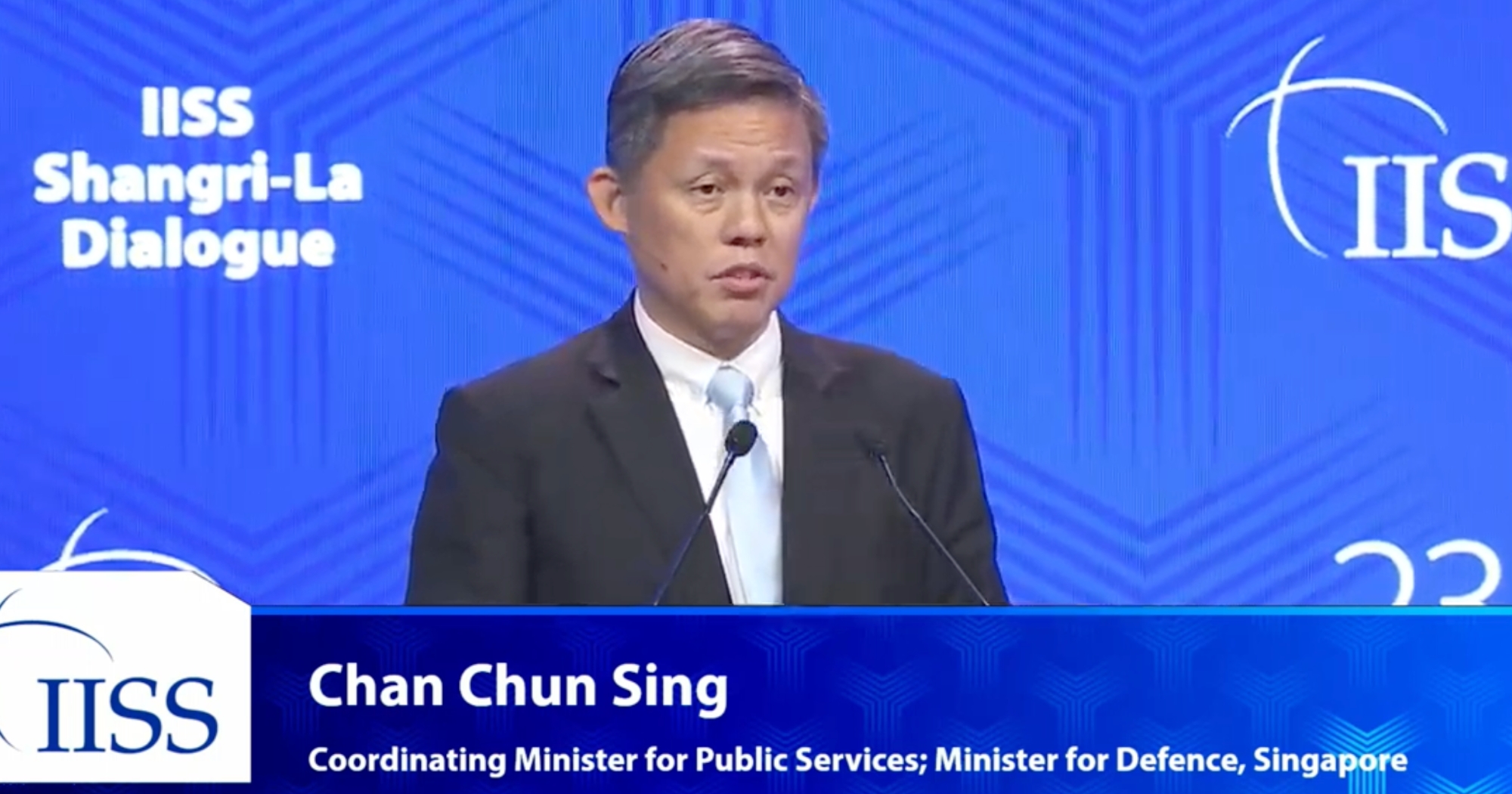
Photo from The International Institute for Strategic Studies' YouTube


The 23rd International Institute for Strategic Studies (IISS) Shangri-La Dialogue (SLD) has now concluded as of May 31, and as usual for this event, it was jam-packed.
The team at Mothership watched almost everything, including the keynote speech, six plenary sessions, and two of the three special sessions.
We watched it so you didn't have to, and here are some key themes of the 2026 SLD:
'Freeloading'
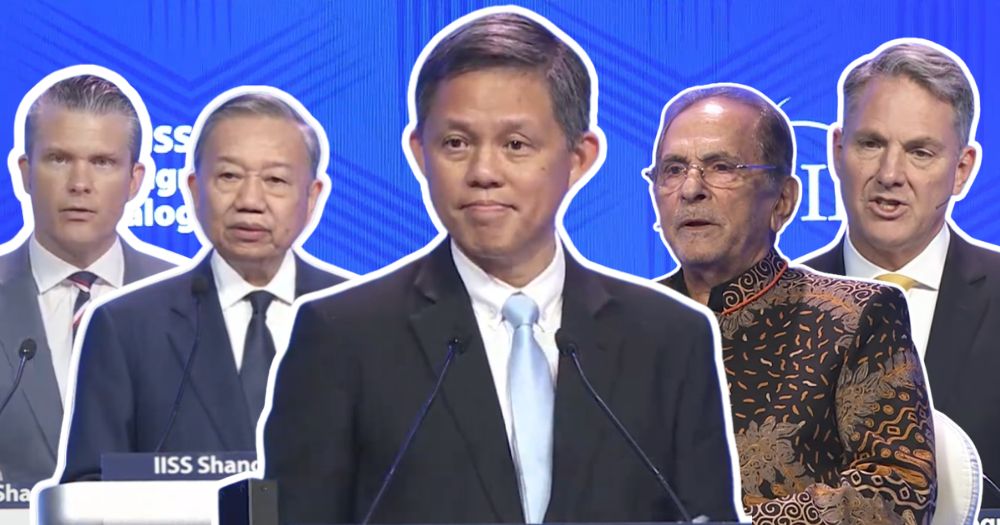
U.S. Secretary of Defense Pete Hegseth spoke on the morning of May 30 and was very clear about what he expected of U.S. allies in terms of defence spending: 3.5 per cent of GDP.
Anything else was considered free-riding, or freeloading, on the American taxpayer.
Hegseth complemented Asian allies, highlighting South Korea, the Philippines, Japan, Australia, Singapore, Indonesia, Malaysia, Vietnam, Thailand, and India, for working with the U.S. where their interests aligned, and for strengthening their military capabilities, notably with U.S. technologies.
He did not mention Taiwan, which had recently approved a US$14 billion (S$17.9 billion) arms purchase from the U.S., only for it to be held up ostensibly because of the war on Iran, but feared it could be used as a "bargaining chip" between the U.S. and China.
The U.S. was making similar “generational investments” in their own production capability and military capability, Hegseth claimed.
When asked about New Zealand, which was doubling defence spending from 1 to 2 per cent of GDP, he said he had nothing against the country, but “only 2 per cent” was “freeloading.”
The benefits of being a so-called model ally would mean that these countries would be moved to the front of the line for expedited arms sales, deep industrial-based collaboration, and expanded intelligence sharing; indolent allies would face the consequences of changing U.S. priorities.
Hegseth justified this by saying that a “practical, interest-driven model of partnership was not a cynical compromise, but instead the most realistic and reliable foundation for enduring peace in the Pacific.”
Undersea cables
Australian Defence Minister Richard Marles had a very clear idea of what he came to SLD to say, providing a lengthy, dense, but unusually detailed speech on May 30, especially regarding Australia’s Critical Underwater Infrastructure (CUI), undersea cables and the like.
Marles pointed out that since 2024, there have been numerous occasions where critical undersea cables have been cut, often by ships dragging their anchors across the seabed, notably in the Baltic Sea and in the Taiwan Strait, clearly implying the incidents were less-than-accidental.
A mere 15 undersea cables connected Australia with their security allies and the global economy, and their security was of paramount importance.
But Marles didn't merely come to SLD to talk about those concerns; he took the opportunity to actually do something about it on the sidelines of the dialogue.
Australia joined 17 countries, including Singapore, to launch the voluntary Guiding Principles for Underwater Infrastructure Defence Exchanges (GUIDE), a framework for them to cooperate to enhance the security of their CUI.
The second thing was to re-ignite the AUKUS alliance with the U.S. and UK.
Together with Pete Hegseth and UK Defence Secretary John Healey, Marles announced a new AUKUS project to develop unmanned undersea vehicles for the purpose of defending such CUI.
These gatherings highlight growing concerns about CUI that have clearly grown since 2025, when it was mentioned but not nearly as often as this year.
Sidelines
Fundamentally, it was these kinds of gatherings that underpin the utility of the SLD.
It is the opportunity for defence ministers like Marles to go from the 17-nation gathering to his three-nation alliance meeting on the same day.
It's the opportunity for Minister for Defence Chan Chun Sing to host not just one but two different lunches with over 15 defence ministers each, allowing them to speak candidly about regional concerns.
And as was noted by IISS's Director-General Bastian Giegerich, there were hundreds of delegates from over 46 nations that were present at the SLD.
Each of them gains the opportunity to speak with their counterparts and build valuable contacts, not to mention vital, incidental, informal meetings.
China: everywhere all at once
One contact that was high on everyone's priority list but ultimately unattainable was that of China's Minister of National Defense, Dong Jun.
Dong failed to make an appearance for the second year in a row, leading some in the media to characterise the Chinese delegation as "low-level", a characterisation that Chan bristled at, suggesting that it was unfair to do so.
While there wasn't a dedicated session for China as there had been in previous years, Chinese representatives sat on the panels of two of the three special sessions, and their delegates made their presence felt with questions and exchanges throughout the weekend.
Sometimes their contributions were biting, as when one delegate pointedly asked Japan Defence Minister Shinjiro Koizumi about Japanese Second World War war crimes.
And it should be noted they were not the only ones with biting comments; for example Malaysian defence minister Mohamed Khaled bin Nordin had choice words about Norway's approach to missile sales.
Norwegian defence minister Tore O. Sandvik has since apologised for his government’s decision to cancel the export licence at the sidelines of the meeting with the Malaysian defence minister.
Of course, AI
And it wouldn't be 2026 if you could escape the topic of artificial intelligence, which has now fully enmeshed itself in the strategic considerations of international militaries.
The conference itself is sponsored in part in 2026 by Helsing, a German military AI firm, and in 2024 and 2025 was sponsored in part by Palantir, an American military AI firm.
It is no exaggeration to say that AI preoccupied the minds of participants at every session from Vietnam's President To Lam's keynote speech, the special address of Timor-Leste President Jose Ramos-Horta, and at almost every other plenary session and special session, with the somewhat ironic exception of Pete Hegseth’s address.
If you are so inclined, consider watching the first breakout session, "Managing Threats to Strategic Stability," which was not explicitly AI-centric but where the participants spoke at length about the present-day impact of AI.
People’s Liberation Army general Meng Xiangqing gave his analysis of the first days of the ongoing Iran war, saying that the U.S. and Israel had used AI to select more than a thousand targets.
He warned that it might improve the effectiveness of the militaries involved, but could also potentially lead the war in an uncontrolled direction.
Commander of Pakistan's Rocket Force Nauman Zakria picked up from where Meng left off, warning that AI cut decision-making time severely, introducing more uncertainty to conflicts and increasing the number of situations where people would react irrationally.
Zakria was involved in a shooting war with India in 2025 and brought a certain level of first-hand experience to the discussion.
Humans
The president of the International Committee of the Red Cross (ICRC), Mirjana Spoljaric, spoke briefly about the impact of AI on the ICRC's work, saying the loss of life and destruction levels were higher than ever in the 90 conflicts the ICRC was active in.
Communication and coordination for the security of humanitarian workers and civilians were more difficult than ever, in no small part due to uncertainty as to where decision makers were.
(In fact, it is worth watching that session for Spoljaric's sharing alone, because in a forum heavily focused on military and government approaches, she gave a distinctly different civilian-based interpretation which was world-weary and heartbreaking.)
Nushirwan bin Zainal Abidin from Malaysia's National Security Council compared the current implementation of AI with that of international telecommunication standards at the turn of the millennium.
Telecom standards eventually converged, and it was logical and obvious that AI standards had to do the same, but Nushirwan lamented that such convergence was unlikely anytime soon.
"Humans," he said, "are stupid in that way."