News


Refreshed NS medical classification system will allow 1,200 NSFs to take up previously ineligible roles
Instead of a single Physical Employment Standard (PES) status, these enlistees will get more detailed results indicating their medical fitness and exemptions.
April 13, 2026, 03:00 PM


From late-2027, those enlisting for the Singapore Armed Forces (SAF) and the Home Team (HT) will be medically graded under a refreshed classification system.
This means medical screening under the refreshed scheme will commence from end-June 2026.
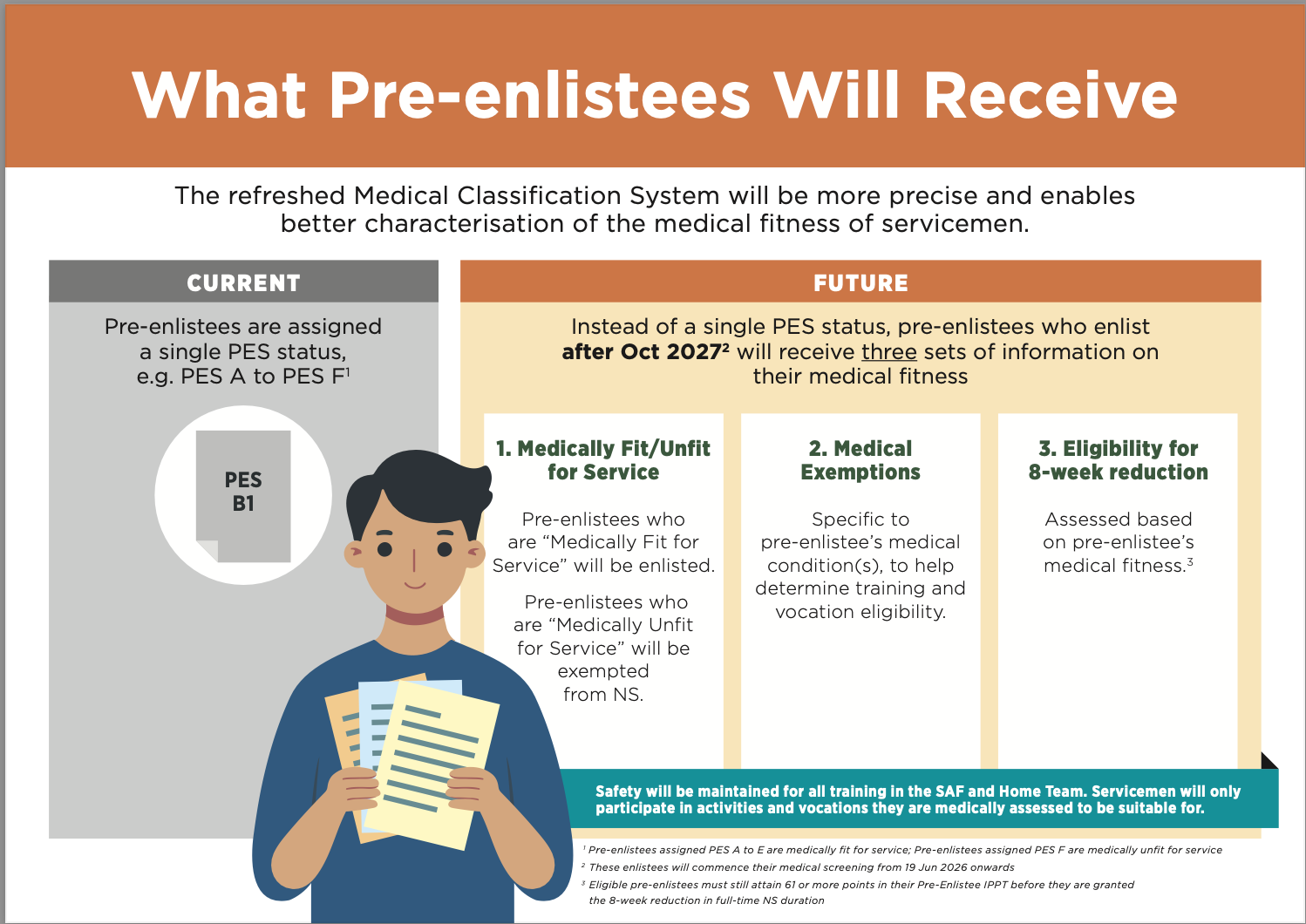
Instead of a single, broad Physical Employment Standard (PES) status, pre-enlistees will receive three sets of medical fitness results following their screening.
These results will determine their eligibility for various training activities and vocations during their national service (NS), the Ministry of Defence (MINDEF) and the Ministry of Home Affairs (MHA) said in a joint release on Apr. 13.
Medical fitness for service & 8-week reduction
Under the refreshed Medical Classification System (MCS), pre-enlistees will be assessed to be either "Medically Fit for Service" or "Medically Unfit for Service".
Those deemed fit will be enlisted to serve national service (NS), while those deemed unfit will be exempted from NS.
Additionally, the medical results will include the pre-enlistee's eligibility for an eight-week reduction in his full-time NS duration, based on his medical fitness.
Those eligible must still attain 61 points or more in their pre-enlistee IPPT to be granted the reduction.
Here's how the refreshed system works, compared to the current one.
Medical exemptions
The medical results will also indicate the pre-enlistees' specific medical exemptions, assessed based on their medical condition, and in line with their functional abilities.
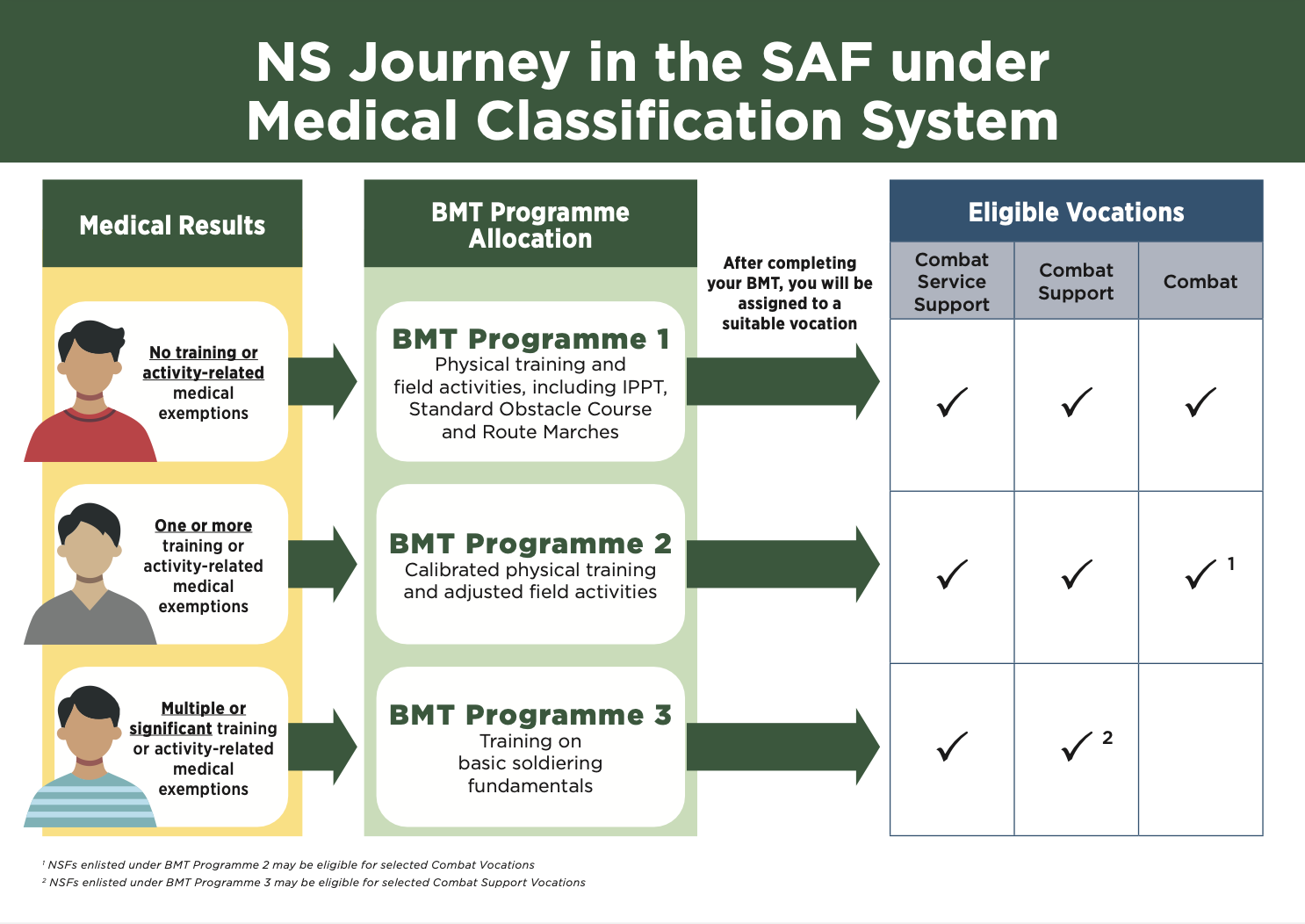
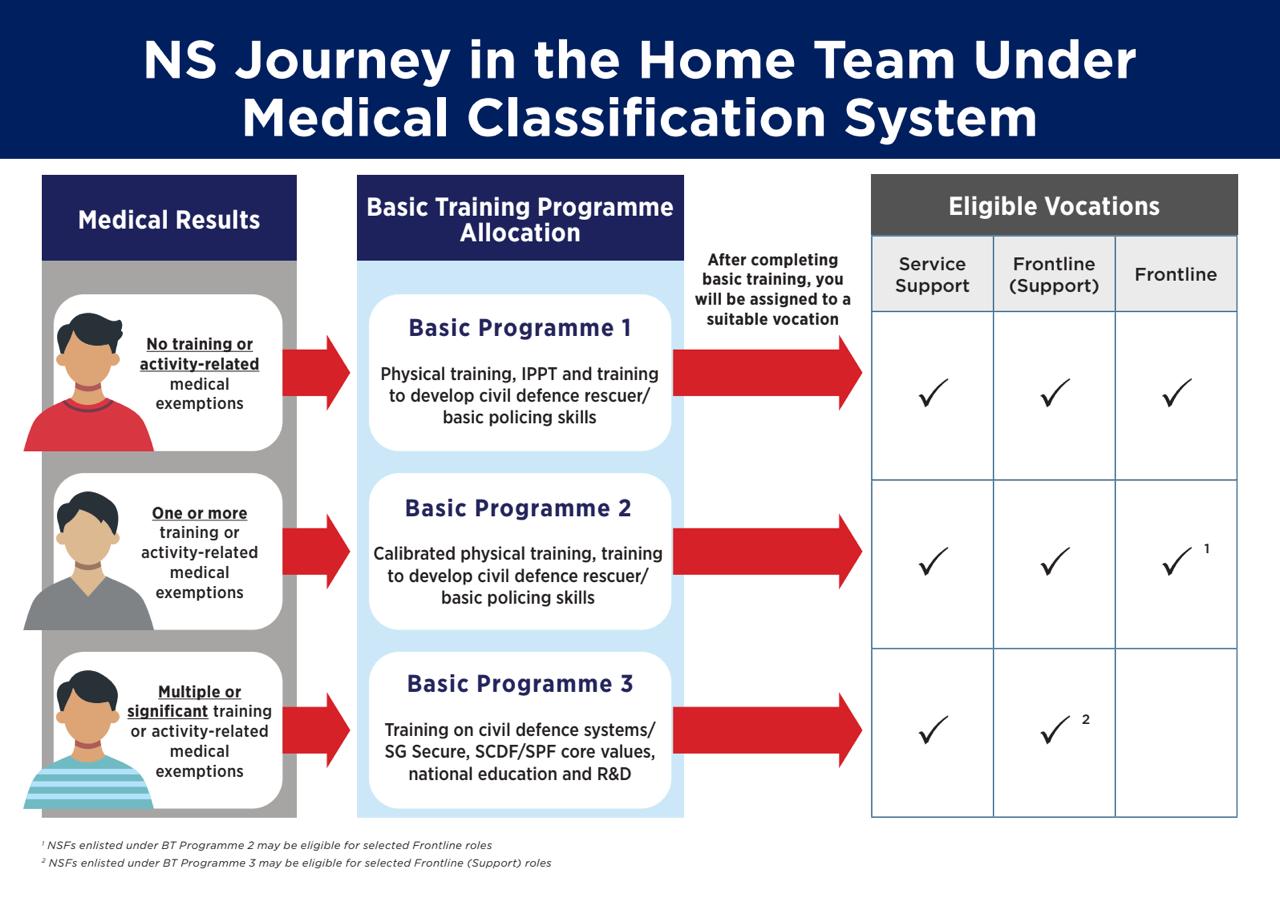
Whether they have exemptions, and how many, will determine which training programme they get assigned to at the SAF, the Singapore Civil Defence Force (SCDF), or the Singapore Police Force (SPF).
For example, at the SAF, a person with no training or activity-related medical exemptions will undergo a 17-week programme with activities such as the Individual Physical Proficiency Test (IPPT), standard obstacle course, route marches, and field training.
He would also be eligible for all vocations.
For someone with one or more such medical exemptions, however, the SAF programme will be shortened to nine weeks, with adjusted physical training and field activities.
He would be eligible for all combat support and combat service support roles, but only selected combat roles.
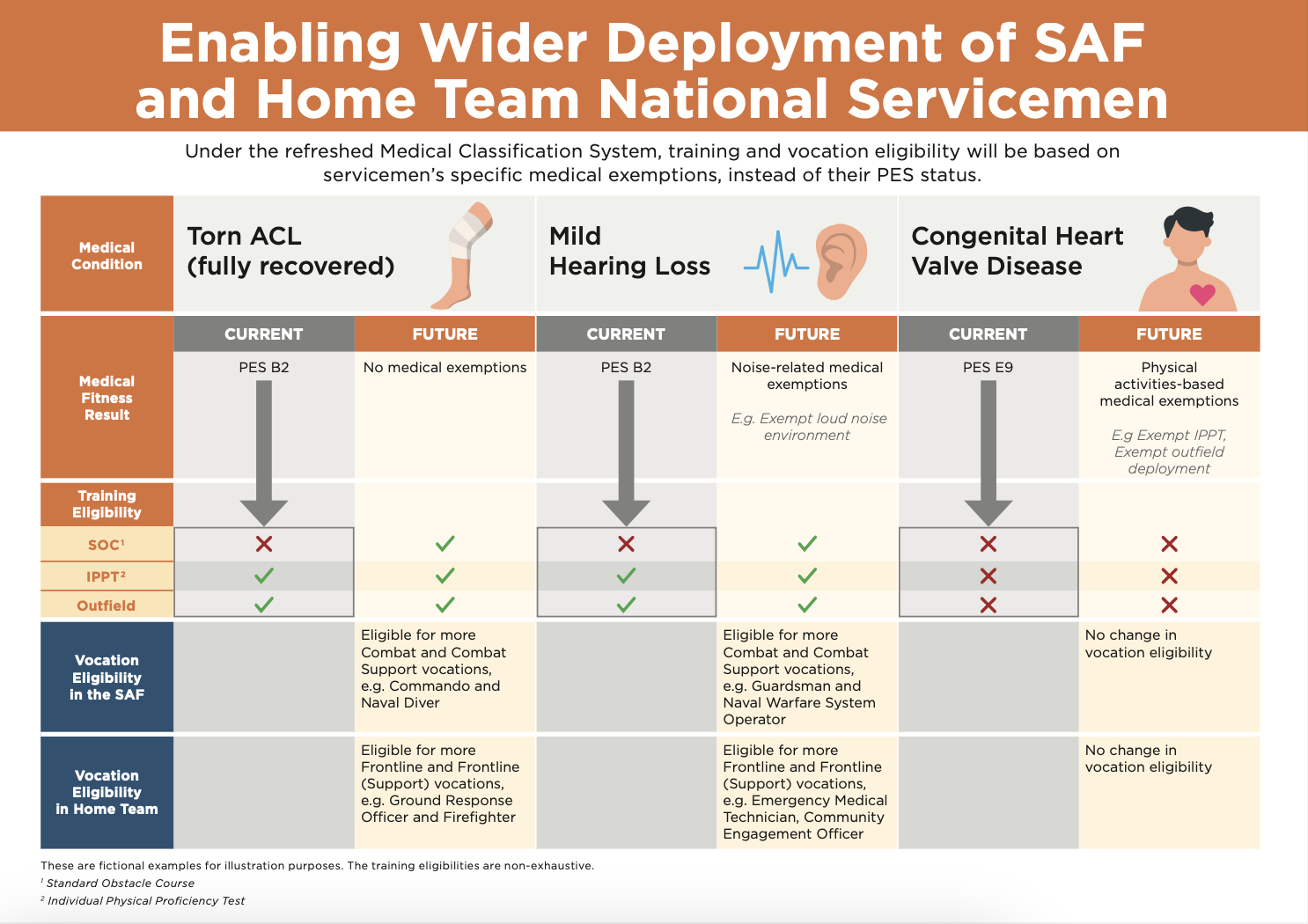
Another example is how an NSF with a seafood or peanut allergy that is currently given PES C, under this refreshed classification, will be more precise in classification, allowing him to enter vocations previously ineligible for.
Here are some infographics from the statement to illustrate the point.
Who will be affected?
The refreshed MCS will take effect for people enlisting at the SAF from October 2027 onwards and at the HT from November 2027 onwards.
Medical screening for these pre-enlistees will commence from the end of June 2026.
They can view their results on OneNS roughly two months after their medical screening appointment.
As for existing full-time National Servicemen (NSFs) and NSmen, they will retain their PES status, barring any changes in their personal medical conditions.
The PES status remains safe and effective to determine training and deployment eligibility for the rest of their time in NS, MINDEF and MHA said.
While pre-enlistees are the first priority in rolling out the refreshed MCS, NS Regulars will also transition to the system from 2028, the two ministries added during a media briefing.
Better matched to roles
This comes after a review by MINDEF in consultation with public medical specialists and specialist advisory boards.
Many pre-enlistees have submitted appeals to review their PES status before their NS enlistment, with three out of four appeals in 2025 being requests for upgrades.
The refreshed system will enable a more precise characterisation of servicemen's medical fitness, so that they can be better matched to roles they can perform safely and effectively.
Operational needs and roles have evolved
The MCS has been revamped to align with the evolving operational needs of the SAF and HT.
The two organisations now have a greater variety of roles, and many new roles do not depend solely on traditional definitions of physical fitness.
The refreshed MCS will thus enable the SAF and HT to move away from the traditional binary classification of "combat fit" and "non-combat fit" that has become less relevant today, MINDEF and MHA told the media.
Technological advancements have also enabled the redesigning of roles.
For instance, the automated loading system for the HIMARS platform means soldiers no longer need to manually carry and load rounds.
Under the refreshed system, about 1,200 servicemen will get opportunities to be deployed to vocations and roles they would have previously been ineligible for.
Safety remains a top priority, and commanders and trainers will get clear guidelines on the medical exemptions and what activities servicemen can and cannot perform.
Top image from Basic Military Training Centre's Facebook