News


No fuel rationing in S’pore unlike other countries, but no one knows how long disruptions will last: Shanmugam
He said that even if Singapore has not needed fuel rationing, global oil and gas export capacity will not return to pre-conflict levels so quickly.
April 07, 2026, 02:39 PM


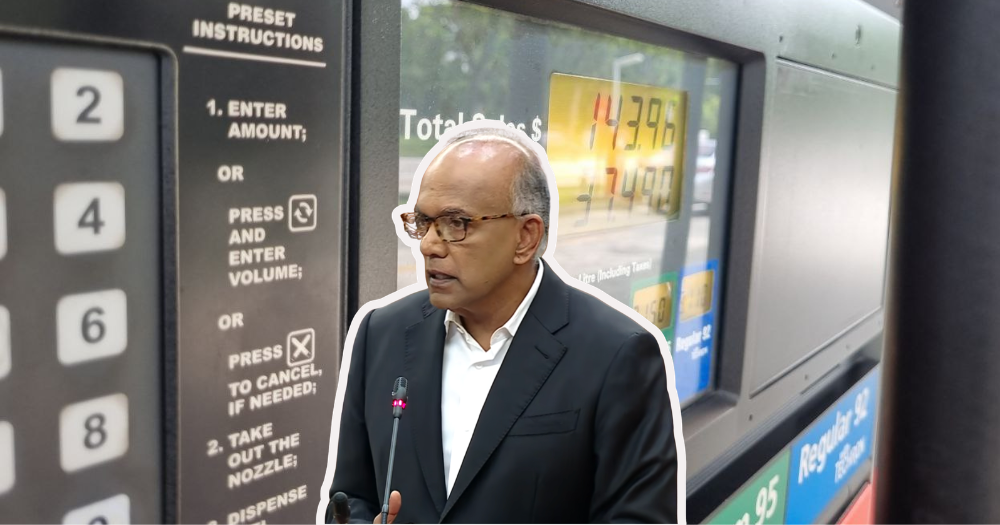
Fuel prices are likely to remain high even if hostilities in the Middle East cease immediately, said Coordinating Minister for National Security and Minister for Home Affairs K. Shanmugam in Parliament on Apr. 7 on the impact of the Middle East situation on Singapore.
He added that damage to key energy infrastructure in the region would take time to repair:
“Even if the Strait of Hormuz fully reopens tomorrow, global oil and gas export capacity will not return to pre-conflict levels quickly.”
Shanmugam was speaking as part of a series of ministerial statements in Parliament responding to concerns over how the conflict could affect Singapore’s fuel, electricity, food supplies and broader resilience.
His remarks come amid rising concern over the knock-on effects of the conflict on daily costs in Singapore, after fuel prices rose sharply and the government warned that electricity tariffs could climb further in the coming months.
No need for fuel rationing so far
Shanmugam said that although several countries have announced fuel export restrictions or introduced rationing measures since the conflict began, Singapore has not needed to take such steps.
“So far, there has been no need to do so,” he assured.
He attributed this to Singapore’s long-built position in global energy markets.
Singapore is “the world’s 3rd-largest oil trading hub” and “6th-largest refinery export hub”, he said, adding that these capabilities were built up over decades through a deliberate long-term strategy.
Today, these underpin Singapore’s fuel resilience, because they give the country access to diverse sources of energy and fuel supplies, allowing it "to respond to disruptions more flexibly".
Singapore has been meeting its domestic needs and international obligations for fuels. However, no one knows how long the disruptions will last, and Singaporeans need to brace ourselves for a "bumpy ride" ahead.
Alternative crude oil secured
Shanmugam confirmed that Singapore has secured crude oil supplies from alternative sources.
“But we have to pay prevailing prices, which are much higher,” he warned.
He noted that Brent crude surged by as much as 70 per cent since hostilities intensified on Feb. 28, with fuel prices at one point increasing from US$71 (S$91) per barrel just before the conflict to a peak of US$141 (S$182).
“Singaporeans are feeling the impact in higher prices as fuel and energy costs rise."
This comes after Shanmugam had earlier said fuel and food prices in Singapore would rise because disruptions to oil and gas supply also push up fertiliser, transport and logistics costs.
Electricity prices could rise more sharply
Shanmugam said Singapore has taken steps to reduce electricity supply risks by diversifying liquefied natural gas imports.
Apart from Qatar, Singapore also imports LNG from Australia, the United States and Mozambique.
He added that GasCo, set up last year to centralise gas procurement for the power sector, has begun buying replacement natural gas to replace disrupted Qatari supplies.
Singapore’s power plants can also switch from natural gas to diesel when needed, while fuel reserves remain in place, he said. Singapore has so far not tapped on its reserves, or needed to resort to fuel rationing.
Still, he cautioned: “If the conflict is prolonged, then we have to expect much sharper increases in electricity prices."
His remarks follow the Energy Market Authority’s Mar. 31 announcement that electricity and town gas tariffs are expected to rise further in subsequent quarters because recent fuel cost spikes have not yet fully flowed through into regulated tariffs.
Deputy Prime Minister Gan Kim Yong made the same point in his own ministerial statement earlier in the day.
Singapore's strategic situation as a refinery hub
Singapore, as a major refining centre, was asked by countries whether we could still supply them with refined fuel products when the crisis hit.
Shanmugam made the point that a mutual interdependence exists, as Singapore is supplied with crude oil and other essential products, while in turn supplying refined fuel products to other countries.
"It keeps Singapore relevant in the international energy trade, and this has enabled us to have continued access to crude oil."
While Singapore remains committed to a green transition, the priority worldwide right now is energy security.
"Countries everywhere need to keep the lights on. Fossil fuel remains part of the global energy mix because renewable energy is not yet able to meet all of the demand."
In this context, Singapore will continue to play its role as a refinery hub, while seeking to diversify its sources of energy.
This includes solar and even nuclear energy, although the latter requires very serious consideration and studied very carefully to ensure it is safe for deployment.
Crisis committee monitoring broader risks
Earlier in his statement, Shanmugam also noted that the Homefront Crisis Ministerial Committee (HCMC), which was activated shortly after hostilities began, has been looking at energy resilience, food supply chains, security developments, support measures and diplomatic relations.
The 13-member committee was formalised after the SARS outbreak and is chaired by the Minister for Home Affairs, with Deputy Prime Minister Gan Kim Yong serving as adviser.
Top images via Mothership, MDDI/YouTube