Environment

NEA to expand Project Wolbachia to 4 new areas including Geylang & Pasir Ris
With the expansion, Wolbachia coverage in Singapore will increase to about 740,000 households.
January 09, 2026, 03:37 PM


The National Environment Agency (NEA) will be expanding Project Wolbachia to help curb the spread of dengue transmitted by Aedes aegypti mosquitoes, Senior Minister of State for Sustainability and the Environment, Janil Puthucheary, announced on Jan. 9.
Four new areas
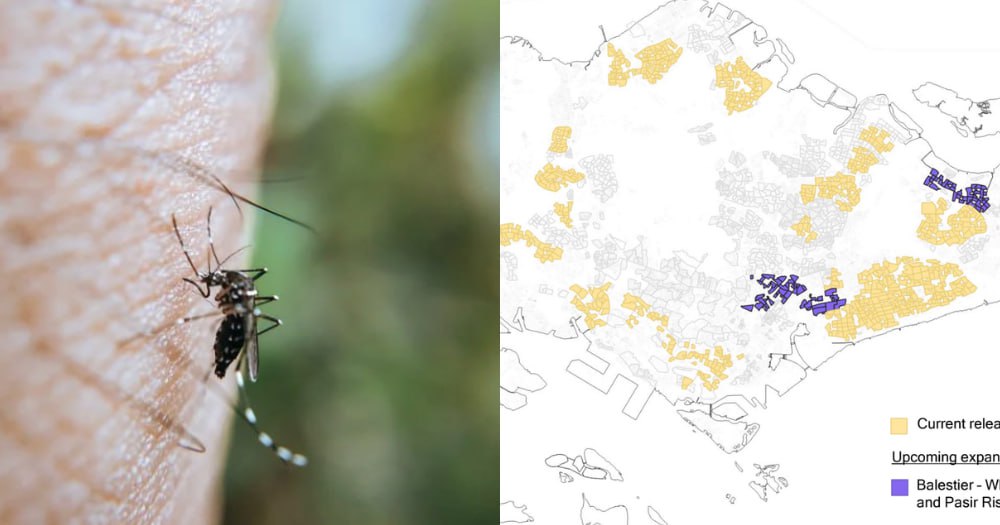
The project will be expanded to Balestier-Whampoa, Geylang, Moulmein-Dorset, and Pasir Ris from the end of January to March 2026.
Releases at Balestier-Whampoa, Geylang, and Moulmein-Dorset are expected to be conducted twice a week at each site, typically in the mornings.
The release schedule for Pasir Ris will be provided closer to the release date.
With the expansion, Wolbachia coverage in Singapore will increase to about 740,000 households.
This puts the country on track to reach 800,000 households, or about half of all households nationwide, by the end of 2026.
 Overall map of Project Wolbachia coverage Q1 2026. Photo via NEA.
Public urged to continue practising B-L-O-C-K steps
In a media release on Jan. 9, NEA highlighted the importance of continuing to practice the B-L-O-C-K steps to eliminate stagnant water and prevent mosquito breeding.
"Wolbachia-Aedes suppression technology represents a powerful tool in our fight against dengue, designed to work alongside - not replace - proven source reduction efforts," the agency said, adding that community effort remains crucial.
The B-L-O-C-K steps include:
- Break up hardened soil
- Lift and empty flowerpot plates
- Overturn pails and wipe their rims
- Change water in vases
- Keep roof gutters clear and place BTI insecticide inside
Project Wolbachia has achieved over 70 per cent reduction in dengue risk so far
Project Wolbachia involves releasing male Aedes aegypti mosquitoes carrying the Wolbachia bacteria.
When these male mosquitoes mate with female Aedes aegypti mosquitoes that do not carry Wolbachia, the resulting eggs do not hatch — a biological phenomenon known as cytoplasmic incompatibility.
Over time, continued release is expected to help reduce the urban Aedes aegypti mosquito population and lower the risk of dengue transmission.
According to NEA, the project has achieved over 70 per cent reduction in dengue risk and 80 to 90 per cent reduction in mosquito populations across multiple sites.
Residents living in adjacent areas were also found to be 45 per cent less likely to contract dengue as compared to areas without Wolbachia releases.
Top photos via Canva and NEA