Interviews

SCDF team leader in Myanmar gives update on search ops, team morale & rescue doggos
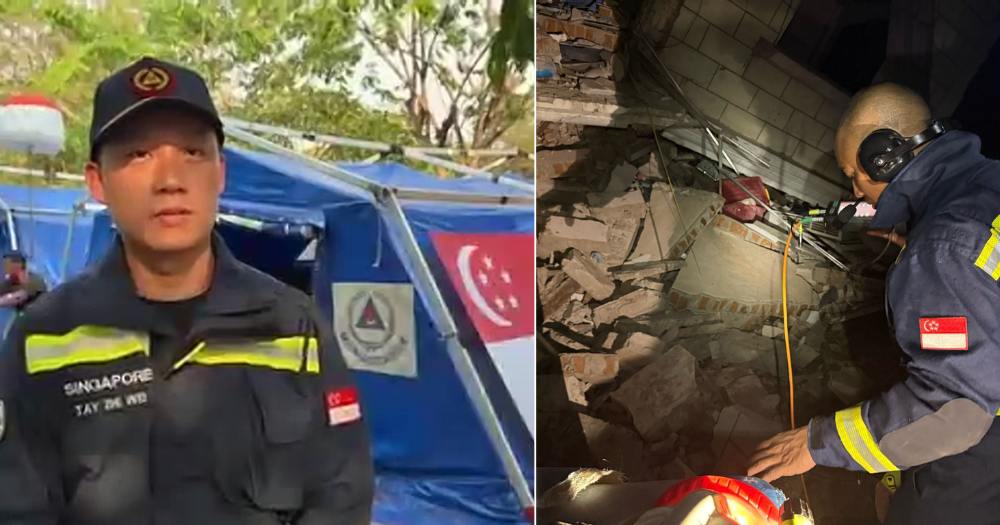
Colonel Tay Zhi Wei, who is leading the Operation Lionheart contingent in Myanmar, gave us an update.
April 01, 2025, 08:06 PM


It's been four days since an 80-member Singapore Civil Defence Force (SCDF) team, including rescuers and search dogs, was deployed to Myanmar in response to a request for humanitarian assistance.
Fatalities from a 7.7 magnitude earthquake, which hit Myanmar on Mar. 28, have reportedly topped 2,000 as of Apr. 1.
Singapore's Operation Lionheart contingent was thrown into action on Mar. 30, with an 8-hour joint rescue operation for a man trapped in a semi-collapsed building in Naypidaw, Myanmar's capital, in collaboration with the local fire department.
Speaking to reporters over a video-call from Naypyidaw, Colonel Tay Zhi Wei, who leads the contingent, addressed questions from the media on how the operation is going so far.

What's the latest update on Operation Lionheart?
Actually, we were one of the first teams to reach Myanmar. We were deployed to Naypidaw, and since arriving here, we have been working non stop.
In fact, at our second site, three to four hours into our operation, we managed to find a site with a casualty, and managed to save a life.
As of Day 4, we have completed 13 sites, and saved one casualty. We have detected, unfortunately, several bodies which we reported to the authorities.
What did you first see when you landed in Naypidaw?
When we first landed at Naypidaw, the airport condition was a bit better than I expected, because we had heard that the airport wasn't working, so I initially thought we couldn't land at all.
We also saw an air traffic tower that had collapsed, which coincidentally, was the area that we went today (Day 4).
Many of the buildings had collapsed in such a way that the first storey had completely given way.
Our initial thoughts were that, if this is the type of collapse that we are dealing with, then we will have a very hard time rescuing casualties.
Tell us more about the 8-hour rescue operation on Mar. 30.
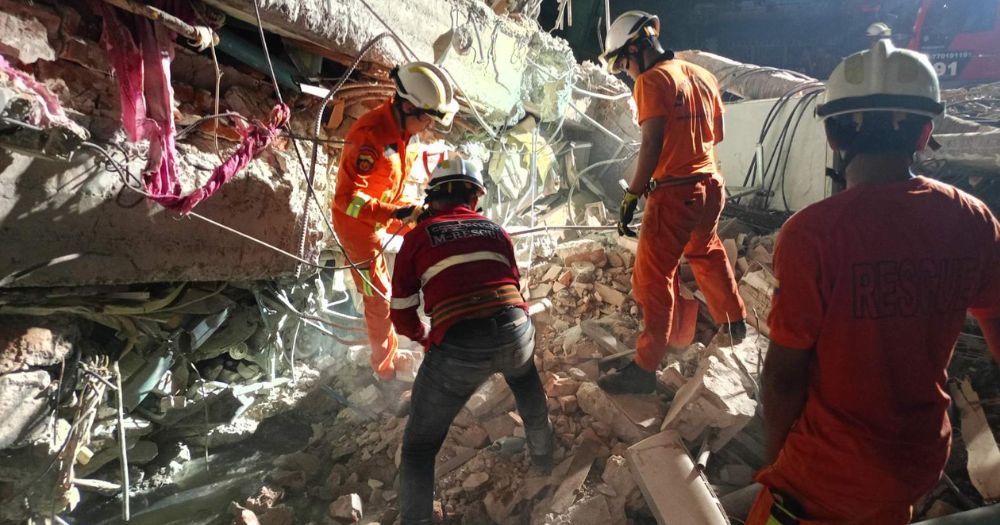
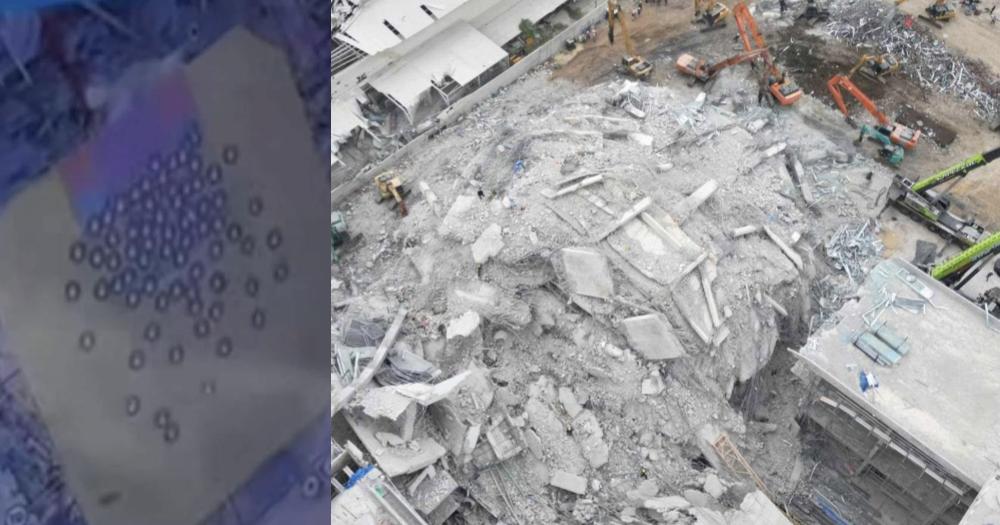
It was the second site we were brought to that day by the fire department, one where they had started work for quite a while, but had difficulty extricating a casualty trapped under a collapsed building.
 Image from SCDF
When we first arrived, we called out to the casualty, and to our surprise, he was able to respond.
We entered a small void in between two buildings and reached a concrete slab that the fire department had made a small breach in. That's how we could hear the person's voice.
 Image from SCDF
He was in a precarious position. We tried to expand the hole but realised it would have affected the integrity of the rubble in the area.
So we used some of our battery operated tools and were able to breach a second hole to access the casualty.
After an eight-hour operation, we were able to get him out with very minor injuries.
Our paramedics found that he suffered bruises on his leg, and the fire department took over the medical treatment and sent him to hospital.
What emotions did your team feel during the rescue operation?
When we first saw him, we knew it would be an arduous task.
But when there are casualties to be saved, we will definitely not let them down, and we will not give up.
We were mobilised in Singapore at 3am on Saturday (Mar. 29) morning, so this was more than 24 hours since then.
Two sections from our contingent started work on the casualty at about 12 plus to 1am.
At about 3am, we deployed two new sections — a fresh crew — to take over.
So it was really a team effort between the fire service department and four sections of our guys to extricate him.
I think that really gave us a boost, because after the first site that day, we were thinking it would be a very difficult search and rescue operation.
The rescue encouraged us that there are more lives that we can save here.
48 of 80 SCDF officers in the contingent are Muslim. How did they celebrate Hari Raya Puasa?
Hari Raya was a busy day for us.
Our Muslim brothers started with Aidilfitri prayers in the morning, and then we had our operations brief on the areas that we would be going to.
We visited four sites in residential areas and subsequently went to a hospital for rescue operations.
At the hospitals, we searched places that would collapse, including upper levels of the hospital and lift shafts.
It was nightfall before we returned back to base.
We concluded by playing a recorded message from our HQ during our debrief, along with some Hari Raya messages from our POH (political office holders).
That's how we spent our Hari Raya.
What are the biggest challenges you faced in the operation?
One of the immediate challenges was that there was no communications signal.
This is to be expected of a disaster site, but it made [our mission] more challenging as we needed time to set up our infrastructure at base so we would have reception.
These included our satellite dish, Broadband Global Area Network (BGAN), and other facilities.
But upon arrival, the fire service requested us to start work immediately, so during the first few sites we responded to, we had difficulties communicating with our base camp.
Another challenge that we faced is that the weather here is extremely hot.
It is 41°C, so we have to implement certain work-rest cycles and hydrate ourselves very frequently in order to keep ourselves going during prolonged operations.
We've seen many of the rescue canines in operation. How are they doing?
The rescue canines are a very important part of our team, and have been deployed for every mission.
We have four dogs and generally deploy them in pairs.
Of course, we take care of our dogs fairly well.
Whenever we travel, if we have a air-conditioned vehicle, we will let the dogs stay inside.
We also hydrate the dogs frequently, and our resupplies will contain all the dogs' kibbles, food and everything else they need.
As it is extremely hot, we also implemented a work-rest cycle for the dogs.
Given the operation is expected to last up to 14 days, what happens next?
What we understand from the local fire service department is that they there are still several sites to be verified, and they will let us know which sides require our help.
Then, we will deploy our teams there to ensure that there are no more live casualties before they commence with other phases of the operation.
When we responded to the collapsed air traffic tower incident today, they were about to start their demolition, but wanted us to confirm if there were any casualties to be rescued first.
So we deployed our two dogs and they were able to find the locations of two deceased victims, with one within the site.
We offered the local team advice from our engineers on how they could remove the dead bodies safely.
This morning, the fire service also alerted us to a case where a 60-year-old lady was trapped and requested our assistance to extricate her.
Fortunately, when we reached the incident site, the lady was already extricated by the local fire service.
Ideally, 72 hours is the golden hour for rescue operations.
But even after that there will be chances of survival, and as long as there's a slim chance of survival, a minute chance for survival, we will be here to lend our hand if they need us.
Top images courtesy of SCDF