News


S’pore hopes Japan will put to rest outstanding WWII issues with Asian partners to strengthen regional trust: Sim Ann
Sim also spoke about China and noted that its policies have significant influence on regional and global stability and can help anchor confidence in the international system.
March 06, 2026, 09:24 PM


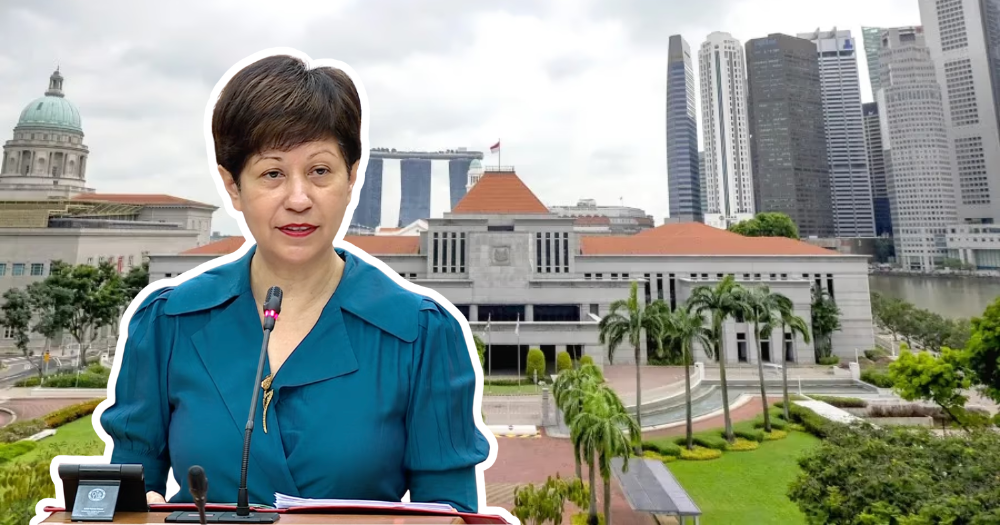
Singapore hopes Japan can consider putting to rest outstanding historical issues with its Asian partners, so that it can contribute even more to the region, said Senior Minister of State for Foreign and Home Affairs Sim Ann on Mar.6.
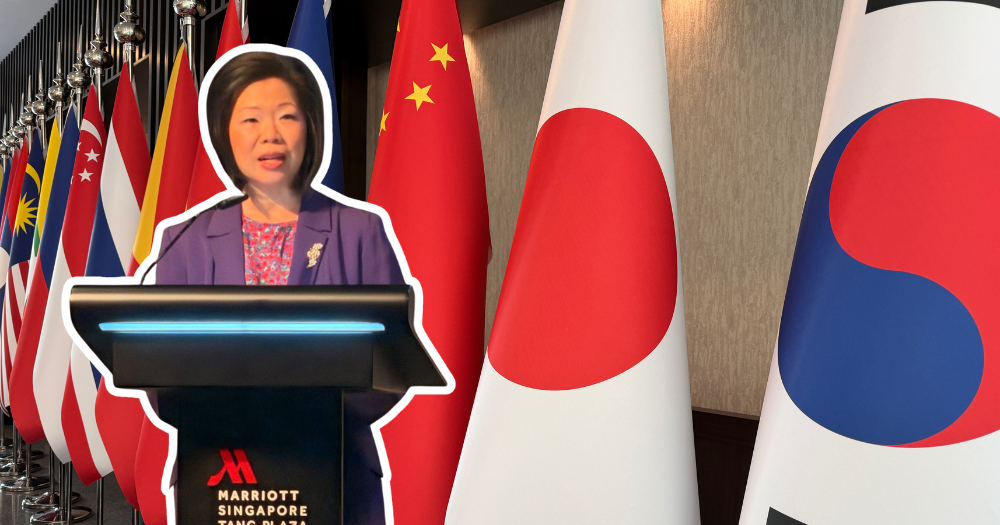
Speaking in a speaker series organised by non-profit organisation Business China, Sim's wide-ranging speech in Chinese revolved around the theme of Singapore-Northeast Asia relations.
She spoke about Singapore's evolving historical and diplomatic relationships with Northeast Asian neighbours China, Japan and South Korea in a "multipolar, less coordinated" world.
"Power is diffusing, strategic rivalry is sharpening, trust between countries is eroding," she said, adding that Singapore must diversify its partnerships and strengthen resilience against uncertainty like other countries have.
"In this evolving geopolitical landscape, expanding and deepening our partnerships is not optional – it is a strategic imperative," she said.
Asean + 3
While Asean remains the "cornerstone" of Singapore's foreign policy, Sim said the bloc cannot operate in isolation.
Singapore also cannot only engage Asean, she added, before pointing to the three aforementioned "Plus Three" partners' importance in the global economy.
"Asean+3" countries accounted for 28 per cent of global final demand in 2022, making it the world's largest collective market, Sim pointed out.
Singapore-China ties
Sim first spoke on the close ties between Singapore and China, whom she said "plays a particularly consequential role among our partners".
Its scale, proximity, and influence in shaping regional and global developments, as well as being the world's second largest economy, makes it a responsible major power, she said.
Singapore and China marked their 35th year of diplomatic relations in 2025 with Prime Minister Lawrence Wong and Chinese Premier Li Qiang exchanging official visits, an act that reaffirmed the depth and continuity of our engagement, she added.
She also pointed out that China was the first non-Asean country PM Wong visited as prime minister, reflecting the importance Singapore places on the relationship.
The nation has also consistently worked with China in regional and multilateral platforms and on wider global issues while being an early supporter of its initiatives.
With its scale and weight, China's policies have significant influence on regional and global stability and can help anchor confidence in the international system, Sim added.
She concluded by reiterating Singapore's interest in working closely with the Asian giant in advancing cooperation
Singapore-Japan ties
She also discussed Singapore's long history with Japan, including the Japanese Occupation during the Second World War and the hardship it brought about to local communities.
While such pasts are widely documented, Sim emphasised that "we remember this history not to reopen wounds, but to ensure we never lose sight of its lessons."
Singapore has also since moved forward since its independence, even acknowledging the suffering of the local Chinese community through S$50 million of reparations provided by Japan in 1966, which went into building the Civilian War Memorial, she added.
Quoting founder prime minister Lee Kuan Yew, she said: "We meet not to rekindle old fires of hatred, nor to seek settlements for blood debts...the world has changed radically."
"However, new dangers have emerged since the end of WWII. This should spur us to cultivate the largest number of reliable and strong friends," Sim said.
Both countries developed a mutually beneficial partnership over the past 60 years.
Japan has also since become a participant in Singapore's nation-building, including in foreign investments and trade, and plays an important role in Southeast Asia, Sim pointed out.
But not all Asian countries appear to feel the same, she said.
'Honest remembrance & continued efforts at reconciliation' needed for Japan
She urged Japan to reconcile its wartime past and acknowledge this painful history with other countries in the region.
"Singapore believes it would be positive for the region if Japan is able to deepen cooperation with more Asian partners and contribute even more to peace, stability and prosperity in the Asia-Pacific," said Sim.
She highlighted the "difficult historical issues" Japan continues to have with some parts of Asia in relation to the severity of damage and suffering caused by wartime Japan.
Most recently, China and Japan were locked in a diplomatic spat after Japanese prime minister Sanae Takaichi started a "row" with Beijing following remarks she made in parliament.
In November 2025, Chinese foreign minister Wang Yi also called on European countries to "safeguard the outcomes" of World War Two.
"These historical issues have to be handled sensitively," Sim said, adding, "with the myriad changes in the broader strategic environment, Singapore also hopes that Japan can consider how it can put to rest these outstanding issues."
"If Japan is able to do so, it will be in the position to make even greater contributions to the region, and to participate in building and upholding an open and inclusive regional architecture."
Singapore's past leaders have made the same points previously, Sim added.
"This reflects Singapore’s long-standing view that honest remembrance and continued efforts at reconciliation can strengthen regional trust."
Singapore-South Korea ties
Sim discussed Singapore's ties with South Korea, which she said have "entered a new phase" with recent official visits between both leaders.
"Singapore and the Republic of Korea (ROK) share similarities in our developmental experience as “Asian Tigers” – we are both advanced, trade-dependent economies that value innovation and openness," she said.
"We share a common goal to uphold the rules-based multilateral trading system."
Both countries are currently among each other's top ten trading partners, she pointed out.
Singapore is also Korea's fourth-largest investor by stock.
Korea, meanwhile, has been heavily investing in Singapore and is involved in the construction of major local land infrastructures, including the North-South Corridor and new MRT lines.
In the region, it plays an increasingly important role as a major trading nation with deep links across global supply chains, Sim added.
Don't be used by others
Despite Singapore's close relationships with these countries, it must be able to stand firm against being used by others, Sim said following her speech.
In response to a query about where the nation stands if "some of these friends" start fighting, she reiterated the sentiments of Foreign Affairs Minister during his Committee of Supply debate on Feb. 27, that Singapore must be able to say "no" to protect long-term national interests.
"We want to be useful, but not to be made use of," Vivian said then.
Despite being a small country, he said that "we have never been naïve" and must exercise agency to navigate a turbulent world.
Top images via Mothership and Canva