Parliament


Budget 2026: S'pore passes largest budget to date, House leader Indranee Rajah reflects on surplus, lowest TFR, morally upright leaders
Within 3 weeks since the delivery of the Budget Statement, Trump doubled down on tariffs, and the Pakistan-Afghanistan & Israel-U.S.-Iran wars broke out.
March 06, 2026, 04:42 PM
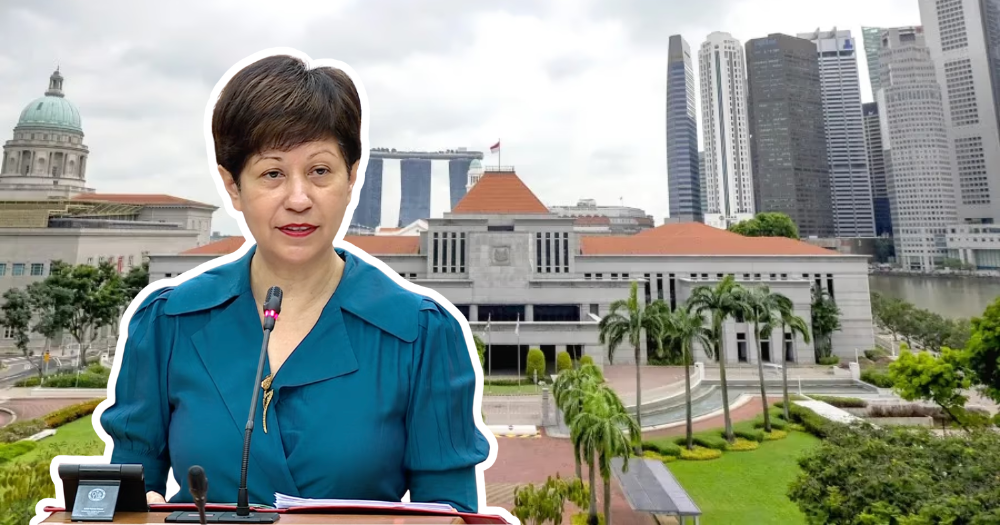


Budget 2026 is the government's largest annual budget to be passed to date, said Leader of the House Indranee Rajah, adding that it comes "against the backdrop of a profoundly changed and uncertain world".
As it is customary of her role, Indranee concluded nine days of Budget and Committee of Supply debates on Mar. 6 by highlighting the more than S$200 billion in estimates that were passed — S$158.9 billion in main estimates and S$49 billion in development estimates.
The Budget is the government's plan to aid Singaporeans in navigating a new reality, she added.
Largest annual budget to date
She pointed out that Singapore's historically large S$15.1 billion surplus puts it in a position of strength, despite repeated questions during the debates on whether the government has been too conservative in its estimates.
In the three weeks since the Budget was delivered by Prime Minister Lawrence Wong on Feb. 12, the world has undergone further change, she said.
On Feb. 20, eight days after the Budget Statement was made, the U.S. Supreme Court struck down U.S. president Donald Trump's Liberation Day tariffs.
However, Trump responded by doubling down on tariffs the next day, triggering another round of economic uncertainty.
On Feb. 26, hostilities between Pakistan and Afghanistan erupted.
On Feb. 28, the U.S. and Israel launched strikes against Iran, which retaliated against other countries in the region, which plunged the Middle East into another round of instability.
Indranee added that these developments have "added to the overall climate of uncertainty", including in business outlooks and energy prices.
"Viewed in light of these changed circumstances, our surplus is less about marksmanship and a whole lot more about assurance and quiet confidence," she said.
"This is not by accident," Indranee added. "It is the result of successive budgets anchored on fiscal prudence, forward planning and catalysing new ways to catch the winds of change even as we provide for current needs."
She contrasted this to other major economies where public debt is rising and highlighted previous instances where Singapore's fiscal prudence has been validated, including during the Covid-19 pandemic.
Singapore's unique system
She also gave a nod to Singapore's "unique system of parliamentary democracy", which has served the country well and continues to deliver good results for Singaporeans, she said.
It is unlike the American system of checks and balances or the British system where the prime minister and the cabinet are given a wider range of discretionary powers.
Indranee said the Singapore system resembles the British system, except that Singaporeans have gone further and superimposed on our constitutional framework the ideal of a political leader who is "upright, morally beyond reproach", someone she said that the" people can trust".
She elaborated:
Rules and processes are important. But even more important are the people who are elected to represent and serve the people, and whether they possess the competence. commitment and conscience to fulfil their duties. If they do, then you do not need as many rules because they can be trusted to do the right thing. If they don’t, we can impose and improve as many laws and rules as you like, but democracy and politics will still go wrong. This applies to governments as much as it does to oppositions, governments-in-waiting.
AI
Artificial intelligence (AI) was also a key feature of this year's budget, which aims to harness it as a strategic advantage, said Indranee.
In his Feb. 26 Budget round-up speech, PM Wong said Singapore's economic strategies must adapt to changing realities, including concerns of AI adoption.
He noted that AI can augment jobs and help workers achieve more, even as it automates certain tasks.
Budget 2026 will allow Singaporeans to implement a refreshed economic strategy and continue investing in workers and drive growth to create jobs, Indranee said.
It can also strengthen support for families and advance the nation's social compact, as well as enhance security and sustainability, she added.
Historically low TFR
Indranee also noted that Singapore's Total Fertility Rate (TFR) was put in the spotlight over the past two weeks.
It dropped to a historic low of 0.87 in 2025, as pointed out by Deputy Prime Minister Gan Kim Yong in his speech on Feb. 26.
It "signals the start of the Marriage & Parenthood reset as a whole of nation effort", said Indranee.
She added: "As we begin this important work, we will take into account the many helpful ideas and suggestions from Members on both sides of the House on what we can do to provide more support for families and couples who aspire to become parents."
Indranee will chair a workgroup with relevant agencies to look into marriage and parenthood issues in light of this, she said in her Feb. 26 speech.
Top images via MDDI & MDDI/YouTube