Parliament


S'pore must be able to say 'no' to protect long-term national interests, even if it doesn't align with others: Vivian Balakrishnan
It must start at home, he said.
February 27, 2026, 01:07 PM

 Despite being small, Singapore can navigate a turbulent world by exercising agency, said Minister for Foreign Affairs Vivian Balakrishnan.
Speaking at the Committee of Supply debate for the Ministry of Foreign Affairs (MFA) in parliament on Feb. 27, he spoke of the changed international world order, including of the rise of populism and deepening polarisation.
"We are in a world where international relations are no longer driven primarily by rules and consensus," said Vivian, who warned that it has become "more dangerous world for small countries" like Singapore.
"This is not a passing tremor. This is a geostrategic tectonic rupture", he said.
Responding to questions on the floor about how Singapore will defend its principles in the new era, he added, "the only viable option is to continue to determine our long-term national interests and exercise our agency to chart our own path."
Exercising agency
Singapore may be a small country, but "we have never been naïve," said Vivian.
He urged for the country to continue exercising agency by tapping on its position as a trusted global hub and bridge builder, but while safeguarding national interests.
"We want to be useful, but not to be made use of."
He pointed out five of such national interests: safeguarding Singapore's sovereignty, securing access to essential supplied, supporting a rules-based multilateral order, maintaining an open and inclusive region and protecting social cohesion.
This may mean not always aligning with the global powers, neighbours or friends, said Vivian.
"On some issues, we will have to say “no” and courteously disagree with our partners. This is not about choosing sides. It is about protecting Singapore’s national interests for the long term."
Staking out a position
Singapore has a proven track record of staking out our position, which can sometimes come with a price, he added.
Among these were the country's condemnation of the U.S.'s actions in Venezuela and Russia's invasion of Ukraine, which Vivian called "a clear violation of international law and the principles of the UN Charter".
On the Israel-Gaza conflict, he stated that while every state has a right of self-defence, "Israel’s military response has breached international humanitarian law.
"On Palestine, our longstanding position remains that the only path to a just and durable peace is a negotiated two-State solution, consistent with the relevant UN Security Council resolutions," he emphasised.
"We took these stands because a world based on “might is right” is more dangerous for us, and for small states in particular."
Vivian added that the government is continuing to assess the U.S.'s invitation to join U.S. president Donald Trump's "Board of Peace", but is in the meantime exploring initiatives, including those announced at the Board of Peace's Feb. 19 inaugural meeting.
Standing our ground
Exercising agency means articulating positions that align with Singapore's national interests, even if they are not always universally welcomed, Vivian pointed out, highlighting five of the MFA's workstreams.
"First, to engage all great powers constructively and give them a stake in the stability and prosperity of our region — because that balance of power gives small states like Singapore room to manoeuvre.
Second, to buttress a wider network of middle-power partnerships for greater stability.
Third, to strengthen a stable and integrated ASEAN – a dynamic region with high growth potential.
Fourth, greater synergy between Singapore and our immediate neighbours.
Fifth, to reinforce a rules-based international architecture despite the current headwinds."
Maintaining networks
It is also important for Singapore to maintain networks with international powers and regional blocs, Vivian said.
US and China
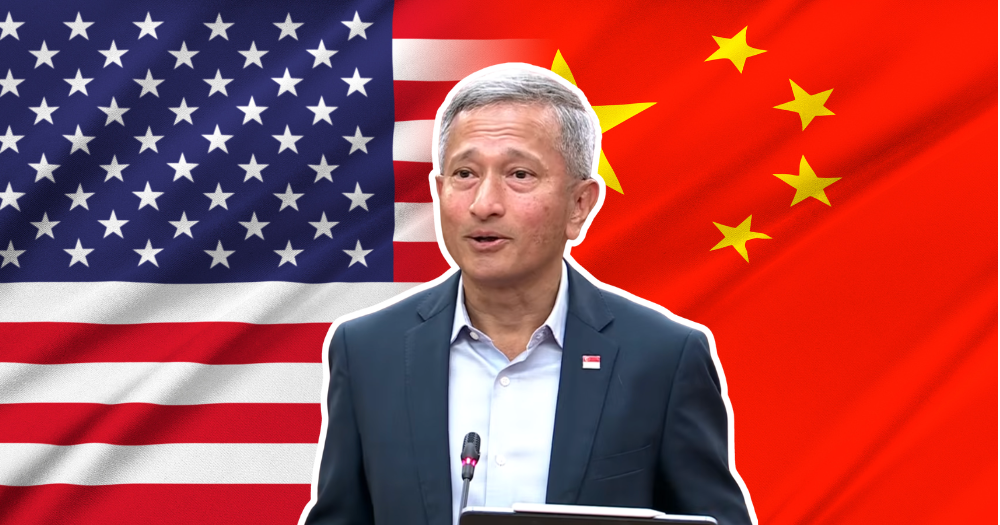
He first spoke on the tumultuous relationship between superpowers U.S. and China, calling both countries vital partners to Singapore.
For Singapore to maintain trust between both countries while preserving its strategic options, he added, "We want to work with the U.S. where our interests coincide. Likewise, we want to work with China where our interests coincide."
"The reality is that every country will have to find creative ways to work with both the U.S. and China."
However, Vivian emphasised that Singapore must still be able to "courteously stand up and say no" where interests diverge.
"And when we say no, both sides must understand it's not personal, but it's based on a principled assessment of Singapore's national interests, and that we are not acting as a proxy for one or the other against them," he said.
Speaking from personal experience, Vivian added that "so long as we maintain this principled approach...we come under less pressure because they know this tiny little city state is one where the more you push them (and) the more spying, the more firmly they (Singapore) will hold their ground and conducting foreign policy on this basis with superpowers."
As for middle powers like Australia, France, India, New Zealand and Vietnam, he said that the MFA will "strengthen our network of partnerships," with such countries.
Asean
Closer to home, Asean remains the cornerstone of Singapore's foreign policy and a "salient platform from which we engage the wider world," said Vivian.
This means there is a need to build the bloc into a cohesive, united and credible organisation in order to remain relevant and be the choice partner of major powers, he added.
Singapore, who will assume Asean chairmanship in 2027, will use the position to deepen integration and promote external partnerships, he told the chamber.
"We will work to keep the ASEAN region open for business, open to the world, and committed to peace, stability and cooperation."
Vivian called Singapore's close relationship with immediate neighbours Indonesia and Malaysia the "bedrock" of Asean cohesion.
He said that this has been achieved through the resolution of longstanding issues and mutually beneficial projects with Indonesia, and the pursuit of beneficial regional partnerships with Malaysia, such as the Johor-Singapore Special Economic Zone (JS-SEZ).
Starting at home
Closing off his speech, Vivian posited that staking a claim in the new world order starts at home.
Singapore's domestic unity, for one, is among the key prerequisites it possesses for success.
"As long as we understand that we are in this together, as long as we can inoculate ourselves from foreign influence, as long as we can disagree maturely and forge a domestic consensus, we will continue to thrive, and we cannot be bought or bullied by anyone."
Singapore economic relevance also factors into its ability to take a stance.
"Paradoxically, today’s more fractious world accentuates Singapore’s value as a hub," he said.
"Our friends and partners know that we speak honestly and independently. They know that we are open and welcoming to all. They know that we honour our word, contracts are sacrosanct, and investments and intellectual capital are protected.
There is a premium for stability, consistency, and respect for the rule of law."
Lastly, Singapore ability to defend itself, through National Service, has helped to and will continue to keep it safe, said Vivian.
"We are a country that hopes for the best but also prepares for conditions that are less ideal."
Top images via MDDI/YouTube & Canva