News

DPM Gan says labour movement has to 'evolve with the times', urges AI-ready workforce
In a separate speech. NTUC secretary-general Ng Chee Meng announced that NTUC reached more than 1.4 million members in 2025.
November 14, 2025, 07:30 PM


Deputy Prime Minister Gan Kim Yong called on Singapore's labour movement to continue evolving with the times, while keeping workers at the heart of its mission.
Speaking at the National Trades Union Congress' (NTUC) biennial Ordinary Delegates' Conference (ODC) on Nov. 13, Gan noted that the global landscape is becoming “more uncertain and fragmented”, with economies facing growing divisions and renewed tensions between labour and capital.
The ODC brought together delegates from NTUC's affiliated unions and associations to review its progress, align strategies, and chart the union's next steps.
This year's theme focused on strengthening NTUC's relevance to an evolving and diverse workforce, while building a more innovative and resilient labour movement at the same time.
AI-ready SG
Gan highlighted the need to ensure that both workers and firms "can move forward together into the new technological era".
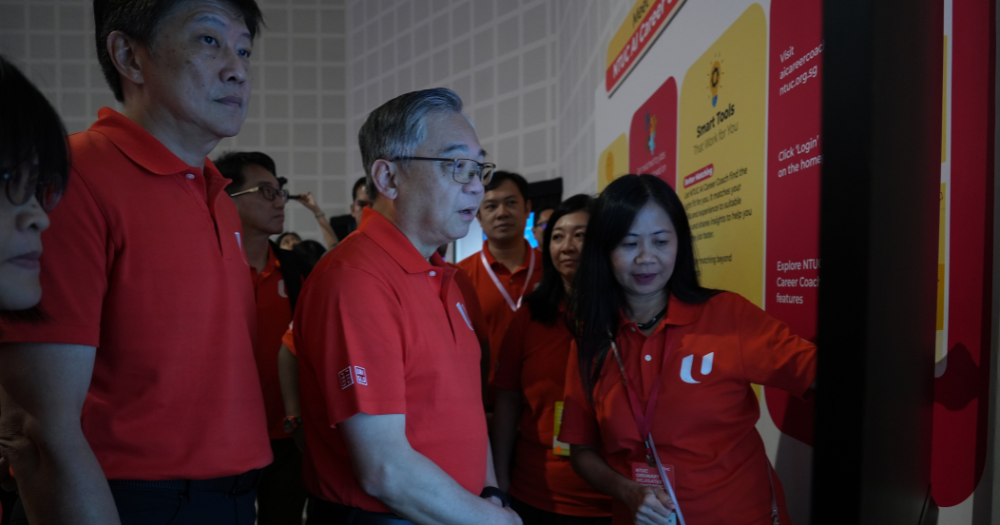
He commended NTUC's proactive response, citing initiatives, such as "AI-Ready SG" and the AI Career Coach.
First introduced by labour chief and NTUC secretary-general Ng Chee Meng during the President's Address debate in September, "AI-Ready SG" encourages workers to use AI tools for continuous learning and innovation.
It also urges employers to adopt AI responsibly, through job redesign, employee upskilling, and ensuring workers benefit from productivity gains.
Building on NTUC's Company Training Committee (CTC) framework, this initiative aims to help firms integrate AI effectively and provide workers with clearer upskilling pathways, including AI-related skills and career navigation tools.
More details regarding the initiative are expected to be announced in 2026.
Gan also pointed to NTUC’s recently launched AI Career Coach, which helps workers assess their career readiness, identify skill gaps and explore opportunities to reskill or transition into in-demand roles.
Adapting to a changing workforce
"As the profile of our workforce evolves, so must the Labour Movement," Gan said.
He also noted that professionals, managers and executives now make up more than half of employed residents, and that "younger workers care deeply about purpose, flexibility and continuous learning".
To remain truly representative, Gan stressed that NTUC must deepen its engagement with those groups by bringing them into the fold, not just as members, but as leaders and advocates within the movement.
At the same time, he underscored the importance of supporting mid-career workers in transition, protecting platform workers, as well as navigating new growth areas such as the green economy, digital services and advanced manufacturing:
"A more representative NTUC will not only give voice to a wider range of workers, but also strengthen the foundation of our tripartite partnership. This will benefit workers, businesses and the government alike."
NTUC on track to hit 1.5 million members by 2030
In a separate speech, Ng highlighted the labour movement's achievements over the past term.
He stated that membership has grown to over than 1.4 million members this year, with NTUC on track to hit 1.5 million members by 2030.
To date, NTUC has set up 3,700 CTCs, helping at least 10,000 workers upgrade their skills, with efforts scaling up to the Cluster level and potentially benefiting another 45,000 workers.
Through its Employment and Employability Institute (e2i), NTUC has also helped place 52,000 workers in jobs.
Moreover, the Progressive Wage Model (PWM) has raised wages for 155,000 lower-wage workers, while 70,000 platform workers have gained better protection through new initiatives.
Three key strategic pillars for the next term
At the start of the conference, NTUC president K. Thanaletchimi also outlined three key strategic pillars to guide NTUC's next term:
- Strengthening its foundation for relevance and growth, including leveraging digitalisation to better connect with members.
- Anchoring an innovation culture for better jobs, by deepening collaboration with the Job Security Council to support job transitions.
- Expanding and developing leadership for the future, through nurturing union leaders and positioning NTUC as a key partner in national discussions.
These strategies aim to ensure that NTUC continues to advocate effectively for workers and remains a trusted voice in shaping Singapore’s future of work.
Top photo via Mothership