News

US tariff on S'pore exports likely to remain at 10%
Singapore has a trade deficit with the US.
August 01, 2025, 10:12 AM
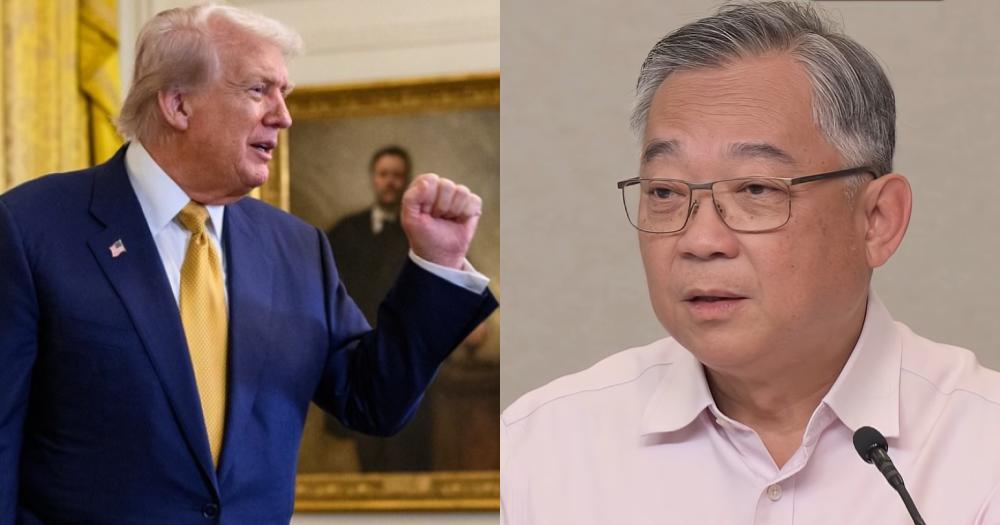

 The tariff rate Singapore will get on its exports to the U.S. from Aug. 1 has been decided, and it’s (likely) 10 per cent.
U.S. President Donald Trump and the White House announced on Aug. 1 that the "universal tariff" for goods entering the U.S. will remain at 10 per cent, which was the same number he announced on "Liberation Day" on Apr. 2, as reported by CNN.
However, this only applies to countries that the U.S. has a trade surplus with i.e. countries that buys more stuff from the U.S. than the U.S. sells to it.
Singapore is one of those countries, the U.S. has a trade surplus with us, we have a trade deficit with them, as pointed out by U.S. Senator Tammy Duckworth during the confirmation hearing of Trump's nominee for Ambassador to Singapore.
@mothershipsg Anjani Sinha, U.S. President Donald Trump's nominee for Ambassador to S’pore, was grilled during his hearing before the Senate Foreign Relations Committee on his knowledge of the country and region. #fyp #usa #singapore #sgnews ♬ original sound - Mothership
Rate limited
Deputy Prime Minister and Minister for Trade and Industry Gan Kim Yong recently concluded his working visit to the United States, where he met with several U.S. officials, including Secretary of the Treasury Scott Bessent and members of Congress.
Upon his return, Gan shared that during his conversations, the U.S. was in "no mood" to discuss a cut to the tariff rate of 10 per cent on Singapore.
Since Jul. 23, it looked as though the baseline rate might be even higher than 10 per cent, with Trump quoted by Bloomberg as saying that there would be a “simple tariff rate “ of between 15 and 50 per cent.
No Asian country that agreed a deal with the U.S. has received a tariff rate of lower than 15 per cent, with Japan receiving 15 per cent after promising to open its rice market to U.S. exports and invest S$700 billion in the U.S.
The Philippines received a rate of 19 per cent, same as Indonesia, while India was hit with 25 per cent.
In that context, Singapore managed to come away with a lower tariff rate without negotiating a separate deal, largely thanks to its trade deficit with the U.S.
Pharma’s choice
But beyond just the baseline tariff rate were concerns about sector-specific rates, such as on pharmaceutical exports.
There was no indication from the White House as of Aug. 1 whether there were any concessions on sectoral tariffs for sectors such as pharmaceuticals or microchips.
Trump has indicated that he intends to impose some level of tariff on the sector, in a bid to bring production to the U.S., and that new rates would be announced by Aug. 1, according to The Guardian.
In 2023, pharmaceuticals accounted for 10 per cent of Singapore's total exports to the U.S., for about S$12 billion worth of goods.
Experts Nikkei spoke to suggested that a rate as high as 25 per cent would be akin to an 11 per cent tariff on Singapore.
This could stymie Singapore’s growth by between 0.1 per cent and 1 per cent.
Prime Minister Lawrence Wong recently said that tariff rates of 10 per cent or so on Singapore would not be "ideal", but Singapore could "live with it."
He added that there remained opportunities to do business with the U.S., and other trade opportunities with other countries such as our Asean partners.
Top image via White House/Facebook & Gan Kim Yong/Facebook