



News

US to review if Aukus nuclear submarine deal aligns with ‘America First’ agenda
The review will be led by Elbridge Colby, who has previously called himself an Aukus “agnostic".
June 13, 2025, 06:38 PM


The U.S. has launched a review into the AUKUS (Australia-United Kingdom-United States) defence pact, which will be judged based on its alignment with the Trump administration’s “America First” agenda.
The multi-billion-dollar pact, signed with Australia and the UK in 2021, sought to help Australia develop a fleet of nuclear-powered submarines over 30 years, representing a major leap in Australia’s military capabilities.
As quoted by the BBC, a U.S. defence official said that the pact was being reviewed “as part of ensuring that this initiative of the previous administration is aligned with the President's America First agenda”.
"As (U.S. Defence) Secretary (Pete) Hegseth has made clear, this means ensuring the highest readiness of our service members (and) that allies step up fully to do their part for collective defence," the defence official added.
Earlier this month, the Australian Broadcasting Corporation reported that Hegseth had conveyed to Australian defence minister Richard Marles that the U.S. demanding Australia increase its defence spending from 2 per cent of its GDP to 3.5 per cent – an additional AU$40 billion (S$33 billion) per year.
Led by an AUKUS “agnostic”
The BBC reported that the review will be led by Elbridge Colby, a top defence department official who has previously called himself an AUKUS “agnostic”.
“In principle (AUKUS ) is a great idea,” he said in a post on X last year. “But I’ve been very skeptical in practice.”
“It would be crazy to have fewer SSNs in the right place and time,” he added, referring to nuclear-powered general-purpose attack submarines.
“I’m convinced we should focus on Asia, readying for a war with China *so we can avoid it.*”
AUKUS is a great example. In principle it’s a great idea. But I’ve been very skeptical in practice. I remain skeptical - agnostic as I put it to @smh - but more inclined based on new information I’ve gleaned.
It would be crazy to have fewer SSNs in the right place and time. 2/
— Elbridge Colby (@ElbridgeColby) August 8, 2024
Marles remains optimistic
Despite concerns that the U.S. will scrap the agreement, Marles said that Australia has been briefed about the review in advance, calling it a “natural” move for the U.S. to take.
"It's something that it's perfectly natural for an incoming administration to do... It's exactly what we did," he told ABC Melbourne.
"There is a plan here. We are sticking to it, and we're going to deliver it."
During his meeting with Hegseth at the Pentagon in February, Hegseth indicated that U.S. President Donald Trump was “very aware, supportive of AUKUS”.
“(He) recognises the importance of the defence industrial base, which the Deputy Prime Minister pointed out the investment Australia is willing to make. It enhances our ability in the subterranean space, but also our allies and partners,” Hegseth said.
“This is not a mission, in the Indo-Pacific, that America can undertake by itself.”
Former Australian prime minister Scott Morrison, who saw the signing of the AUKUS deal in 2021, said in a LinkedIn post that the review was a “departmental review, not a policy decision, and should not be over-interpreted.”
“Now is the time for Australia to make the case again. We have a good case to make in both our own interests and those of our AUKUS partners, especially in the U.S.”
However, not all Australians are for AUKUS. As of May 6, polls have indicated that over 54 per cent of Australians want a more independent foreign policy, up from 44 per cent two months prior, with critics arguing that AUKUS makes Australia more vulnerable without the autonomy to make its own decisions.
What is AUKUS?
Signed in 2021 under the Biden administration, the US$239 billion (S$307 billion) trilateral security partnership planned to help Australia acquire a fleet of eight nuclear-powered submarines.
According to Bloomberg, as many as five of the U.S.’ nuclear-powered Virginia-class submarines are to be sold to Australia by the early 2030s,
Australia and the UK are also to collaborate on a next-generation submarine, known as the SNN-AUKUS, due for completion in the 2040s.
Beyond submarines, AUKUS involves sharing technology in areas such as quantum computing, artificial intelligence and advanced weaponry.
However, the pact is not without its critics. Amid recent reports that the Pentagon is reviewing the deal, China once again voiced its opposition, citing the risk of nuclear proliferation.
"We oppose manufacturing bloc confrontation and anything that amplifies the risk of nuclear proliferation and exacerbates arms race," China’s Foreign Ministry spokesperson Lin Jian said on Jun. 12.
Meanwhile, Southeast Asian countries have taken a mixed stance towards AUKUS from the get-go, though in recent years, fewer states continue to dispute AUKUS and its role as a counterbalance against a rising China.
With the AUKUS deal being the first time since 1965 that the U.S. has agreed to share its highly sensitive submarine technology, scrapping it would certainly raise questions about its commitment to the interests of its other allies in the Asia-Pacific.
Related stories
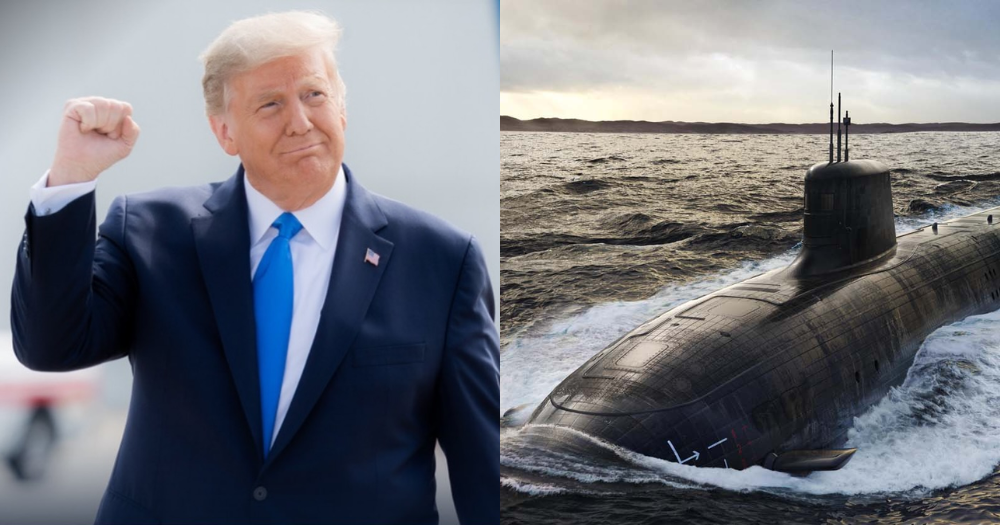
Top image via Donald J. Trump/Facebook & Wikimedia Commons