



News

Omitted records, unheeded warnings: MOT investigation report on Sep. 2024 EWL disruption
The station manager of Tuas Link station initially conducted a check, but reported that there was no burning smell.
June 06, 2025, 12:45 PM


An investigation by the Transport Safety Investigation Bureau (TSIB) found a number of potential issues in the lead-up to the September 2024 East-West Line (EWL) disruption.
TSIB is the air, marine, and rail accidents and incidents investigation authority under the Ministry of Transport (MOT).
Among its findings were omitted maintenance records and warnings that were erroneously dismissed as "false", according to the May 31 incident report.
Recommendations to improve processes in future were also included in the report.
Burning smell
The six-day EWL disruption — one of the worst rail incidents in Singapore's history — was caused by an uncommon mechanical failure.
The problem in question was a damaged axle box in the train, a first-generation Kawasaki Heavy Industries (KHI) vehicle.
The mechanism overheated and failed, igniting and burning off pieces of rubber in the axle box.
The first report of something awry was made at around 8:25am on Sep. 25, after the train departed from Tuas Link Station towards Pasir Ris.
Operations staff reported a "burning smell" to the control centre.
As instructed by the control centre, the station manager of Tuas Link station checked the track.
But he reported that there was no burning smell.
15 minutes later, the control centre instructed the station manager of Clementi to inspect the train when it arrived at Clementi station.
At 8.52am, the Clementi station manager confirmed that there was indeed a burning smell inside the train.
Subsequently, the control centre ordered the train to be removed from service and returned to the depot.
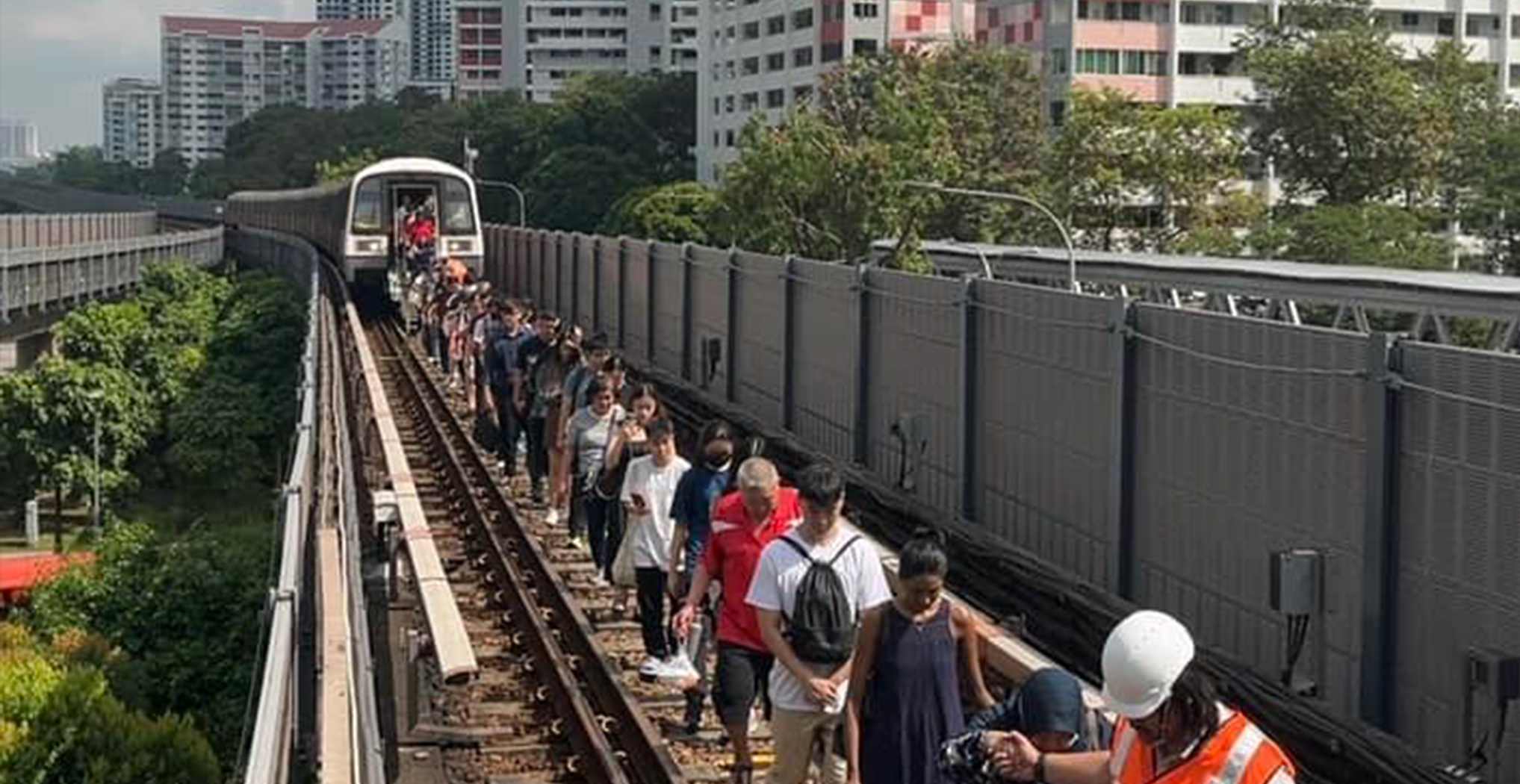
The passengers were all detrained.
Unheeded warnings
The report also noted that a temperature warning was issued earlier that day, at 7:23am.
A system sensor detected that the axle box had a temperature of 118°C — significantly higher than the typical operating temperature of 65°C.
It generated a Level 1 warning.
Typically, the system identifies the train by its ID number, allowing the controller to take follow-up action.
But in this case, the system failed to identify the train, and instead generated a Null ID label.
The controller monitoring the system saw the warning, but erroneously believed it was false.
The training did not address or provide guidance on what to do in the event of a Null ID.
The controller hence did not take any follow-up option.
According to the TSIB report, there had previously been instances of Null IDs being generated.
Staff had also provided feedback to the rail operator, and to their supervisors.
But the issue had not been resolved, and Null IDs continued to be generated.
Due to the lack of resolution, the controllers might have been led to believe that warnings associated with Null IDs were false warnings that did not warrant any follow-up action.
"Repeated exposure by [controllers] to false warnings and alarms might result in desensitisation and, over time, a diminished response to warnings and alerts," the report noted.
It also acknowledged that SMRT should ensure that reported issues are followed through on. If controllers had been properly briefed, the train might have been withdrawn earlier.
The issue has since been resolved.
Maintenance schedule
The investigation team found some omitted records in the maintenance schedule.
SMRT's maintenance schedule typically requires trains to be overhauled at intervals of 500,000km.
This interval may be extended by up to 10 per cent — translating to an interval of 550,000km — without the need for technical assessment or justification.
Extensions up to 15 per cent, 25 per cent, and beyond 25 per cent will need to be evaluated and approved by SMRT senior management respectively.
In this case, the train had its overhaul interval extended twice: Up to 15 per cent in August 2022, and beyond 25 per cent in August 2024.
This translated to revised intervals of 575,000km and 750,000km respectively.
According to SMRT's processes, these extensions would have required assessment prior to approval.
But assessments of the two extensions were omitted in the waiver approval system’s record.
In addition, SMRT was not able to furnish any record, assessment, or approval for assessments beyond 15 per cent up to 25 per cent.
"While the lack of records on maintenance decisions may not have directly contributed to the incident, this incident highlights the importance of ensuring that records of evaluations and decisions made in an organisation’s operations are documented."
TSIB also noted that closer scrutiny by the authorities may be warranted in the granting of extensions to overhaul intervals, as it is a "deviation from the maintenance schedule".
The report also acknowledged that when overhauled at the standard 500,000km mark, the trains' axle boxes had been historically problem-free.
But when stretched beyond 500,000km, the quality of the axle boxes and its components "were no more assured".
At the time of the incident, the train had logged 690,000km — a 38 per cent increase from the initial 500,000km.
SMRT will enhance this approval process by July 2025.
Under the revised process, it will be mandatory to document the justifications for such extensions.
There are also plans to have more trackside infrared sensors to enhance detection of hot axle boxes.
SMRT must also report extensions to overhaul intervals to the authorities for assessment.
"Breaches" found
In response to Mothership's queries, the Land Transport Authority previously confirmed that a breach of license had occurred, that contributed to the disrupted service.
In view of this, LTA intends to issue a S$3 million financial penalty to the SMRT.
Several factors were taken into consideration in determining this amount, such as SMRT's service recovery efforts, which amounted to S$10 million.
The spokesperson added that it has served a notice of intent of the penalty to SMRT.
SMRT is aware of the penalty and is currently reviewing the matter.
Top image from SMRT/Facebook