News


Climate change doesn't recognise borders nor pause for conflict: Teo Chee Hean on importance of sustainability drive
“The real race is against time and not against each other.”
May 19, 2026, 05:21 PM
Top image via Temasek


Global geopolitical tensions are no longer merely a "backdrop" to the world, said Teo Chee Hean.
Rather, they have become an “active force” in reshaping economies, supply chains and strategic choices.
But amidst the ongoing uncertainty, "one reality remains unchanged", said the former Senior Minister and Deputy Prime Minister.
“Even as geopolitical tensions rise, the world has just recorded its hottest years, with global emissions continuing to rise and reach humans.
Climate change does not recognise borders. Nor does it pause for conflict."
A vulnerable world
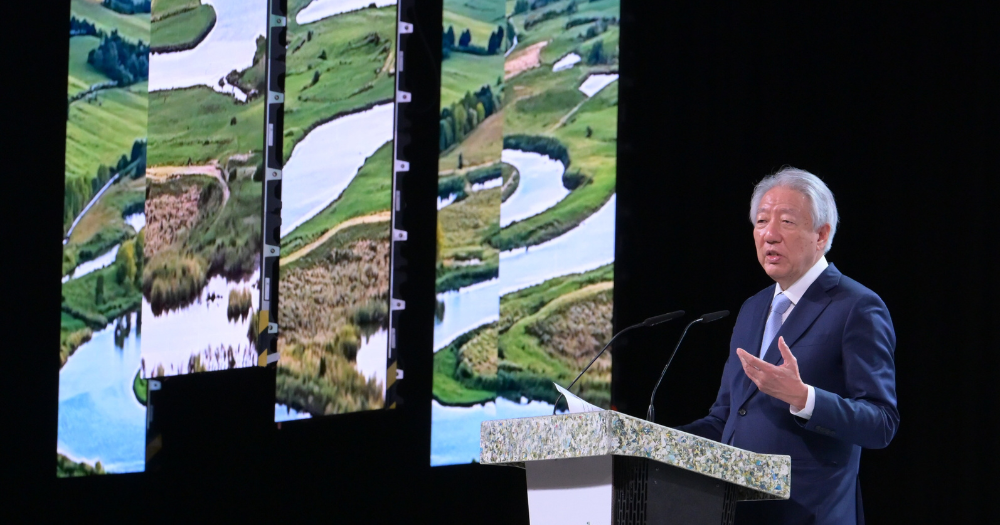
Teo was speaking on May 19 at Ecosperity Week 2026, Temasek’s annual sustainability conference.
The chairman of Temasek Holdings acknowledged that the world is facing not just economic uncertainty, but deeper systemic instability.
Referring to disruptions involving the Gulf region, Ukraine and the Middle East, he said:
“We're seeing how deeply interconnected and vulnerable our world has become.”
In response, countries are increasingly prioritising security, resilience, and self-sufficiency, he observed.
Climate change continues amid geopolitical tensions
Despite these tensions, Teo said climate change remains an urgent issue that continues to affect all countries.
Amid various issues, he highlighted the rise of AI and the resultant "exponential demand" for data centres.
This raises questions about energy and water use, as well as the need for sustainable digital infrastructure, he said.
There is also the issue of climate adaptation, a "core priority" amidst growing climate risk.
"We have to assume that, at the present rate at which we are dealing with mitigation, it will not be enough. And adaptation will have to be a very strong theme for us in the coming years," he said.
Teo warned that conflicts could slow climate progress:
“If anything, conflicts make the transition harder, which is why cooperation matters even more.”
Race against time
In these focus areas, “innovation and intent” must come together, Teo stressed.
He pointed to the Asia-Pacific as being central to future climate efforts, given that the region is home to around 60 per cent of the world’s population.
It also accounts for roughly half of global emissions, and is where much of the world's future demand, industrial expansion, and infrastructure growth will take place.
“How Asia navigates this transition will shape global outcomes," he said.
As it is, an interconnected ecosystem is "already taking shape": China is a world leader in electrification, India in renewable energy, South Korea and Japan in battery components.
If brought together effectively, it can strengthen resilience and accelerate sustainable growth, he said.
Teo ended by stressing the need for countries to work together in an increasingly fragmented world.
“After all, the defining challenge of our time is not competition between countries.
The real race is against time, and not against each other.”