Parliament


Stick to appointments where possible to keep polyclinic waiting times short, but situations dynamic: Koh Poh Koon
"What we're trying to do is to stick as much as possible to more scheduled appointments, so we minimise that variance," Koh said.
May 07, 2026, 02:08 PM
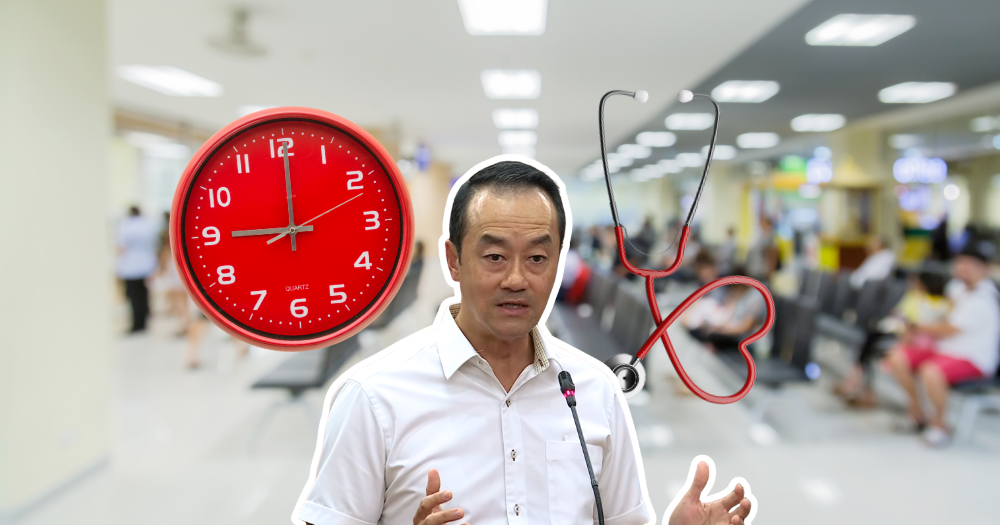
In 2025, the median and 95th-percentile waiting times at polyclinics were eight minutes and 72 minutes respectively.
This applied to walk-in patients, and likely took place during peak hours, said Senior Minister of State for Health Koh Poh Koon.
He was responding to a question in Parliament on May 7 by Sembawang Member of Parliament (MP) Vikram Nair.
Nair had asked about average waiting times at polyclinics for walk-in patients during peak and off-peak hours.
He'd also asked if there were plans to redistribute patient load across off-peak hours.
Stick to appointments where possible
As a general practice, polyclinics always schedule fewer appointments than full capacity, to accommodate walk-in patients with acute medical needs, said Koh.
But while the Ministry of Health (MOH) does not track waiting times by off-peak and peak hours, the high waiting times likely took place during peak hours.
This is why it is important for polyclinics to operate on an appointment basis "as much as possible", to spread out patient arrivals throughout the day, he explained.
In response, Nair acknowledged that waiting times for walk-ins have improved since two years ago, when the figures were 17 minutes median, and 164 minutes for the 95th-percentile.
"But I think one and a half hours of waiting time is still quite long, and I was wondering if there are any plans to introduce more capacity for polyclinics," he said.
Koh replied that it is less a matter of increasing capacity, and more a matter of optimising capacity.
"We could actually leave a lot of empty slots, just in case there are walk-in patients. But that means there will be a lot of time wasted that will not be used, if there are no walk-in patients," he said.
"In that sense there will always be a trade-off there."
Daily situations 'dynamic'
But he acknowledged that the day-to-day situation can be "dynamic".
"What we're trying to do is to stick as much as possible to more scheduled appointments, so we minimise that variance," Koh said.
"But as you can imagine, it's often not so straightforward to determine ahead of time how that conversation and that consultation with each particular patient will go."
Some patients may have complex issues, with multiple medical problems, and consultations will take more time.
If a clinic receives multiple such patients, it can cause "a snowballing effect", in which patients with slots at the end of the morning or afternoon end up waiting longer.
This is even if they have been given a scheduled appointment, he said.
As such, clinics try to meet patient demands in various ways. One way is by performing triage for walk-in patients, so that non-urgent cases can be rescheduled to the next day.
This way, he or she will not have to be subject to long waiting times as a walk-in patient, Koh said.
Walk-ins versus appointments
Workers' Party secretary-general Pritam Singh subsequently asked if MOH is taking note of the number of walk-ins, compared to the number of scheduled appointments.
He pointed out that in a super-aged society, certain individuals may experience difficulty making appointments.
In response, Koh said that they don't have the numbers but that "in general", most patients will try to schedule an appointment, to reduce their own waiting times.
"But healthcare being the way it is, there will always be a sudden onset of discomfort and unwellness, that will prompt a walk-in appointment," he acknowledged.
This is why Singapore's healthcare system does not operate based on polyclinic resources alone, but in tandem with General Practitioner (GP) clinics.
Many GP clinics are on the Community Health Assist Scheme (CHAS), so patients have the option of seeking subsidised treatment there as well, he said.
Over time, as Singapore improves its Healthier SG enrollment, patients and GPs will forge stronger relationships and better understanding.
This will hopefully help "spread the load" to GP clinics as well, he added.