Parliament


WP MPs' proposals for AI disruption payouts are 'pessimistic' & lack confidence in S'poreans: Tan See Leng
Back-and-forth.
May 07, 2026, 12:20 PM
Photo from MDDI/YouTube
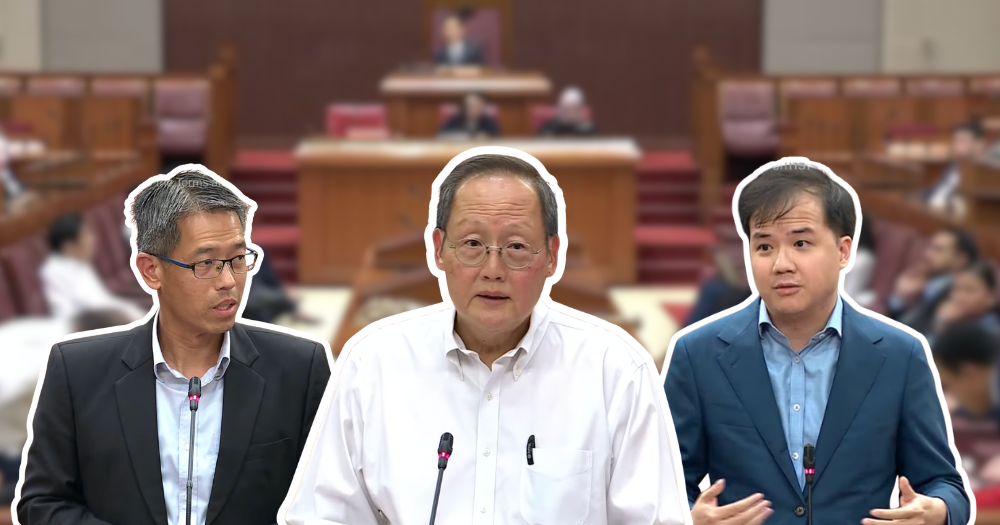
In his response to the motion about Singapore's AI transition on May 5, Manpower Minister Tan See Leng addressed proposals by various Members of Parliament (MPs).
In particular, he criticised proposals by Workers' Party (WP) MPs Andre Low and Gerald Giam, saying that they "rest on a more pessimistic premise".
Both MPs rejected his criticisms.
The proposals
The motion, which aims for an AI transition without a rise in joblessness, was first put forward in Parliament on May 5 by labour chief Ng Chee Meng.
24 MPs responded to the motion, making policy suggestions and highlighting potential gaps.
Among the suggestions were ones by Aljunied MP Giam and Non-Constituency MP Low.
Giam proposed a "national AI equity fund", in which an annual dividend — starting from S$500, and increased over time — would be paid out to every adult citizen.
This would be a "strategic surplus transfer", from enterprises which benefit immensely from AI, to Singaporeans, he said.
Unlike CDC vouchers, which reflect the current fiscal situation, these dividends would be "a structural entitlement, a function of receipts, rather than what the fiscal mood of the moment happens to be", Giam said.
Meanwhile, Low suggested payouts via redundancy insurance, for Singaporean workers displaced through AI disruption.
The response
In his speech, Tan thanked Giam and Low for the "seriousness with which they have engaged on this issue".
But he criticised both proposals as "rest[ing] on a more pessimistic premise, that Singaporeans are essentially passive passengers in the AI transition".
Their suggestions, he said, presume that Singaporeans are "without agency to seize the opportunities and can only rely on support for a journey they cannot steer".
"Both their proposals are not empowerment. To me, it is a settlement — resigned to the fact that mass displacement is inevitable, and that the best we can do is soften the blow," he said.
"We should have more confidence in the tenacity and adaptability of our fellow Singaporeans."
"Our tradition, Singapore's tradition, has been to invest in people, rather than to compensate them for the circumstances," he emphasised.
Tan further argued that funding upskilling is "the better use of any surplus generated by AI adoption".
"To that end, the government has spent over S$10 billion over the last five years on local workforce initiatives," the minister said.
The clarifications
Low subsequently asked Tan to clarify "how he has managed to read that basis [that Singaporeans are helpless passengers] into our speeches".
Having strong social safety nets and upskilling Singaporeans are not mutually exclusive, he argued.
"In fact, we believe that strong social safety nets are precisely what will enable Singaporeans to take a risk-taking approach, and embrace the opportunities that AI will deliver," he said.
Tan replied that he was "very glad that [Low and Giam] believe that Singaporeans have what it takes to work with the government, with the unions, with the businesses, to chart their own future".
Giam subsequently took the stand to disagree with Tan's assessment of his proposal, saying the fund should not be viewed as "compensation for failure".
"As earlier Ms Jasmin Lau said... gains from AI must translate to greater security for all Singaporeans," he said.
He then asked Tan about how the government intends to ensure that workers receive a "direct and tangible share of AI productivity gains".
In response, Tan said that "the straight answer is through real income improvement".
He added that the upcoming launch of the Skills and Workforce Development Agency (SWDA) will have "very clear KPI outcomes" including job redesign, better wages, and career progression for workers.
"That's how we envisage the pie to be shared," he said.