



News


Actions of flight crew 'appropriate' for unexpected turbulence, cannot rule out weather radar malfunction: TSIB report on SQ321 turbulence in 2024
SIA has since sent out a bulletin informing crew of the radar malfunction issue and troubleshooting steps.
May 19, 2026, 06:01 PM
Photos via Thairath, TSIB


Singapore's Transport Safety Investigation Bureau (TSIB) has concluded its investigation into the 2024 severe turbulence event on Singapore Airlines' SQ321, which left one British man dead and several others injured, including an Australian woman who broke her spine and was left paralysed from the waist down.
A 59-page report on its findings was published on May 19, 2026, almost two years after the incident occurred on May 21, 2024.
TSIB found that the actions by the flight crew in reaction to the sudden turbulence were "understandable and appropriate" for the situation.
It also found that it cannot rule out the possibility that a malfunction of the onboard weather radar prevented the crew from detecting the presence of storm clouds along the plane's flight path.
Lead-up to turbulence
SQ321, which operated on a Boeing 777-300ER, departed London on May 20, 2024, for Singapore.
The flight crew was provided with a routine pre-flight package, which included a weather forecast.
The forecast noted that there might be a convergence of storm clouds in the region of Southwestern Myanmar.
Hours later, on May 21, SQ321 cruised at an altitude of 37,000ft over the region at about 7:30:00am (all times noted in UTC).
At the time, most passengers were being awakened from rest or sleep, while the cabin crew were preparing for breakfast service.
Looking outside the cockpit window, one of the pilots noted that the immediate flight path ahead was clear of clouds, except for high level clouds in the distance.
They continued to monitor their flight instruments for weather.
Requested another flight path
At 7:44:52am, while flying past their waypoint over Southwestern Myanmar, the pilots requested for a more direct flight path to their next waypoint, citing weather.
However, TSIB noted that weather was cited by the pilots to increase the likelihood of air traffic controllers accepting their request, according to the flight crew. They had no concerns about the weather at the time.
Air traffic controllers granted the crew a similarly direct but different flight path from what was requested, and they accepted.
At 7:45:55am, one of the pilots checked the weather radar and saw that there were no weather returns on the display.
TSIB also noted that there were no discussions of weather in the cockpit at the time, based on the cockpit voice recording.
Turbulence
The flight later experienced convectively induced turbulence, which is associated with convective clouds and thunderstorms and can generate strong updrafts and downdrafts, TSIB explained.
The plane experienced drastic changes in altitude within 4.6 seconds.
The pilots later declared an emergency, and the plane was diverted to Bangkok's Suvarnabhumi Airport.
Of the 211 passengers aboard, one died and 51 were seriously injured, while 22 sustained minor injuries.
Of the 15 cabin crew, five were seriously injured and one sustained minor injuries.
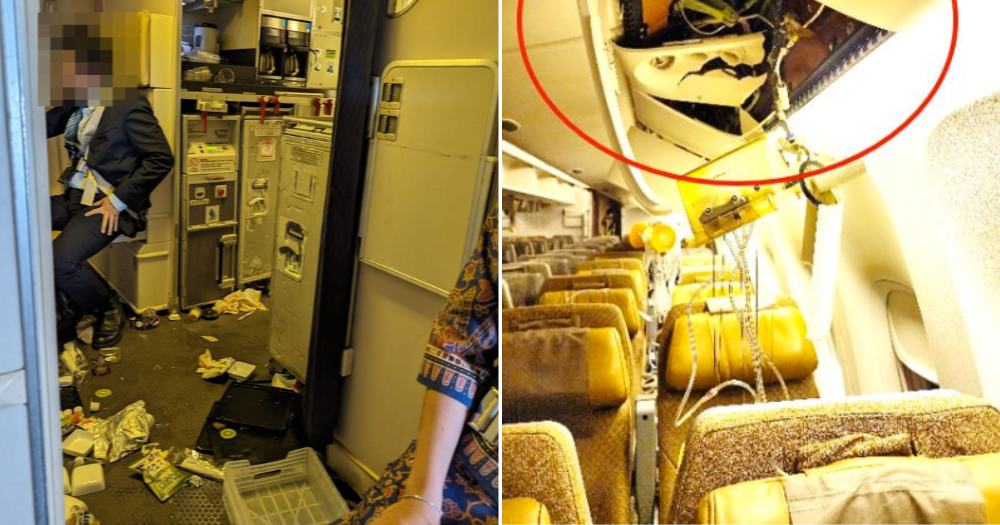
The plane's interior was damaged, including the seats and luggage compartments.
Flight crew actions 'understandable' and 'appropriate'
In its investigation, TSIB referred to satellite images from the time of SQ321's flight over Southwestern Myanmar and noted that there was indeed significant cloud cover over a large area at the time.
They also noted that there were developing convective clouds at the location where the turbulence occurred.
This cloud started at 27,500ft and developed to a cloud top height of about 40,000ft as SQ321 progressed.
"The turbulence experienced by the aircraft was likely the result of this rapidly growing cloud," TSIB noted.
 Image via TSIB.
When the flight crew experienced a rapid change in the gravitational force experienced by the plane, TSIB noted that they initiated manual control inputs to stabilise the aircraft.
The flight crew manually flew the aircraft for 21 seconds before they re-engaged the autopilot.
"Faced with the unexpected turbulence event, the actions of the flight crew are understandable and appropriate for the situation," TSIB concluded.
Crew unable to visually observe clouds
Another issue dealt with by the report was whether the flight crew detected the inclement cloud formations along its flight path.
TSIB noted that the flight crew did not visually observe any clouds in its immediate flight path.
This is despite what was indicated by satellite imagery.
However, TSIB also noted that satellite images provide only top-down views indicating the cloud coverage of the highest clouds, and do not provide information on the clouds’ vertical profile (e.g. what is under the cloud tops, whether there are empty spaces under the layer clouds, and how low are the cloud bases).
TSIB also took into account the observations of other flight crews who were flying in the area at the time, noting that they saw "widespread clouds".
However, TSIB noted that these crews were on a different flight path from SQ321 and their accounts were about the "general condition of the weather over Myanmar".
These other aircraft also used a WXR system that was of a different model from SQ321.
On these, TSIB remarked, "The investigation team is unable to understand why the flight crew of [SQ321] did not see the widespread clouds."
Weather radar malfunction
On-board SQ321 at the time was also a weather radar (WXR).
About four minutes before it encountered the turbulence, the weather radar, which detects rainfall in the vicinity of the aircraft, did not return an indication of storm clouds in the path, as observed by one of the pilots.
Citing Singapore Airlines' (SIA) maintenance records, TSIB noted that there were 103 flights with weather radar-related issues reported.
Of these reports, about 35 per cent pertained to the display of incorrect weather information, which does not trigger fault messages.
Weather radar diagnostics
TSIB later worked with the manufacturer of the weather radar to run diagnostics on SQ321's weather radar.
The affected B777 was flown back to Singapore on May 26.
On this ferry flight back, the ferry flight crew was instructed by the manufacturer to run a diagnostic test on the weather radar.
They were instructed to switch between the aircraft's two selectable weather radar systems, WXR-L and WXR-R.
During a flight, only one WXR system, as selected by the flight crew, operates at any one time.
They were also told to wait five minutes on each mode for the radar data to be fully processed and to photograph the outcome.
When comparing the display output between the two selectable systems, the ferry flight crew found that less weather information was being displayed on WXR-R than on WXR-L.
WXR-R was the system which the SQ321 flight crew used.
 Photo via TSIB.
Pilots' account credible: TSIB
However, the radar's manufacturer noted that the ferry flight crew running the test only waited one minute to photograph the results of WXR-R instead of five, as instructed.
This meant that the result of this test was not representative of the relative system performance between WXR-L and WXR-R, as it takes five minutes for the weather data to be populated, according to the manufacturer.
However, TSIB still found the account of SQ321's pilots — that the weather radar did not properly display the weather data in its path — to be credible.
TSIB noted that there was "no verbal communication recorded between [the pilots] about weather" prior to the turbulence.
One of the pilots was also heard on the recorder expressing shock following the turbulence.
He was heard commenting, "How come suddenly..." and "We hit something... I don't see anything here."
Furthermore, TSIB explained that, according to SIA's maintenance record, there were three recorded instances of weather radar display malfunction on the involved aircraft before the turbulence incident on May 21, 2024.
These instances were on Apr. 29, May 1 and May 15, 2024.
As such, TSIB concluded that it cannot rule out the possibility that the affected SQ321 aircraft experienced a similar situation in which incorrect weather information was being displayed.
SIA's reliability programme
On why SIA had not acted on the three reported incidents, TSIB explained that SIA has a reliability programme that tracks recurring defects for all aircraft systems, including the weather radar.
SIA acts on each defect that is detected and takes additional troubleshooting action when the same defect recurs on the same aircraft three times within 10 days.
"In the case of [SQ321], the three reports did not occur within 10 days," TSIB noted.
TSIB further noted that the aircraft maintenance manual (AMM) by the aircraft's manufacturer did not provide specific guidance on how to troubleshoot reports for the specific malfunction experienced by SQ321's flight crew.
Whenever the malfunction in question was reported, engineers would perform tests in accordance with the AMM.
However, TSIB noted that the AMM cannot replicate the conditions which the radar is exposed to during flights.
The AMM also considers the case closed once the radar passes the AMM test, with no further action considered necessary.
Safety actions by SIA
TSIB noted that SIA has taken a number of safety actions.
Its flight crews have been informed of the potential weather radar issues without fault messages and provided guidance on how to troubleshoot.
SIA has also started sending reports of the weather radar display issue on its B777-300ER fleet to the aircraft manufacturer and the weather radar manufacturer.
It has also equipped its crews with enhanced turbulence monitoring and awareness tools, which are installed in electronic tablets.
Other safety actions include providing weather radar refresher training to its crew and emphasising the fastening of seat belts to passengers.
Safety recommendations to manufacturers
With these findings, TSIB has also made several safety recommendations to manufacturers.
They include the recommendation that the aircraft manufacturer develop guidance for flight crews to ascertain whether a weather radar was displaying incorrect weather information during a flight, as well as the corrective actions to take.
It also recommends that the aircraft manufacturer provide guidance for maintenance personnel to identify such weather radar issues.
To the weather radar manufacturer, TSIB recommended that they develop a means for recording images of weather information displayed to aid in rectification of the display issue.
TSIB also recommended passengers on flights to obey the seat belt signs, to fasten their seat belts while seated, and to not move around the cabin unnecessarily as turbulence could occur without warning.