News


S'pore cannot assume yesterday's strengths will automatically become tomorrow's place: Gan Kim Yong
8 thrusts, 32 recommendations.
May 13, 2026, 12:00 PM
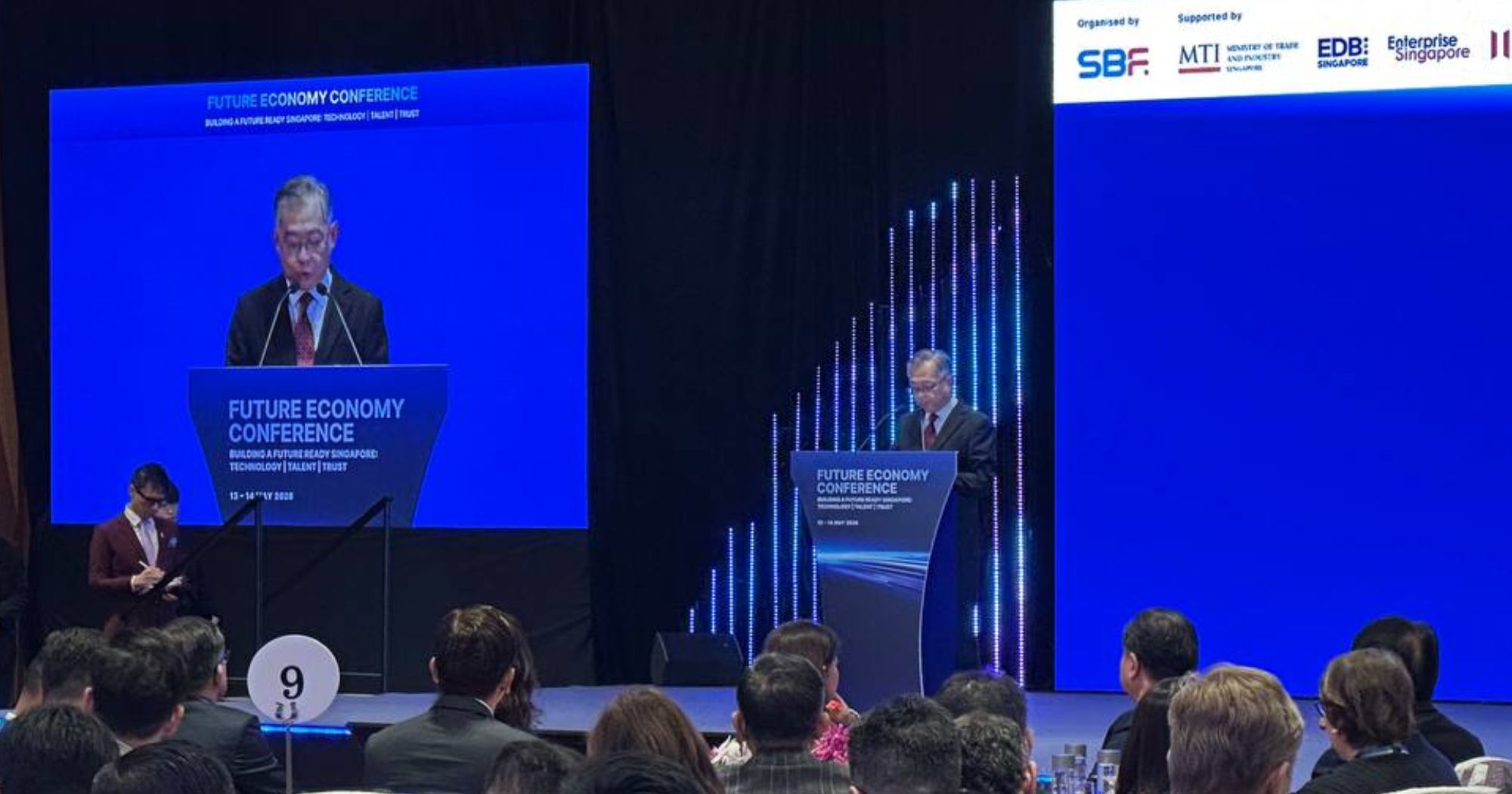
Photo by Mothership


"In a changed world, Singapore cannot assume that yesterday’s strengths will automatically become tomorrow's place," Deputy Prime Minister Gan Kim Yong said at the Future Economy Conference on May 13.
Singapore must thus keep renewing our economy by "building capabilities that matter and bring value to the world, by developing enterprises and workers that are nimble and adaptable, and by strengthening trusted connections that make us resilient and reliable", Gan said.
Gan, who is also the Minister for Trade & Industry, spoke about the creation of a broader range of "good jobs" amongst other recommendations put forth by the Economic Strategy Review (ESR) committees during the conference.
ESR
The ESR was launched in August 2025 to formulate an economic blueprint for Singapore amidst a volatile global environment.
Since its formation, the five ESR committees have conducted over 80 engagements and consultations with Trade Associations and Chambers (TACs), unions, businesses, and workers, engaging more than 7,700 stakeholders across various sectors, the Economic Strategy Review said in a press release.
These engagements surfaced important perspectives on the challenges facing businesses and workers and opportunities to be seized.
The committees have since submitted their recommendations to the government, setting out an economic strategy to” secure growth and create good jobs in a fundamentally changed global environment”.
8 thrusts
The ESR’s recommendations are guided by three imperatives: sharpen Singapore’s value proposition, enhance our agility and adaptability and build resilience alongside efficiency.
The three imperatives undergird eight thrusts that will drive the next bound of economic growth and workforce transformation for Singapore, the Economic Strategy Review said.
- Build global leadership in areas of strength and take bold bets for future growth.
- Make Singapore a global leader in Al solutions and an Al- empowered economy
- Strengthen Singapore's role as a connected and trusted hub
- Foster a more dynamic enterprise ecosystem so more Singapore-based companies can start, scale and succeed globally
- Create more and a broader range of good jobs
- Establish a stronger system for career transitions and worker support
- Empower workers to learn for life and take charge of their careers
- Build economic resilience as a core capability
Creating more good jobs, but also a broader range for what defines a good job
To approach employment in a volatile global market, there is a need for the creation of a broader range of "good jobs".
Recognising that holding back the deployment of AI and automation to preserve existing jobs will erode Singapore’s competitiveness, the ESR suggested that we must be “deliberate in shaping outcomes”.
This can be achieved by ensuring our economic strategies focus on creating good jobs and prioritising technologies that augment rather than replace workers, the ESR suggested.
By supporting the technological uplifting of our workforce, the ESR said we can develop a wider range of roles that offer Singaporeans more meaningful and sustainable career paths.
Ultimately, the recommendations are to deepen local capabilities in growth sectors and advance an AI strategy designed to complement, rather than replace, human workers.
The ESR committees also recommended raising the quality of AI-resilient sectors like healthcare and education while strengthening entrepreneurship as a viable career path.
Full recommendations
Here are the full 32 recommendations:
Thrust 1: Build global leadership in areas of strength, and take bold bets for future growth
a. Sharpen our ability to attract and anchor leading industries.
b. Accelerate the transformation of existing operations.
c. Entrench investments deeply into our ecosystem.
d. Invest in emerging technologies to create new growth engines.
e. Expand into high-value trust-based services.
Thrust 2: Make Singapore a global leader in AI solutions, and an AI-empowered economy
a. Make Singapore a location of choice for high-impact AI solutions.
b. Develop leading firms as “Champions of AI”.
c. Accelerate economy-wide AI adoption.
Thrust 3: Strengthen Singapore’s role as a connected and trusted hub
a. Build next-generation physical and digital connectivity in an integrated manner.
b. Capture more value from orchestrating flows.
c. Build leadership in trusted data flows and digital infrastructure.
d. Reinforce and extend Singapore’s role as an energy hub.
Thrust 4: Foster a more dynamic enterprise ecosystem so that more Singapore-based companies can start, scale and succeed globally
a. Expand access to growth capital and strengthen support for startups.
b. Anchor and grow the next generation of leading enterprises.
c. Strengthen support for Singapore-based firms to internationalise.
d. Enable firms to restructure and transition more smoothly.
Thrust 5: Create more and a broader range of good jobs
a. Stay open while building deeper Singaporean capabilities in growth sectors.
b. Advance an AI strategy that complements workers.
c. Raise quality and attractiveness of jobs in resilient sectors.
d. Strengthen entrepreneurship as a viable pathway.
Thrust 6: Establish a stronger system for career transitions and worker support
a. Create “career bridges” to support workers in at-risk roles.
b. Enable earlier intervention in retrenchment support.
c. Strengthen support for Professionals, Managers and Executives (PMEs).
d. Closely monitor the impact of AI on workers and adjust policies where needed.
Thrust 7: Empower workers to learn for life and take charge of their careers
a. Deepen SkillsFuture support for career transitions and lifelong learning.
b. Integrate learning with work and employer needs.
c. Invest in future-ready skills – AI, human skills, and global exposure.
d. Build a more nimble ecosystem of career and employment services.
Thrust 8: Build economic resilience as a core capability
a. Build energy resilience through strategic buffers and diversification.
b. Prepare for a low carbon and climate-resilient future.
c. Identify and mitigate critical supply chain vulnerabilities.
d. Expand Singapore’s network of trusted partnerships.
The government will study the ESR recommendations and work together with industry partners and unions, business leaders and workers, to translate these recommendations into action, according to the Economic Strategy Review committees.
The full ESR final report will be made available soon.
More information on the ESR can be found on www.gov.sg/features/esr.