




Abroad


S'pore-based ship operator & employee face criminal charges in Baltimore bridge collapse, follows S$2.86 billion settlement
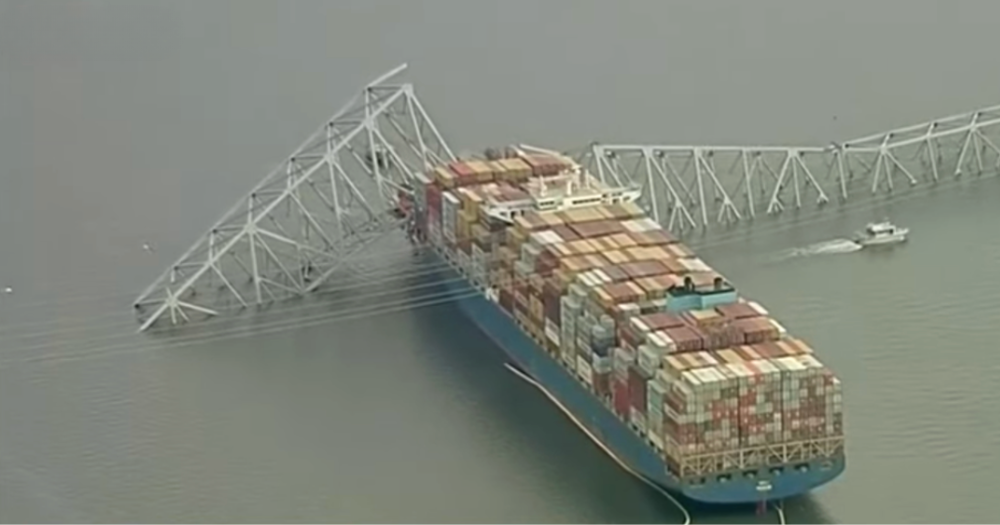
The collision of the Singapore-flagged container ship, the Dali, with the bridge on Mar. 26, 2024, killed six construction workers.
May 13, 2026, 11:40 AM
Top photo from CBS News/YouTube


U.S. prosecutors have announced criminal charges against a Singapore-based ship operator for the deadly 2024 collapse of Baltimore's Francis Scott Key Bridge.
The collision of the Singapore-flagged container ship, the Dali, with the bridge on Mar. 26, 2024, killed six construction workers.
On May 12, 2026, prosecutors accused Synergy Marine Private Limited, based in Singapore, and Synergy Maritime Private Limited, based in Chennai, India, of intentionally relying on an improper fuel pump that contributed to the crash.
According to Associated Press (AP), U.S. prosecutors also accused the ship operator of lying to investigators.
The indictment also named and charged Radhakrishnan Karthik Nair, 47, an Indian national who was the technical superintendent for the vessel.
S$2.86 billion settlement
The indictment follows a US$2.25 billion (S$2.86 billion) settlement between the state of Maryland, Synergy Marine, and Grace Ocean announced in April 2026, with the amount revealed on May 12.
In October 2024, it was previously reported that two Singapore-based companies had agreed to pay the U.S. government a nearly US$102 million (S$134.5 million at the time) settlement.
The two companies, Grace Ocean Private Limited and Synergy Marine Private Limited, were asked to cover the cleanup fee to prevent costs from falling on American taxpayers, reported The Guardian.
Maryland officials estimate that it costs between US$4.3 billion (S$5.47 billion) and US$5.2 billion (S$6.62 billion) to replace the bridge, which aims to open in late 2030, reported AP.
Ship operator accuses U.S. Justice Department of turning accident into crime
Acting U.S. Attorney General Todd Blanche said the incident was a "preventable tragedy of enormous consequence".
The companies and Nair were charged with conspiracy, misconduct causing death, failing to immediately inform the U.S. Coast Guard of a hazardous condition, obstructing the U.S. National Transportation Safety Board (NTSB) and making false statements.
Both Synergy companies were also charged with releasing pollutants into the Patapsco River.
Synergy Marine expressed its disappointment and accused the U.S. Justice Department of turning the accident into a crime, reported AP.
The company said: "This was a maritime casualty that should be assessed through the full factual, technical and regulatory record, rather than through selective mischaracterisations in a criminal indictment."
"Synergy will vigorously defend itself against these inaccurate allegations."
According to AP, Nair's lawyer, David Gerger, said his client "thinks about this accident every day, but he certainly did not cause it".
Events of the collision
The Dali, which was bound for Sri Lanka, lost power twice in a four-minute span as it shifted from sea to the Port of Baltimore, crashing into the bridge.
According to AP, investigators said a loose wire in a switchboard likely caused the first power loss, which led to the steering failure.
The second power loss was due to the pump to supply fuel not being designed to automatically restart after a blackout.
Investigators said that if the proper fuel pumps had been installed, the vessel would not have crashed into a supporting column of the bridge.
Head of the U.S. Federal Bureau of Investigation's (FBI) Baltimore office, Jimmy Paul said: "As alleged, the bridge was struck and collapsed because those who were responsible for the ship’s operation deliberately cut corners at the expense of safety."
The U.S. government alleged that two of the Dali's sister ships encountered the same problems, tracing back to the same pump type.
The FBI also found that the ship had experienced two blackouts in port a day before the incident, but failed to report it to the NTSB.