Court


'You have written this piece to convey falsehoods': Davinder Singh puts to Bloomberg's Low De Wei, who disagrees
Senior Counsel Davinder Singh sought to challenge Low's argument that non-caveated property deals in Singapore are "shrouded in secrecy".
April 13, 2026, 10:52 PM
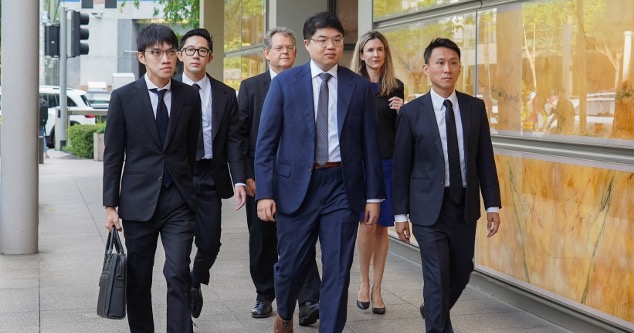


Bloomberg reporter Low De Wei was grilled on the witness stand by Senior Counsel Davinder Singh, the lawyer representing Manpower Minister Tan See Leng and Home Affairs Minister K Shanmugam, over an intense two hours on the fifth day of the defamation trial.
Singh questioned Low about his representation of non-caveated property deals in Singapore as "shrouded in secrecy" in his article from Dec. 12, 2024.
This article, published by Bloomberg, is at the centre of the trial.
Shanmugam and Tan have brought the lawsuit against Bloomberg and Low over this article, arguing that it falsely implied they had taken advantage of the lack of disclosure requirements to make property deals non-transparently.
Secret to the public?
Low took the witness stand at 10:30am. After a few questions from Low's lawyer, Senior Counsel Chelva Retnam Rajah, Singh began his cross-examination.
Singh questioned Low on his understanding of the word "secret". Low replied that in the case of his article, he was referring to information not known to the public.
Singh brought up two online databases where a person can look up information on property transactions: the Integrated Land Information Service (INLIS), and the Urban Redevelopment Authority (URA)'s Real Estate Information System (REALIS).
He put forth that a person can search for a specific property address on both platforms, and obtain various details about the property's transfers once they are completed, even if the transactions are not caveated.
Such details include the identity of the seller, the purchaser, and the purchase price.
Steps first
Low asserted that there were several steps to the search before a member of the public can obtain the information.
Singh accepted this, and asked him if it is correct that any member of the public can access the information by taking these steps.
Low affirmed this, and agreed that he was aware of it before publishing his article.
Anyone can, by searching for a specific address on both INLIS and REALIS, access these transaction details, and find out whether a transaction had caveats lodged, Singh asserted.
Low eventually agreed that what Singh had said was correct.
Distinction between ease of access and secrecy
Since anyone could have found them out, there would be no secrecy to whether a transaction was caveated or not, and no secrecy as to the names of the seller and buyer, and the price, Singh argued.
Low disagreed. He asserted that it is "very expensive" to do even a few simple searches on INLIS, and he doubted that people would have "thousands and thousands of dollars" to search property deals every day.
Singh asked whether it was his evidence that because doing a search entails a cost, the information is secret to the public.
Low then said it's not just about the cost, but that a person would also need to know what they are looking for.
It might not be known that a certain transfer happened in the first place, he added shortly after.
Low then argued that in his article, he meant that while people often find out about property deals through REALIS, it is very difficult for them to find out about non-caveated deals.
That's why there is non-transparency, he added.
The judge, seeking clarification, asked if Low meant that non-caveated deals are "shrouded in secrecy" because of the way a search on them has to be done. Low agreed.
"Disingenuous"
After a break, Singh focused on a portion in the Bloomberg article in question.
It began by referencing Law Minister Edwin Tong's response to a parliamentary question on Oct. 14, 2024, (Tong was 2nd Minister for Law at the time) and then went on to say the following:
"The Singapore Land Authority [SLA], a statutory board under the law ministry, does not collect general data on landed residential properties acquired through trust companies if the beneficiaries are Singapore citizens.
In essence, that means that property agents and other service providers involved in the transactions are primarily responsible for verifying the identities and source of wealth of Singaporean mansion buyers."
Singh asserted that these points were included in article to give readers the false impression that the Singapore government does not know the identities of the benefactors, if they are Singapore citizens who acquired the properties through trust companies.
The article suggests that it is left to the private sector to verify those identities, Singh added.
"What you did was disingenuous," he said to Low, who disagreed.
Low said that when he reached out to the Singapore Land Authority (SLA) while drafting the article, what he understood of their response was the agency was "very keen" to emphasise the role of property agents and other service providers as "primary gatekeepers" for verifying the identities and wealth sources of Singaporean buyers.
The other service providers were not identified in the article.
"Selective"
Singh then questioned why, given that Low had earlier established that "secrecy" in the article focuses on what the public does not know, the article would discuss whether the government knows this information.
Singh said Low had also received a reply from the SLA, about the government knowing who the benefactors are.
"Why are you selective in falsely conveying to readers that because the government doesn’t [collect that data], it’s left to others to do it?" Singh asked.
He also asked Low why did he "falsely create the impression", based on all the replies he received from the government and others, that because the government doesn't know, it's left to private service providers to find out.
Low disagreed that he did so, saying that if he had wanted to make such a point, he would describe the private sector as the "only" ones responsible, instead of primarily responsible for the task.
"It becomes quite clear you have written this piece to convey falsehoods," Singh said.
Low said he completely disagreed.
The trial will continue on Apr. 14.
Top images by Azrizal Abu Che'/Mothership