



Parliament


S'pore must ensure growth remains inclusive & creates meaningful careers for all: Tan See Leng
By December 2025, over 80 per cent of university graduates from the 2025 cohort had secured employment.
March 03, 2026, 05:18 PM
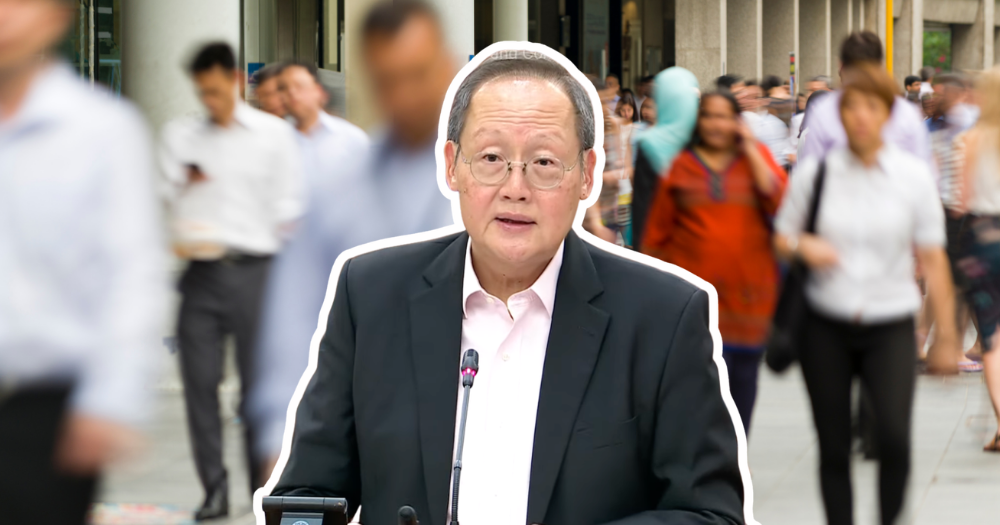


Singapore’s labour market remains resilient, said Minister for Manpower Tan See Leng on Mar. 3.
Tan was speaking at the Committee of Supply debates for the Ministry of Manpower (MOM) in Parliament.
Unemployment rate low at 2.9 per cent
According to Tan, as of December 2025, Singapore has recorded 17 consecutive quarters of employment growth since it emerged from Covid-19 pandemic in 2021.
The resident unemployment rate stood low at 2.9 per cent, while the labour market remained tight, with more vacancies than jobseekers.
Real median incomes also grew by 8.3 per cent from 2020 to 2025.
Lower-wage workers also saw real incomes grow by 15 per cent from 2020 to 2025, supported by productivity improvements and targeted wage support.
Three key priorities
In his speech, Tan outlined three key priorities for MOM.
1. Empowering Singaporeans through every stage of life
Supporting fresh graduates
According to Tan, more than four in 10 job openings are entry-level PMET roles suitable for young graduates.
He also revealed that by December 2025, over eight in ten of university graduates from the 2025 cohort had secured employment, comparable to the previous cohort.
More than 400 graduates have also begun traineeships under the Graduate Industry Traineeships (GRIT) programme, a joint initiative by MOM and Workforce Singapore (WSG).
Tan stated that GRIT applications will be extended to the 2026 cohort.
He pointed out that work-based learning pathways are also being strengthened through programmes such as the AI Apprenticeship Programme, as well as the SkillsFuture Work-Study Programme (WSP), which will be enhanced to support more flexible pathways that combine training and work.
To boost global exposure, MOM will also be expanding the Overseas Market Immersion Programme (OMIP), which has supported more than 120 local professionals since its launch in 2024.
Free subscriptions to AI tools for six months
As previously announced by Prime Minister Lawrence Wong as part of his Budget 2026 statement, those who take up selected SkillsFuture AI courses will receive free subscriptions to premium versions of best-in-class AI tools for six months.
Tan shared that MOM has been engaging providers such as Google, Manus, Microsoft and OpenAI, and further details will be announced in due time.
Workforce and Skills Singapore (WSSG)
SkillsFuture Singapore and Workforce Singapore will also be merged into a new statutory board, Workforce and Skills Singapore (WSSG), Tan announced.
Jointly overseen by MOM and the Ministry of Education (MOE), the new agency aims to streamline skills development and job support under a single umbrella.
"Bringing them under one roof creates a single, powerful engine for human capital development," Tan said.
Support for senior workers
As previously announced, retirement and re-employment ages will be raised to 64 and 69, respectively, from Jul. 1, 2026, as part of plans to reach 65 and 70 before 2030.
The Senior Employment Credit will be extended until end-2027 to continue supporting employers hiring senior workers, while CPF contribution rates for senior workers will increase in 2027 to strengthen retirement adequacy.
Eligible Singaporeans aged 50 and above with CPF balances below the Basic Retirement Sum will receive a top-up of up to S$1,500.
"For seniors who may face challenges in building up enough savings despite their best efforts, we are committed to support you."
A new CPF investment scheme featuring life-cycle products that reduce risk with age will also be introduced.
Tan noted that the CPF risk-free returns remain highly attractive, and not everyone has the appetite for investment risk. Hence, this new scheme will be voluntary.
2. Enabling businesses to thrive in a changed landscape
Tan said Singapore will continue to remain globally connected and open to talent that can complement the skilled local workforce, while reducing reliance on foreign labour where there is scope to raise productivity.
ONE pass
According to Tan, since the launch of the Overseas Networks and Expertise (ONE) Pass in 2023, more than 8,000 individuals have taken it up.
Tan noted that many of these individuals contribute to sectors critical to Singapore's future economy.
In order to attract top talent in areas such as artificial intelligence and quantum computing, a new ONE Pass AI and Tech track will be introduced in January 2027.
Minimum qualifying salaries
He also noted that Employment and S Pass Qualifying Salaries are regularly updated to keep pace with local wage benchmarks, ensuring that foreigners who come here do not compete mainly based on accepting lower salaries
As previously announced during the 2026 Budget announcement, Employment Pass (EP) minimum qualifying salaries will be raised from S$5,600 to S$6,000 for new applications from Jan. 1, 2027, with renewals affected from Jan. 1, 2028.
S Pass qualifying salaries will also rise, with the first increase from S$3,300 to S$3,600.
Prioritising quality for Work Permit holders
Work Permit levies will be streamlined across sectors, with higher levies for basic-skilled workers in the Marine Shipyard and Process sectors to encourage companies to hire higher-skilled workers.
For the Manufacturing and Services sectors, levy tiers will be consolidated.
Tan said they will retain existing levy rates for the highest tier, so that firms with a higher reliance on Work Permit holders continue to pay higher rates.
Eight new occupations in food services, social services and air transport will also be added to the Non-Traditional Source Occupation List (NTS-OL) from September 2026.
Enterprise Workforce Transformation Package
Tan said that over S$400 million has also been set aside for the Enterprise Workforce Transformation Package (EWTP).
From March 2026, firms can tap the new SkillsFuture Workforce Development Grant (Job Redesign+) (WDG(JR+)) under the EWTP for up to 70 per cent of project costs, capped at S$150,000 per company.
A redesigned SkillsFuture Enterprise Credit will also be launched in late 2026.
3. Building workplaces that work for all
Tan said economic growth and business transformation must go hand-in-hand with fairness and inclusion.
MOM will also continue efforts to improve wage outcomes for lower-wage workers, Tan said, including through raising the Local Qualifying Salary and extending the Progressive Wage Credit Scheme to 2028.
From 2027, the minimum qualifying threshold for wage increases under the scheme will be raised from S$100 to S$200 to better target firms investing in capability and workforce development.
Tan shared that MOM has also signed an MOU with the Specialists Trade Alliance of Singapore to embark on a pilot to uplift the electrical trade.
As part of this pilot, Tan said they will work with industry to develop initiatives for tradespeople, such as a more structured career and skills progression ladder, and apprenticeships. They started with the electrical trade, given its essential role in Singapore's future economy.
Concluding his speech, Tan said Singapore’s strong labour market and wage growth reflect deliberate policies to invest in workers’ skills, support business transformation and uphold fairness at the workplace.
"The road ahead will be neither certain nor easy," he said. "But we have proven over the last 60 years that we can overcome any challenge as long as we are prepared to tackle them collectively, together."
"We did it before, and we will do it again."
Top photos from MDDI/YouTube and Canva