Parliament


Speed limit for PMAs in S'pore to be set at 6km/h from Jun. 1, matches brisk walking pace
Other regulations were also introduced.
February 03, 2026, 02:44 PM

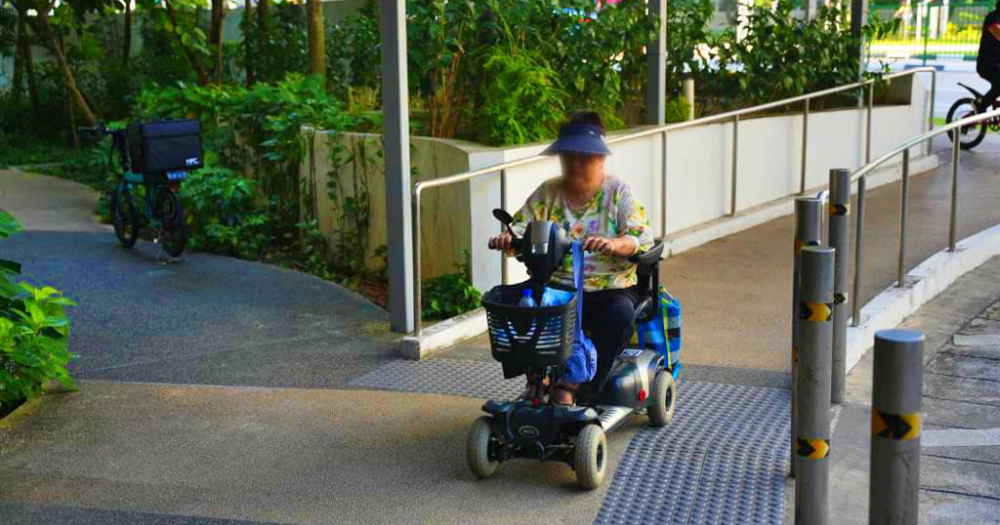
 Personal mobility aid (PMA) users in Singapore will see a new speed limit of six km/h from Jun. 1, 2026, under new regulations imposed by the Land Transport Authority (LTA).
A number of changes pertaining to PMAs and Personal Mobility Devices (PMDs) were announced by Minister of State for Transport Baey Yam Keng in parliament on Feb. 3.
Speed limit changes
Users of motorised PMAs traveling on public paths will only be able to ride at a maximum speed of six km/h, or a brisk walking pace, reduced from the current 10 km/h.
From Jun. 1, 2026, selling mobility vehicles with a device speed limit above six km/h will carry penalties of up to S$20,000, imprisonment up to 24 months, or both, with higher penalties for non-individuals and repeat offenders.
Displaying and advertising non-compliant mobility vehicles will carry penalties of up to S$10,000 or imprisonment up to 12 months, or both.
Users who ride mobility vehicles at a speed exceeding six km/h on public paths will face fines up to S$2,000 or up to six months' imprisonment, or both, with higher penalties for repeat violations.
PMA users with existing devices that have speed limits of up to 10 km/h will be allowed a transition period to continue using their devices until Dec. 31, 2028.
However, they must ride no faster than six km/h on public paths.
PMA dimension and weight limits
From Jun. 1, PMAs will have new size and weight regulations, set at 120 centimetres in length, 70 centimetres in width and 150 centimetres in height.
PMAs must also not exceed a laden weight of 300kg to be allowed on public transport and public paths, in line with existing dimension restrictions on public transport.
Offenders caught riding such devices on public paths face penalties of up to S$10,000 in fines, imprisonment of up to six months, or both, with penalties increasing for repeat offenders.
Selling oversized mobility vehicles for use on public paths will also be an offence, with penalties of up to S$20,000, imprisonment of up to 24 months, or both, with higher penalties for non-individuals and repeat offenders.
Medical certificate needed
With the exception of certain groups, users of mobility scooters will also need to possess a valid Certificate of Medical need.
This also applies to equivalent devices, such as manual wheelchairs with detachable motorised attachments steered by handlebars.
To attain a Certificate of Medical Need and ride on public paths, relevant users will have to undergo the Assessment for Mobility Scooter (AMS), which can be provided by a user's regular doctor, occupational therapist or a general practitioner from Feb. 27.
Exemptions
Groups exempted from the aforementioned requirements are:
- Seniors aged 70 and above
- Beneficiaries of subsidised mobility scooters from the Seniors' Mobility and Enabling Fund (SMF) before Feb. 27, 2026
- All existing and prospective beneficiaries of subsidised mobility scooters from the Assistive Technology Fund (ATF)
- Past and future applicants of the Ministry of Health's (MOH) disability schemes who are assess with Activities of Daily Living (ADL) needs in either 'Mobility' or 'Transferring'
Apart from seniors aged 70 and above, all other users can check their exemption eligibility via LTA's OneMotoring website using their NRIC and date of birth from Feb. 27.
Users will have three months to obtain the certification, Baey said.
From Jun. 1, enforcement officers will be deployed to request for users' particulars and check for their eligibility to use mobility scooters.
Those caught riding on public paths without a Certificate of Medical Need will face penalties of up to S$2,000 in fines, up to six months' jail, or both.
The penalties also apply to businesses that employ or allow individuals to ride mobility scooters on a public path during work without a valid certification.
Baey said the changes were welcomed by engaged genuine mobility scooter users, who voiced their concerns about the increasing misuse of mobility scooters.
The new regulations will not apply to motorised wheelchairs, which Baey said currently does not have a problem of misuse.
Mandatory registration of mobility scooters
Mobility scooters and its equivalents will need to be registered under LTA from Jun. 1, to strengthen the enforcement of the rules governing mobility scooters and ensure only compliant devices are obtained.
The requirement will be rolled out in two phases.
In the first phase pertaining to new mobility scooters, retailers can only advertise, display and sell registered mobility scooters from Jun. 1.
LTA's appointed vendor will conduct checks to ensure the scooter's model is whitelisted and complies with device requirements before being registered under the retailers.
At the same time, business operators importing, manufacturing or wholesaling mobility scooters will need to have a Health Sciences Authority (HSA) medical device dealer licence.
The importer or manufacturer must also ensure the mobility scooter model is listed on the HSA Class A Medical Devices Database before the scooter can be whitelisted and registered for sale.
Retailers are also responsible for checking via OneMotoring that prospective owners possess a Certificate of Medical Need, or is exempted from requiring one.
In the second phase pertaining to existing mobility scooters, LTA will deploy roving stations at community touchpoints from mid-2027 to facilitate registration.
Compliance checks on the device and user will be conducted by LTA's appointed vendor before registrations.
From Jan. 1, 2029, it will also become an offence to use a non-registered mobility scooter on public paths, and only retailers can register new mobility scooters.
Fire safety
Under the new regulations, registered e-scooters will be required to be certified to the UL2272 fire safety standard and undergo periodic inspection every two years.
PMD-related fires were found to have largely been related to non-UL2272 certified e-scooters, or illegally modified to become non-UL2272 certified.
From Jun. 1, it will be an offence to keep non-UL2272 certified e-scooters, on top of riding it on public paths or roads, which is currently already an offence.
Keeping devices that do not comply with the safety requirements, or unsafe devices, will warrant a penalties including fines of up to S$2,000, imprisonment up to three months, or both, with higher penalties for non-individuals and repeat offenders.
Top images via Baey Yam Keng/Facebook