



Branded
I followed a S’pore police officer for half a day. Here’s what I learned.
Sneak peek into the lives of those who keep our country safe.
The sun was just beginning to rise as I pulled into Woodlands Police Division Headquarters on an early Wednesday morning.
I couldn’t help but yawn at times, blinking slowly to ease the dryness in my eyes.
Beside me, Muhammad Albaqir Bin Abdul Rahim, 24, was alert, focused, and listened attentively as I peppered him with questions.
This was a typical day for him, he explained, noting that police officers – specifically, Ground Response Force (GRF) officers – had to report before 7:30am for their morning briefings.
Though he would be doing his usual mobile patrol with his colleague around the Mandai area, he admitted that he was slightly nervous today.
Makes sense: it was a slightly different day compared to his usual patrol, as I’d be tagging along.
Despite his relative youth, he spoke confidently about his work and appeared comfortable with his role.
Watching him prepare for the day ahead, it was hard to imagine that this role had not always been part of his plan.
A once very timid kid
If you asked Albaqir when he was young what he would be doing, becoming an officer with the Singapore Police Force (SPF) was the last thing on his mind.
Describing himself as a “very timid” kid, he said he used to be the guy who lay low and avoided putting himself in the middle of any conflict.
Yet it all changed in secondary school when he heard of a slashing incident at a local educational institution.
Hearing about this incident in such close proximity sparked his interest in learning more about the criminal justice system and Singapore’s laws.
This in turn led to his decision to join the SPF following his graduation from ITE, as he wanted to be part of a team that the public can trust and rely on to keep Singapore safe.
The opportunity to join the SPF came in the form of its Policing-Study Diploma Programme, which allowed him to develop practical skills within the Force while also deepening his knowledge of the criminal justice system and the law.
On patrol
At Woodlands Police Division Headquarters, officers began slowly trickling in as it approached 7:30am.
Once everyone was present, the briefing began — a Team Leader guided the team through work updates and explained where everyone would be deployed for the day.
 Photo by Mothership.
The team discussed recent developments, and how these could impact the safety and security of Singapore, especially in their area of patrol.
After the briefing ended, Albaqir then brought us down to the ground floor of the Division Headquarters, where officers were methodically gathering their equipment.
It was then time to head out to start patrolling.
Although I arrived at headquarters with a colleague, I was the only one who could sit in the car because the officers needed to be ready in case an unexpected arrest became necessary.
Hearing that, I felt nervous but excited at the same time — would I actually see an arrest happen in real time?
I sat in the back of the vehicle, where a gated metal barrier separated the front seats from the rear.
“Are you comfortable back there, Amber?” Albaqir asked me. Unlike regular car seats, the back seat of the police car was made of hard plastic.
The officers told me there were numerous times when they had to sit in the back seat after an arrest, such as in instances where the subject happened to be particularly rowdy.
Now I was feeling nervous.
While Albaqir was sitting in the passenger seat of the car, monitoring updates from the team on his phone, his colleague, Mohamed Faez, drove along the route.
Faez has been with the SPF since 2014 and is a Field Training Officer (FTO), meaning he is responsible for training and mentoring new GRF officers posted to his team.
“If he does anything wrong, I’m responsible,” Faez joked.
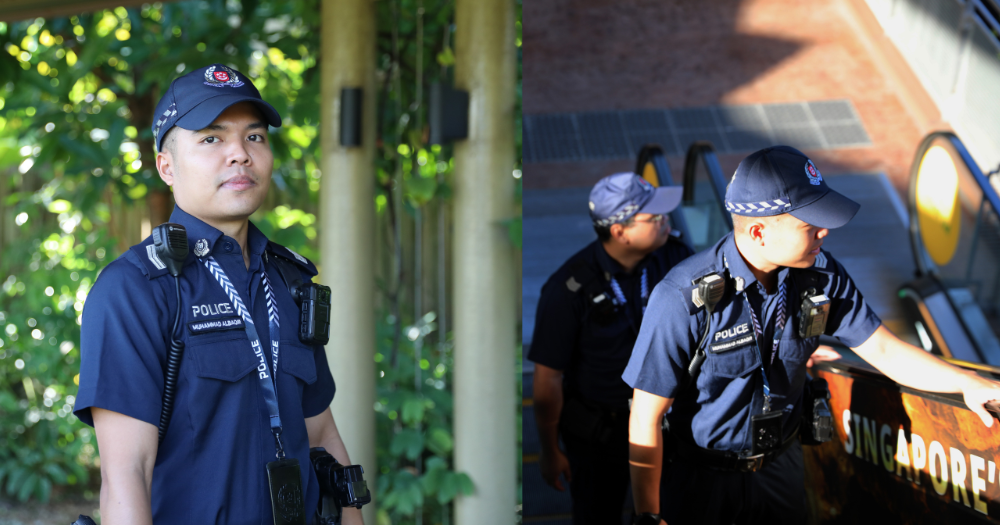
We subsequently pulled into Mandai Wildlife Reserve and disembarked from the car to continue the patrol on foot.
Both officers appeared calm yet alert as they moved through the area.
 Photo by Mothership.
Such patrols are meant to bolster existing security measures at tourist attractions, deter public security incidents, and foster a sense of security among the public and tourists alike.
Making arrests and dealing with uncooperative suspects
Patrolling tourist attractions is only one part of their responsibilities, however.
Officers are also deployed at Woodlands Checkpoint and in housing districts, responding to incidents and emergencies, and enforcing the law.
When Albaqir was stationed at Woodlands Checkpoint, he recalled gathering information on individuals, such as their travel history and preparing arrest reports, among other tasks.
In such instances, he would work together with teams from the Immigration & Checkpoints Authority (ICA) and the Central Narcotics Bureau (CNB) to ensure the situation is handled efficiently and in accordance with procedure.
It’s also important to remain calm in high-pressure situations as a GRF officer — Albaqir shared how he has dealt with numerous cases where individuals were uncooperative, including an elderly man who used an axe to destroy a neighbour’s window pane.
He stressed the importance of staying composed, not letting arrestees provoke you, and clearly explaining the reasons for their arrest and the next steps.
Albaqir credits colleagues like Faez for patiently explaining even the smallest details, which helped him understand the workings of the SPF.
He stressed that collaboration was key.
“As a team, we need to work together. If you’re not working together, what’s the point of having a team?” he said.
Advice for those wanting to pursue a career in the SPF
When asked if he had any advice for someone considering a career in the SPF, Albaqir advised them to know their reasons for wanting to join in the first place.
He didn’t sugarcoat the realities of the job, remarking that SPF officers are constantly exposed to high-risk situations and thus must undergo stringent training to equip them with the skills and confidence to handle highly tense situations.
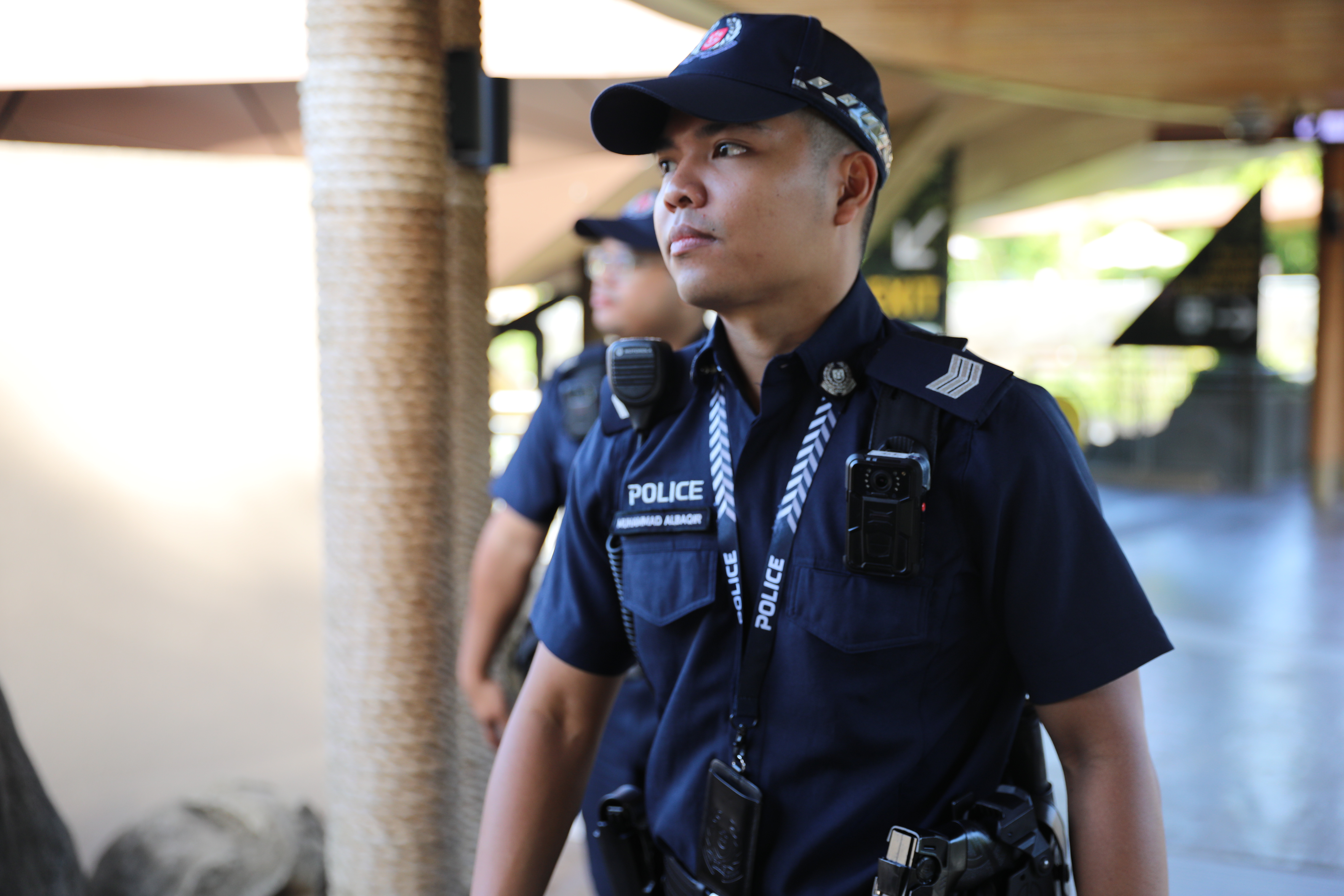 Photo by SPF.
For those interested in pursuing the role, Albaqir said that the SPF Policing-Study Diploma Programme offers a great opportunity to learn both the theoretical aspects of policing and the criminal justice system, alongside the practical experience of being an SPF officer.
Seeing what happens behind the scenes was an insightful experience that helped me understand how SPF officers work to keep Singapore safe.
If I’m being honest, part of me had hoped something would have happened along the way so I could see the officers in action.
Unfortunately (or maybe fortunately), my brief glimpse into their lives ended quickly and without any incident.
Yet it definitely sparked my interest in learning more about the SPF.
What is the SPF Policing-Study Diploma Programme?
The SPF Policing-Study Diploma Programme allows one to pursue a sponsored diploma while being employed full-time with the SPF as a Direct-Entry Sergeant, drawing a full salary with a S$35,000 sign-on bonus.
Those under the 2.5-year programme can look forward to studying a range of different subjects, including Business Skills and Law, Cybersecurity and Forensics, and Criminology and Policing Skills.
They will ultimately graduate with a Diploma in Policing & Security Management from Temasek Polytechnic.
The programme is open to graduates with an NITEC Certification with a minimum GPA score of 2.0, or any Higher NITEC Certification.
You can learn more about the programme here.
This branded article by the SPF made this writer curious to learn more about what their officers do.
Cover photo via SPF.