Branded
People who fixed Tengah’s cooling system share behind-the-scenes & how they became friends with residents
“CCS is cooler than you think!” a resident wrote.
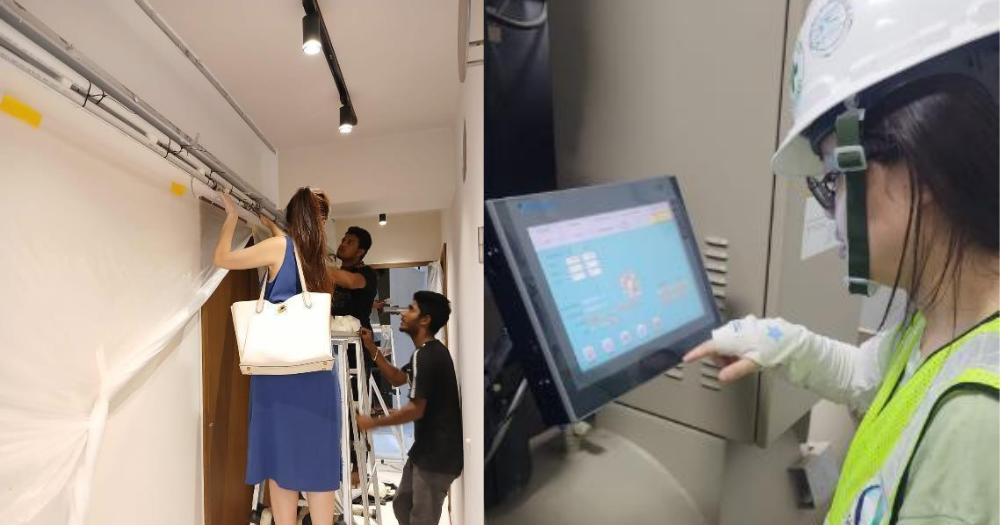
“It was late at night, just after the first batch of Tengah residents collected their keys sometime around August 2023,” Ayu Martiningsih recalled. “The moment the resident turned on the system, water started dripping.”
Ayu, as one of many SP Group staff volunteering to be on standby to tackle issues arising from the centralised cooling system (CCS) during the first move-ins, arranged to meet the resident the next morning with technicians in tow. While the problem was fixed quickly, more calls started coming in.
“That was when my heart sank,” she shared.
Covid-19 delays had compressed the timeline to hand over units to residents, resulting in workmanship issues. At the time, SP Group’s priority was to get technicians on site as fast as possible, but there was another issue: the gap between technical jargon and residents’ understanding.
“The technicians were explaining in engineering terms, and residents couldn’t follow. That’s when I realised someone needed to bridge that gap – to explain what was going on, how it would be fixed, and how long it would take.”
Ayu eventually became that bridge as part of the Resident Engagement team for the Tengah estate.
Today, the situation has improved considerably. In SP Group’s latest engagement survey, 84 per cent of CCS subscribers rated SP Group’s responsiveness as “good” or “very good”, and around 70 per cent said they would recommend the system to others, a huge turnaround from the early days.
At Tengah, flat cooling works a little differently. Instead of every flat having its own condenser, chilled water from centralised plants installed on the rooftops of selected HDB blocks are piped into homes to keep them cool.
With air conditioning accounting for 30 to 40 per cent of home energy use, more efficient cooling presents an opportunity to cut emissions significantly. The system, developed by SP Group, is part of its “smart energy town” concept that also includes solar panels and electric vehicle charging points.
Building trust from the ground up
For months, Ayu was practically living in Tengah.
“I was there every weekday from 8am to 9pm,” she said. “I’d open doors to empty [unoccupied] units for the technicians, stay while repairs were done, and lock up at night.”
The team also had a target and that was to get a technician within the same day, if possible, or at least within 24 hours from the time a case was reported. “From the time we entered the home, we aimed to resolve the issue within 10 working days,” she added.
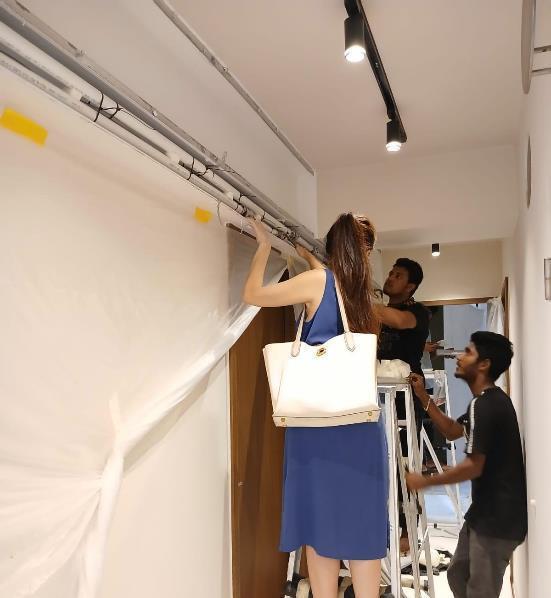 Ayu would spend her nights and days doing rounds of inspections across Tengah housing estates. Image via SP Group
Her phone never stopped buzzing, whether it was a video of dripping vents at 2am or worried residents asking for help at 5am. It was physically draining, but it built trust between the team and Tengah homeowners.
“There was one anxious resident who called me saying, ‘Ayu, there’s a waterfall in my house!’” she recalled. “Turns out the issue was with the toilet drain pipe and had nothing to do with the CCS. We had a good laugh about it after that.”
Over time, Ayu found that most residents just wanted reassurance and transparency.
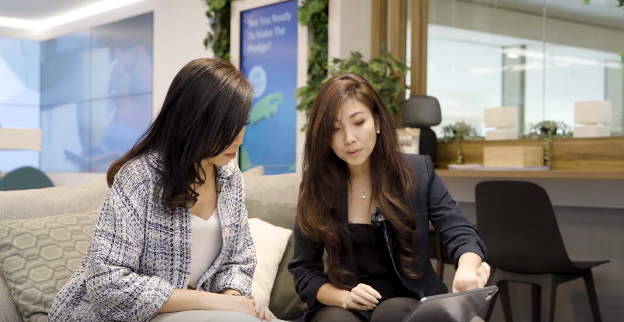 Ayu explaining the CCS onboarding process to a resident. Image via SP Group
“Once I explained things clearly and showed that we were following up, most were very understanding. Some even became friends with me.”
12-hour days behind the scenes
While Ayu was fighting fire on the frontlines, engineers were tackling the root causes behind the scenes.
One of them was Li Yanhong, a Principal Engineer for the Sustainable Energy Solutions team at SP Group.
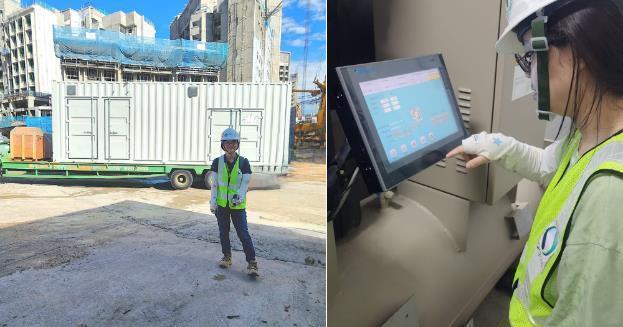 Photos of engineer Li Yanhong at Tengah site. Photos via SP Group
“For us, the pressure started even before residents moved in,” said Li. Covid-19 delays meant compressed timelines and weeks of back-to-back 12 hours, from 9am to 9pm, trying to test and fine-tune every chiller and fan coil unit (FCU).
So when the first leaks and condensation issues appeared, the engineers felt it keenly.
One of the toughest moments came when chilled water wasn’t flowing properly to a block just days before key collection. Li and another teammate spent days running test after test, poring over data, until they noticed one flow reading that didn’t look right. The cause was a faulty valve that was only partially open.
“We cut the pipe and replaced it just one day before residents moved in. When my chief engineer called to check in, he could hear how happy I was.”
Over time, patterns emerged. Leaks, for example, were traced to overtightened brass T-joints that cracked with expansion and contraction within the flats. “We collected all the joints, measured and compared installations by different contractors, and found that overtightening was the culprit,” Li says.
That led to the pre-emptive replacement of brass T-joints, including uncracked ones, with stronger galvanised iron T-joints, a new installation manual and stricter testing procedures. The engineering team also developed an app-based checklist for quality control, documenting checks, faults, and rectifications for every unit before handover.
Tengah’s CCS now a valuable showcase
By mid-2024, Tengah’s pioneering residential CCS had made a 180-degree turnaround. With extra manpower, improved workmanship, refined processes, and more resident engagement, complaints dropped significantly.
“The most heart-warming thing is when residents tell me, ‘All is good now. The bills are fine. The air-con is cold,’” Ayu said. “That makes all the effort worth it.”
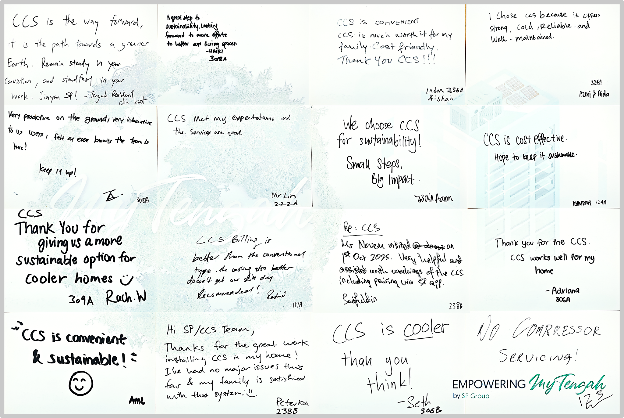 Happy residents, happy life. Image via SP Group
Tengah’s CCS now serves as a valuable showcase, not just for SP Group and Housing & Development Board, but for Singapore’s wider push towards sustainable cooling solutions.
The CCS is an important piece towards achieving Singapore’s net-zero emission ambitions by 2050.
While Tengah’s CCS had a bumpy start, the lessons learnt will pave the way towards more sustainable urban cooling solutions in other developments.
This article is brought to you by SP Group.
Top photo from SP Group.