




News

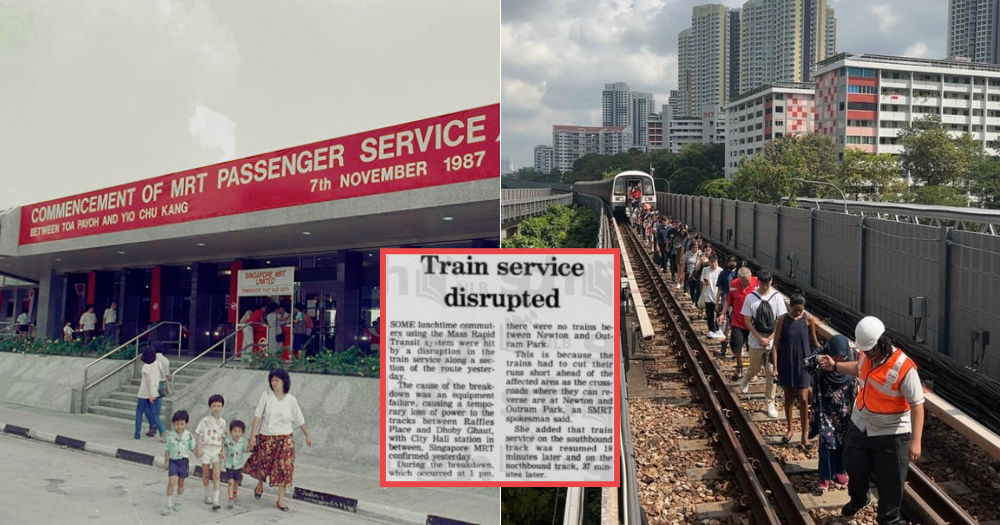
I tried finding out when S'pore MRT trains first broke down. Answer: 3 months after opening in 1987.
A ride through the past.
September 29, 2025, 02:49 PM


During Singapore's 60th National Day celebrations, the live audience was asked to wave placards in the air expressing their hopes and dreams for Singapore.
One man's placard read: "I want to have a reliable and affordable public transport system."
It turned out to be a foreshadowing of things to come.
No more than a week later, train operations along the entire North East Line (NEL), as well as the Sengkang-Punggol LRT
(SPLRT) ground to a halt on Aug. 12 due to a power switchboard failure.
NEL operations resumed normal service after three hours, while the LRT lines only returned to normalcy the following morning.
In the month afterward, the rail network would suffer eight more disruptions.
The timing of it all got me wondering: When did train disruptions enter our national consciousness, and must we necessarily accept it as part of our lives?
A point of departure?
To be clear, while I find that public transport fares are affordable now, it's hard not to wonder about reliability whenever train disruptions appear in the headlines.
In fact, according to the latest statistics from the Land Transport Authority (LTA), rail reliability has indeed fallen to a five-year low, despite remaining well above the reliability yardstick.
It feels to me, as someone almost half as old as Singapore, that train disruptions weren't a thing growing up.
Then, past a certain point in recent history, they just wouldn't stop being a thing.
2010s
Anyone whose NRIC number starts with "S", and maybe the pioneers of the "T" prefixed generation, will definitely remember the episodic disruptions of the early 2010s.
By the end of 2009, the MRT network grew to comprise four lines — North South Line (NSL), East West Line (EWL), NEL and Circle Line (CCL) — that stretched 118.9km.
Together with the LRT lines, the rail network extended over a total distance of 147.7km.
At the helm of the Ministry of Transport (MOT) was Lui Tuck Yew, whose tenure from 2011 to 2015 would be marred by major disruptions along Singapore's rail network.
If I had to pick a poster child for this era, I'd choose the July 2015 twin breakdown of the NSL and EWL.
It's hard to forget scenes like these.
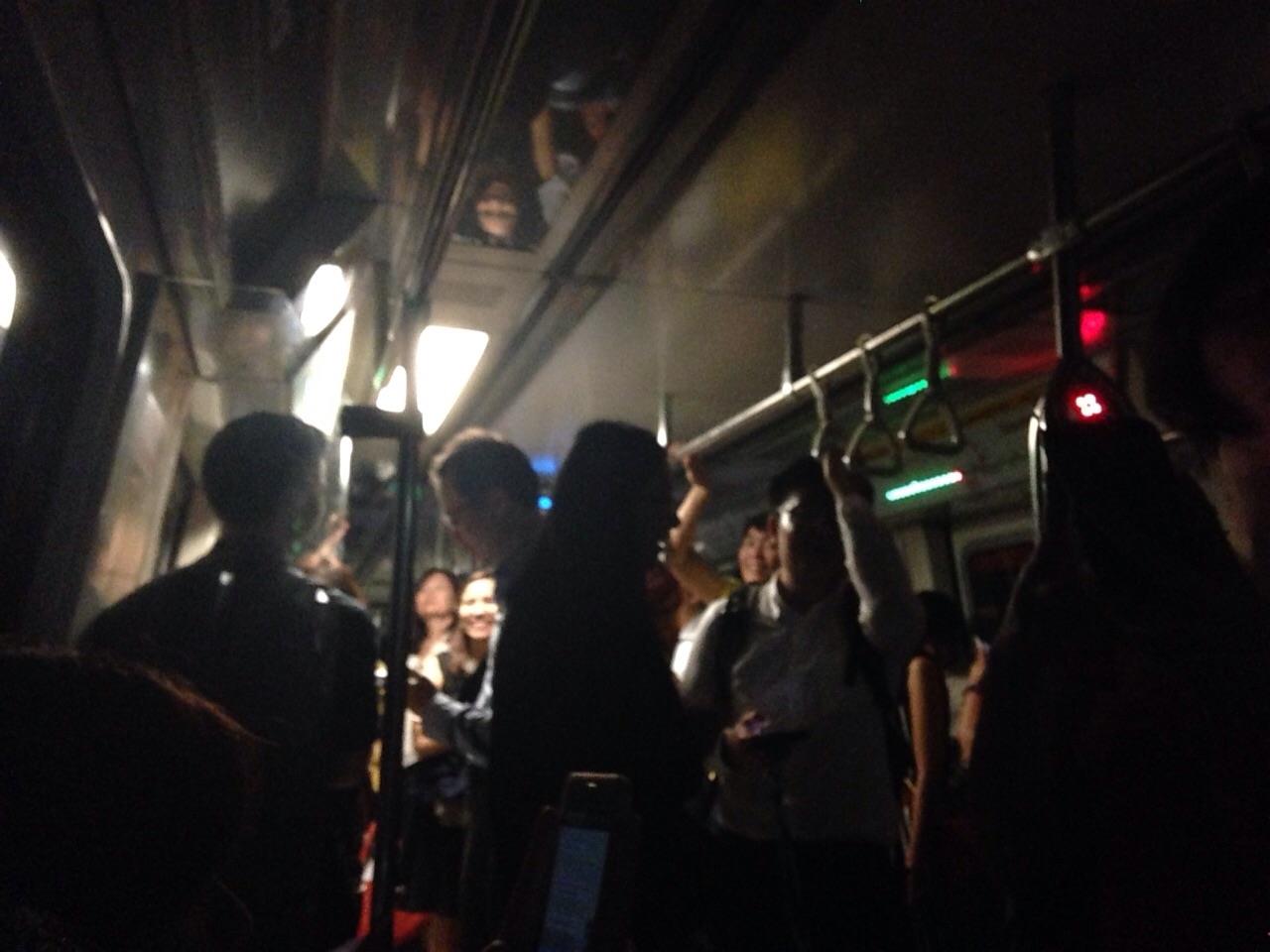
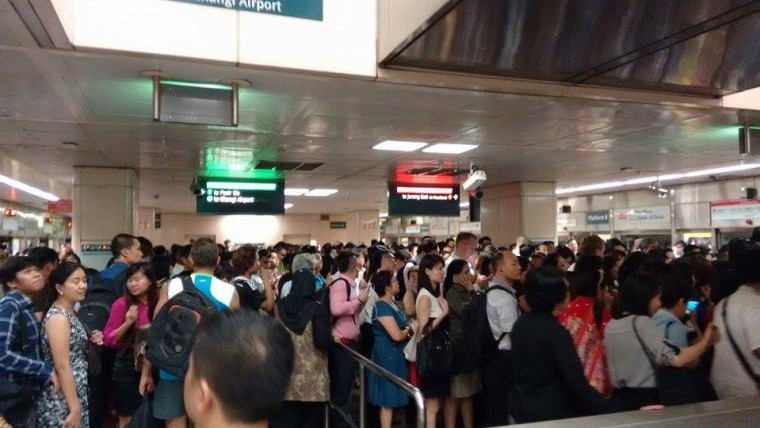
The July 2015 disruption wasn't an isolated case, but the peak of a build-up that began at the start of the decade.
Four years earlier in 2011, the CCL suffered a major disruption twice in two months: once on Sep. 20, and again on Dec. 14.
The NSL was down twice in two days: once on Dec. 15 and again just two days later on Dec. 17.
 SMRT's announcement on Dec. 17, 2011 via Twitter, now called X. Screenshot via @SMRT_Singapore / X.
The 2011 breakdowns were so jarring that a government committee of inquiry was set up to investigate its causes.
SMRT's then-president and CEO resigned in January 2012, but that did not stop the problems.
2012 began with delays on the EWL and NSL, followed by a 20-minute track fault-induced disruption on the CCL.
The NEL was not spared from breakdowns either.
Between March 2012 and January 2013, it would go down four times.
In fact, between 2010 and 2015, there was a total of 243 reported delays and disruptions, as suggested by data collected by community-run site mrtdown.org.
mrtdown.org monitors social media accounts, including those of SMRT and SBS Transit, for service announcements and updates.
The announcements and updates are then processed using AI, as well as human verification before being added to its database.
Just a month after the 2015 twin breakdown, Lui would write to then-Prime Minister Lee Hsien Loong about his decision to step away from electoral politics.
Since the dawn of trains
It seems convincing that the early 2010s marked a turning point for rail reliability, with the convening of government committees and high-profile resignations.
Yet, digging through historical headlines may well feel like déjà vu.
Singapore's MRT network opened on Nov. 7, 1987 with five stations along the NSL that stretched a humble 6km.
About three months later in February 1988, SMRT apologised for a 40-minute disruption caused by a malfunction at Bishan station, Lianhe Zaobao reported then.
On Mar. 13, 1988, the first prime minister of Singapore Lee Kuan Yew officially opened the MRT network, which by then had 20 operating stations across both NSL and EWL.
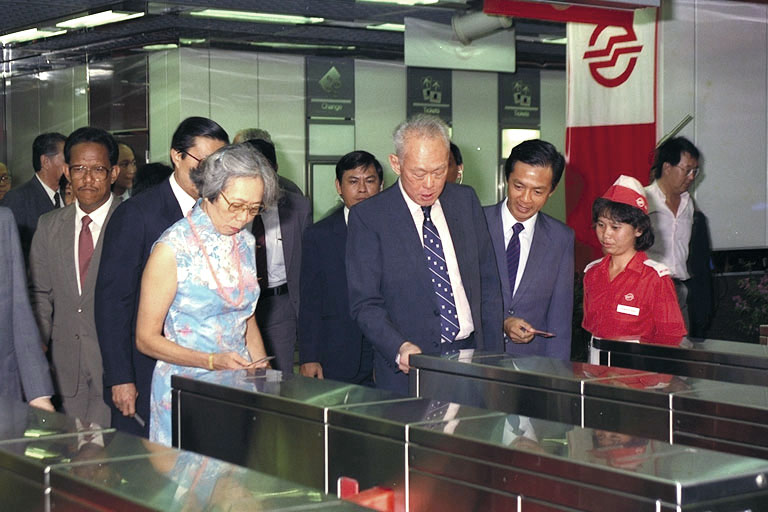 Photo via SMRT.
Three months later in July, equipment failure disrupted lunchtime train service between Newton and Outram Park for 37 minutes, according to The Straits Times (ST).
 Screenshot via NLB.
"We do want her to know how sorry we are for the inconvenience we have caused her," SMRT wrote in 1989 in a forum letter reply on train delays.
In September 1990, two delays took place over two days.
A Jan. 11, 1991 Zaobao headline read: "Train service disrupted again due to power supply failure."
In 1992, delays caused by chewing gum-jammed train doors led to the chewing gum ban.
In May 1993, the NSL went down for three hours due to a defective train.
Later that year on Aug. 5, a train collision took place at Clementi station, injuring 156.
This was the MRT's first major accident.
Signalling fault in 1997. Point machine failure in 2000. Delay in 2005. Technical fault in 2010.
Not forgetting, twice were rail operations disrupted by a stroke of divine will.
 Screenshot via NLB.
I could go on, but train delays or disruptions of varying magnitudes have made it to the headlines almost every year since 1987.
And Singaporeans were just as upset back then as they are today.
Take this forum letter from December 1993.
 An ST Forum letter from Dec. 13, 1993. Or is it an angry Facebook post from today? Screenshot via NLB.
And this strikingly familiar response from Singapore MRT, as SMRT was called then.
 Snippet from SMRT's response. Screenshot via NLB.
Turning point
When Khaw Boon Wan took over the transport ministry portfolio in September 2015, the network had already expanded to 199.6km in length.
The rail reliability standard, measured in terms of mean kilometres between failure (MKBF), was 133,000 train-km.
Singapore's MKBF performance was far below that of rail networks in places like Hong Kong and Taipei, Khaw told parliament 2016.
Against this backdrop, the rail reliability target was set to be raised progressively, with goals of clocking 400,000 train-km by 2018 and 800,000 train-km by 2020.
The plan worked so well that in 2017, 30 years after Singapore's train network opened for business, Khaw raised the rail reliability target to one million train-km by 2020 to keep pace with Taipei Metro's performance.
Singapore's trains achieved that goal one year ahead of schedule in 2019.
Another key decision was made on Jul. 15, 2016.
After more than four years of negotiations, MOT announced that the LTA will take over all operating assets of the North-South, East-West and Circle lines as well as the Bukit Panjang LRT Line, from SMRT for $1.06 billion.
The goal of the new framework is to allow SMRT "to better focus on fulfilling its role as a public transport operator to deliver high levels of operational reliability, safety, and service for the benefit of our commuters".
Rail reliability would continue to improve beyond 2019, peaking at over two million MKBF in 2022.
For a while, it felt like there was calm even as delays and disruptions continued to occur.
It was not until the six-day EWL disruption in 2024, the worst train disruption to date, that seemingly thrusted rail reliability back under the spotlight.
The 2024 EWL disruption affected about 500,000 passenger journeys each day.
Part and parcel of life
And that brings us back to present day, with the NDP man and the NEL disruptions.
As Acting Minister for Transport Jeffrey Siow recounted in parliament, there were at least six incidents over the past three months, including the Aug 12 NEL/SPLRT and Aug 15 SPLRT incidents, Jul 3 and July 19 BPLRT incidents, and Aug 6 EWL and Sep 2 NSL incidents.
Siow has responded to these by setting up a rail reliability task force to further improve the rail networks' performance.
However, Siow also said in Parliament on Sep. 22 that "train delays happen in every system, in every city", just like our phones, computers, and cars, and that "zero disruptions" is an unrealistic expectation.
Despite the inevitability of disruptions, Siow said that the goal is still to “absolutely minimise” them due to the inconvenience to commuters, and the authorities will “work doubly hard to do so”.
To that end, he isn't wrong.
Scouring through the headlines, train disruptions have indeed been part of our everyday and our national consciousness since the rail network's inception.
The cynics may argue that the unending disruptions and delays since day one are proof that the operators have fared poorly.
It's important to remember that while rail reliability have fallen to a five-year low, it still clears the 2010-2015 numbers by miles.
Also, according to data collected on mrtdown.org, from 2010 onwards, the lines that saw the most disruptions or delays were the NSL and EWL, two of Singapore's oldest lines.
Why so upsetting?
So, why do we still get so upset at train delays and disruptions, even after Singapore has achieved and maintained 10-fold improvements in rail reliability since the 2010s?
When Lee Kuan Yew opened the MRT way back in 1987, he was asked if the MRT featured in his vision for Singapore.
"I can't say no altogether, but we tried very hard to avoid such a massive investment on something which was fixed in position.
...
Finally, we found we couldn't and so we have got it now."
The government's acceptance paid off, and the MRT quickly became part of the Singapore story and a symbol of our rapid development.
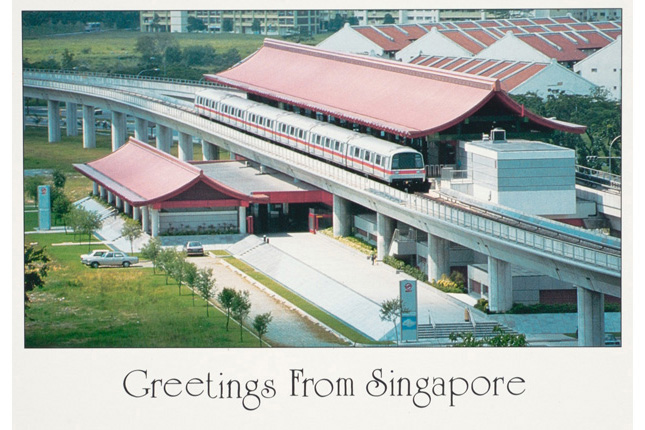 Postcard featuring Chinese Garden MRT in the early 1990s. From National Museum of Singapore via Roots.sg.
Today, the MRT and LRT have become a keystone in Singapore's push for a car-lite society.
When the 14th parliament opened in 2016, Khaw shared that the government's vision was to have three out of four commuters take public transport as their main mode of travel by 2030, and at least 85 per cent by the 2050s.
Cycling and an expanded rail network underpinned this vision.
Singapore's rail network now stretches 240km and carries almost three million riders daily.
In comparison, only one-third of Singapore's 1.42 million resident households owned cars, then-Transport Minister Chee Hong Tat told parliament in 2023.
Once a reluctant investment, Singapore's rail network is now giving everyone access to affordable and efficient transport options without the need for cars.
The impetus to realise this vision is more pronounced now as private car ownership, decided by way of COE bids, has become a pricey commodity.
In this context, when Singapore's rail network does fail, it becomes more than just a moment's inconvenience.
It is the disruption of an essential service that many rely on.
Naturally, this will elicit disappointment and frustration, no matter how much train disruptions and delays should be part of our realistic expectations or how technically rational their causes are.

Siow also explained in parliament on Sep. 22 that beyond one million MKBF, the metric becomes "less meaningful" as the "very small" number of yearly disruptions lead to disproportionate distortions.
MKBF or not, metrics like it are just attempts to objectively measure what has become an obviously subjective concept that is rail reliability.
When Khaw decided on one million train-km as the proxy for reliability in 2016, he explained that this level would best balance cost and reliability.
He also added:
"My own sense is if we can consistently maintain this one million MKBF, that should be good enough. But if for various reasons, future Singapore commuters are demanding an even higher level and are prepared to pay for that greater level of reliability, well, for that, we leave it to the next transport minister."
Top image via SMRT, NLB