News
Vivian Balakrishnan calls for reform of UN Security Council to better fulfil its mandate
Singapore prospered under the stability and predictability of the "old world order", but will benefit from a UN for the future.
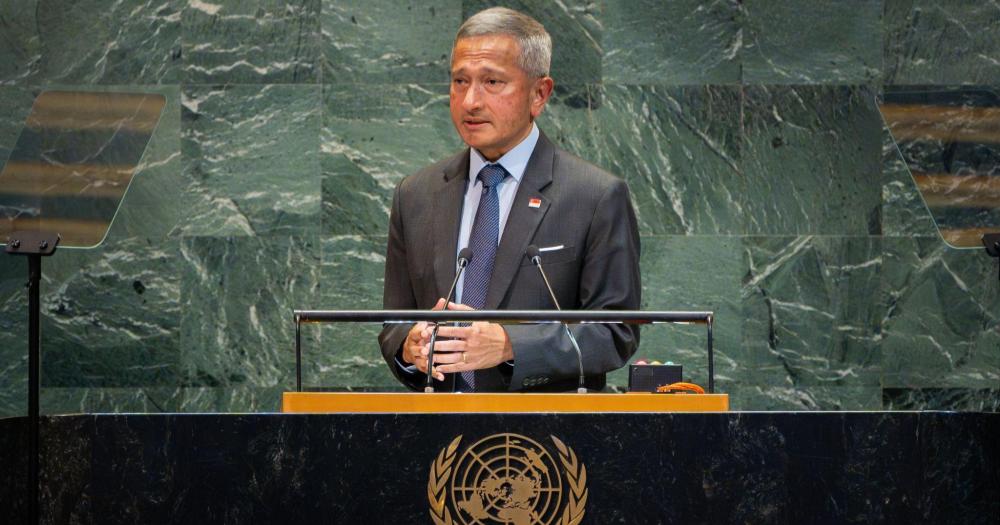

 Singapore’s foreign minister Vivian Balakrishnan called on the United Nations to “reform to be fit for the next stretch” on Sep. 27, while attending the United Nations General Assembly (UNGA) High Level Week.
Vivian was speaking in New York, where he had been attending UNGA, as well as meeting senior leaders from around the world, by his own estimate, over 80 ministerial-level meetings in less than a week.
Reform for the future
In his speech, Vivian issued a clarion call for reform, saying that just as the world had changed dramatically in the last 80 years, “it was clear that the UN needed to reform to 'be fit for the next stretch”.
“We need a more representative and a more inclusive UN that reflects current realities.”
Vivian referred to the UN Security Council’s (UNSC) “primary responsibility for the maintenance of international peace and security”, saying that it “clearly needs reform to better fulfil this mandate”.
On this front, he had a specific issue, the cynical use of vetoes by the P5, which he said must be constrained.
In addition, the wider UN membership “must reach agreement on how this veto is to be exercised in the future”.
The P5 and the rest
Vivian was referring to the UNSC’s five permanent members, the P5.
These comprise the victors of the Second World War, the U.S., the USSR (now Russia), China (first the Republic of China, now the People’s Republic of China), the United Kingdom, and France.
These five members sat in the council permanently, while the 10 elected but non-permanent members rotated through the council on two-year terms, with five being elected every year.
The P5 not only permanently sits on the council, but also has the right to veto any decision to prevent the adoption of any UNSC resolution, regardless of how much international support it has.
This veto has long been controversial, always seen to be wielded in defence of the P5’s national interests, but in recent years, the veto has come to be used in support beyond mere security interests.
Recent examples include Russia’s use of the veto to prevent resolutions against its invasion of Ukraine.
Meanwhile, the U.S. has blocked resolutions calling for a ceasefire in Gaza six times as of Sep. 2025.
Delivery for real people
Vivian said that Singapore commended the role played by the UNSC’s elected members, saying that they gave the wider UN membership “greater agency in addressing the pressing issues of the day.
He said that it was important to strengthen the relationship between the UNSC and the General Assembly.
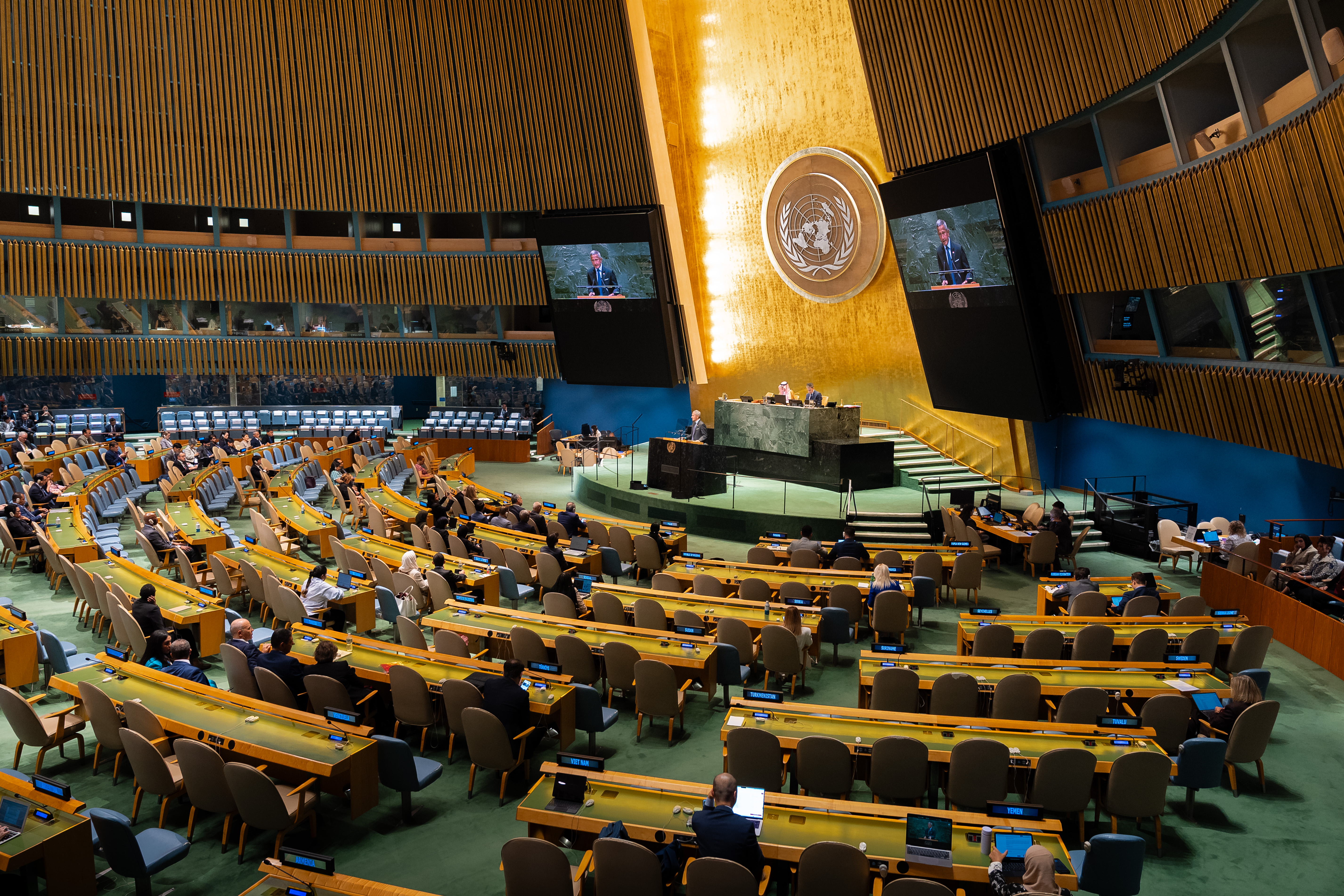 Image via MFA
The world needed a UN that “delivers for real people on the ground.”
Vivian cited needs such as clean water, education, pandemic preparedness, social mobility, jobs, and an international financial architecture that delivers stability and prospects of progress for all.
These are “the building blocks for sustainable development and human dignity.
Turbulent times
Earlier in his speech, Vivian had acknowledged the more turbulent world that now existed in contrast to the preceding 80 years of peace and prosperity.
He credited the UN and the UN Charter for providing the stability and predictability that allowed Singapore to grow and prosper, and was built on a multilateral system founded on international law.
Vivian gave examples like the UN Convention on the Law of the Sea, which granted things like freedom of navigation, and agencies like the International Civil Aviation Organization and International Maritime Organization; all of which were crucial for trade-dependent Singapore.
Although the system was not perfect, with rules and laws not always evenly applied or respected, it provided a clear framework for people and states to tell right from wrong.
But the world now grows more turbulent, with wars raging in the Middle East, Ukraine, and parts of Africa.
Old World Order
Part of the reason for this was that the primary underwriters of the “old world order” were now taking a more transactional, narrower view of their national interest.
This, and the “sharper strategic context” between superpowers, meant they were less able to cooperate and to underwrite and manage the global commons.
Vivian also addressed an issue that had been on the minds of many at the gathering, the recognition of Palestine.
He gave a summarised version of his speech in Singapore’s parliament, saying “Singapore will recognise the State of Palestine when it has an effective government that accepts Israel’s right to exist and categorically renounces terrorism”.
No passivity, fatalism, or pessimism
He said that Singapore believes that the multilateral system and international law, underpinned by the UN, remains the "best way to uphold global peace and prosperity in a fair and inclusive way".
Small states like Singapore could not afford to be passive, fatalistic, or pessimistic.
Small states and middle powers have the agency and strategic autonomy to collectively protect their long-term national interests, as well as the global commons.
Singapore, he said, will support “the UN80 process to strengthen this institution and the multilateral system”.
3 success stories
He cited three success stories where Singapore had recently contributed to, which Vivian said showed the multilateral system still works.
The first was the Biodiversity Beyond National Jurisdiction Treaty (BBNJ), whose negotiations had been presided over by Singaporean Rena Lee.
The BBNJ Agreement will enter into force on Jan. 17 2026, having recently passed the 60 ratification threshold needed to bring it into force.
The second example was the Final Report of the Open-Ended Working Group on Cybersecurity, which had been chaired over the past five years by Burhan Gafoor, Singapore’s Permanent Representative to the UN.
The working group had managed to reach a consensus and agreed to establish the Global Mechanism on Cybersecurity, strengthening the “normative framework for responsible State behaviour in cybersecurity”.
The third example was the adoption of two treaties on Intellectual Property by the World Intellectual Property Organization, which is led by Singaporean Daren Tang.
Tang was nominated for a second term in July 2025.
Vivian said the three examples “demonstrate that even in these fractured, fractious times, it is possible to come together to manage our global commons, and to achieve agreement and consensus”.
Related story
Top image via MFA