News

6-day EWL disruption in Sep. 2024 caused by 'rare' & 'catastrophic' mechanical failure: LTA, SMRT
The train has since been decommissioned.
June 03, 2025, 05:00 PM
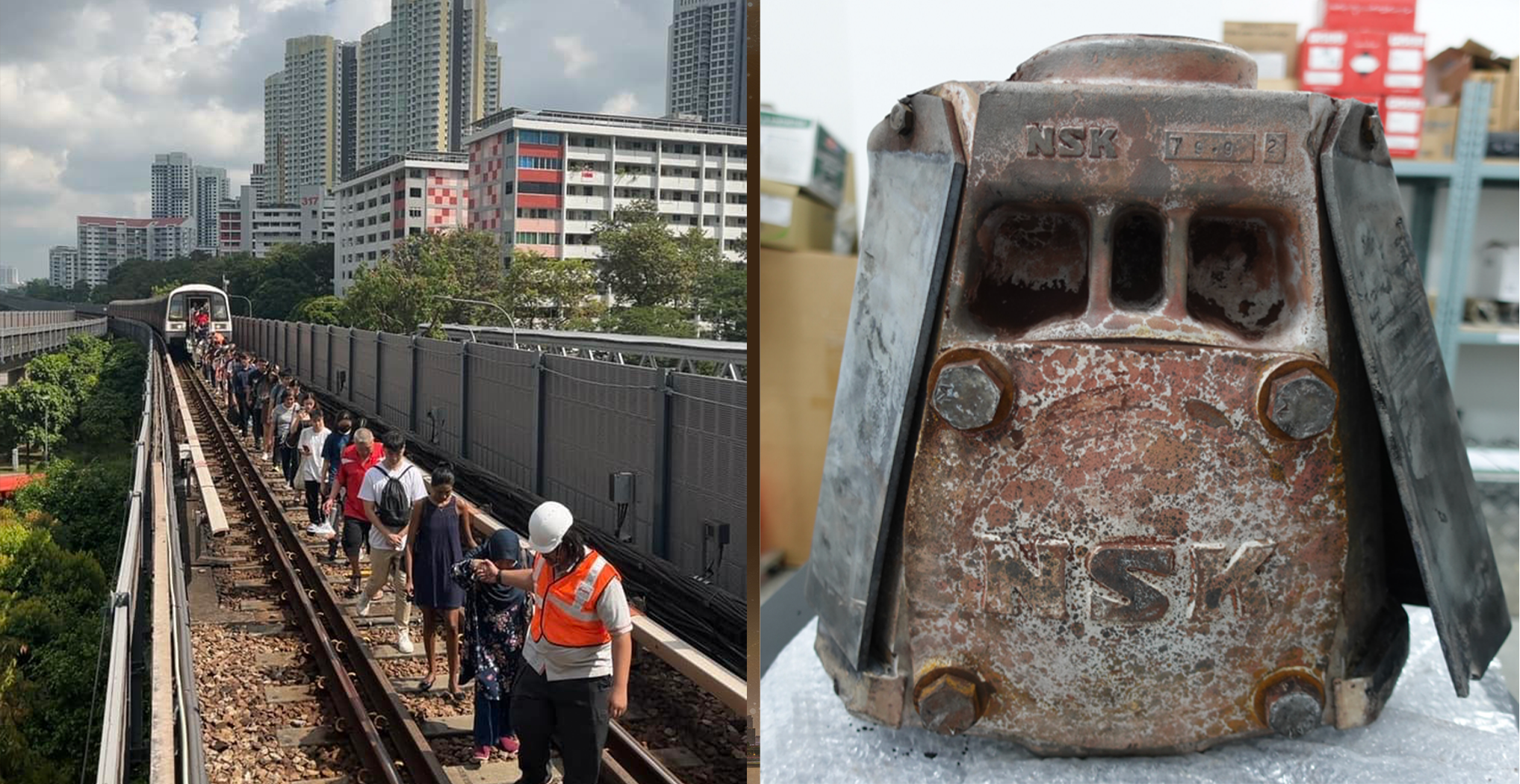


The six-day disruption of the East-West Line (EWL) in September 2024 was caused by an uncommon mechanical failure.
In a Jun. 3 statement, LTA released a summary of the findings of the investigation, which was conducted with an expert panel.
While the investigations found that SMRT staff responded to the situation “appropriately”, it also acknowledged a breach of license that contributed to the disrupted service.
Here’s what happened.
What happened
The disruption was caused by a damaged axle box, a component in the train that allows the wheels to rotate smoothly.
This resulted in “extreme heat” being generated, igniting and burning off pieces of rubber in the axle box.
As the train travelled from Jurong East to Clementi, some people reported a “burning smell”.
Smoke was also observed in the cabin.
After the station manager confirmed this, controllers instructed the captain to take the train out of service.
About 850 commuters were detrained and guided to Clementi MRT station.
SMRT then withdrew the train towards the nearest depot, Ulu Pandan Depot, for assessment.
According to LTA, on-site inspection of potentially damaged trains, for example at MRT stations, is not feasible due to insufficient space on the platform and viaduct.
However, near Dover station, the axle box was dislodged and fell off the train. The wheels of the third train-car subsequently came off the rails.
This caused “severe damage” to the rails and other equipment, which required six days of repairs.
Earlier, it was reported that 34 rail breaks were detected across 1.6km of tracks between Dover and Clementi stations.
In response to Mothership's queries, an LTA spokesperson said that where assessed to be safe, trains are typically withdrawn at the normal speed of around 70km/h.
That was also the case with this train.
Iff SMRT had withdrawn the train at a slower speed, there might have potentially been more limited damage.
"In this case, SMRT’s staff were not aware that the damage to the incident train was to the axle box, and that withdrawing it at normal speeds could further exacerbate the damage," the spokesperson said.
Why it happened
While a definitive cause was not identified as the axle box, bearings, and chevron spring debris were too badly damaged, the mechanism likely failed because of degraded grease, LTA said.
This led to increased friction in the axle box, and its subsequent overheating and failure.
Burnt rubber and metal pieces were later found in the train’s path — which pointed to an overheated axle box.
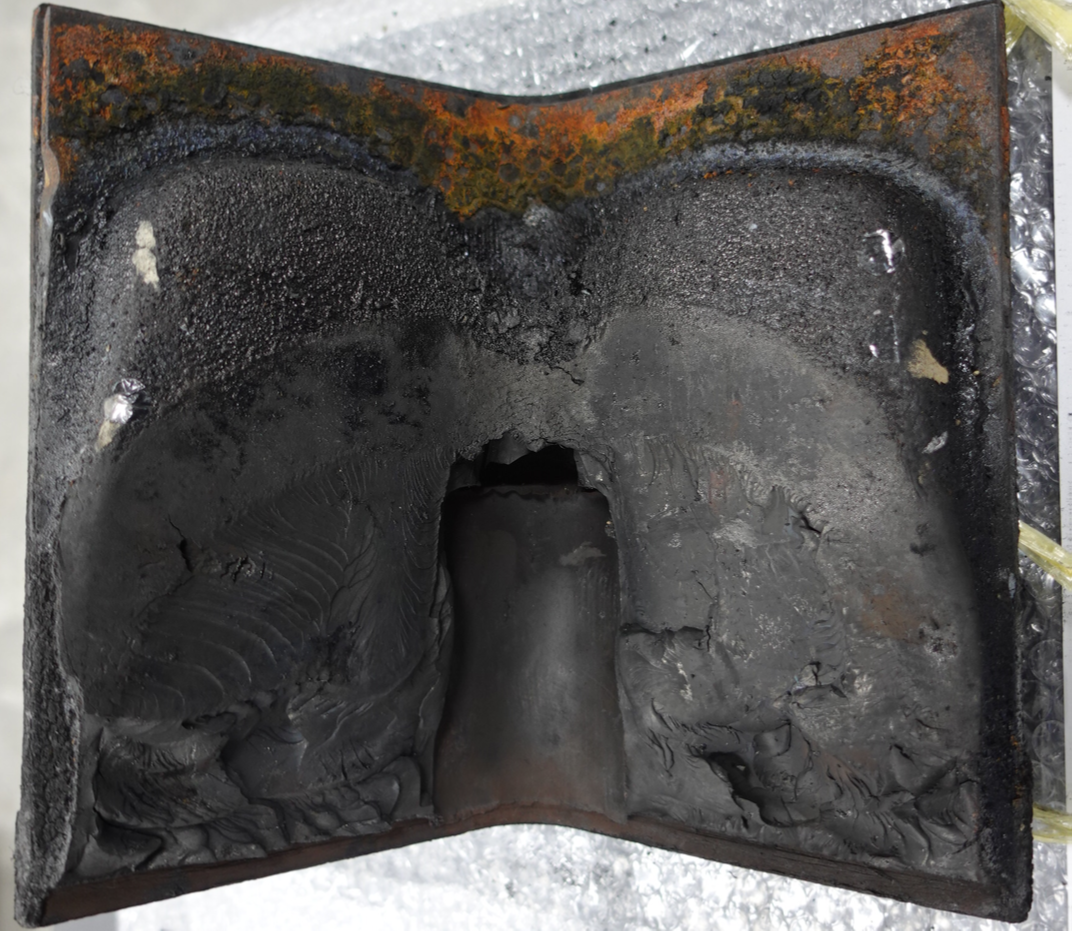 Burnt springs in the axle box. Photo from LTA
In addition, prior to the incident, elevated temperatures were detected in the axle box.
Temperature logs from earlier that day found that the axle box had a temperature of 118°C — significantly higher than the typical operating temperature of 65°C.
But due to a system issue, the incident train could not be identified and action could not be taken promptly.
In the days prior, the temperature was also “slightly elevated”, but still within operating thresholds.
Could it have been avoided?
The train in question — which has since been decommissioned — was part of the first-generation Kawasaki Heavy Industries (KHI) fleet.
It had been in service for over 35 years at the time of the incident, and was last overhauled in July 2018.
Initially, the KHI fleet was supposed to be replaced by new Movia trains by March 2024.
But this was delayed due to the Covid-19 pandemic.
Because of this, SMRT continued to regularly maintain and overhaul its existing KHI fleet.
SMRT also twice extended the overhaul interval for the incident train.
Initially, the train had to be maintained after logging 500,000km. This was later extended to 575,000km in August 2022, and 750,000km in August 2024.
At the time of the incident, the train had logged 690,000km. Along with the other KHI trains, it was due to be decommissioned by the third quarter of 2025.
In addition, as axle box failures are not common, SMRT had not undertaken a detailed engineering and risk assessment on the overhaul interval required for the axle box.
The degraded grease hence went unnoticed.
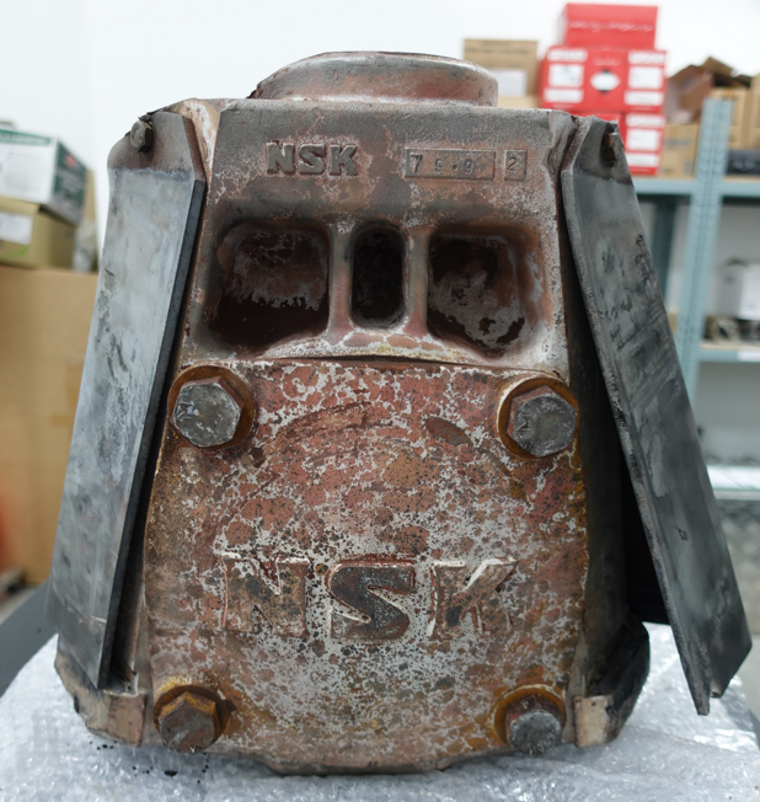 Damaged axle box. Photo from LTA
“Had the incident train been overhauled in a more timely manner, the condition of its axle box assemblies would have been checked and any degraded grease could have been replaced earlier,” LTA said.
Lam Sheau Kai, president of SMRT Trains, said that while "similar axle box dislodgement incidents have occurred in other metro systems", these are "extremely rare, sudden, and catastrophic" incidents.
On the overhaul regime, he said their “overhaul regime has served us well over the past 38 years".
But what may have caught them "off-guard" this time was a convergence of factors.
These include delays in new train deliveries due to Covid-19, their efforts to "balance and adjust overhaul schedules", and the lag in receiving "critical spare parts".
He noted that for rare, black swan events like Covid-19, it is important that "SMRT and LTA, operator and asset owner, should come together to reassess collectively".
"In hindsight, we could perhaps have exercised greater caution in how we managed the transition and decommissioning of the older trains.”
What now?
As a result of the breach that led to the disruption, LTA will impose a financial penalty of S$3 million on SMRT.
In determining the quantum, LTA acknowledged that SMRT bore the cost of repairs, free bridging and shuttle services, and free travel to passengers alighting at Jurong East and Buona Vista.
In total, this amounted to over S$10 million.
SMRT’s service recovery was also determined to have been managed “satisfactorily”, LTA said.
This included the prompt activation of bridging shuttle buses, shuttle trains and so on.
The financial penalty collected will go to the Public Transport Fund to help lower-income families with their public transport expenditures, LTA said.
LTA has since served a notice of intent for the financial penalty to SMRT.
SMRT is aware of the penalty and is currently reviewing the matter.
Moving forward, SMRT has implemented a system to detect abnormal axle box temperatures.
It has also reduced the speed for trains being withdrawn back to the depot from 70km/h to 35km/h, “to limit any potential damage to the tracks and trackside equipment”.
SMRT, LTA, and the National Transport Workers’ Union have set up a workgroup to review and enhance systems.
It has also engaged overseas metro operators in Guangzhou and Taipei for “mutual learning”, LTA said.
Top image from SMRT/Facebook and LTA