News

Idea that cannabis is 'safe drug' a false narrative, S'pore determined to maintain a tough stance: Shanmugam
The minister also explained why Singapore imposes the death penalty on drug traffickers.
May 15, 2025, 02:52 PM


Two months ago, the Central Narcotics Bureau (CNB) picked up a haul of cannabis-infused chocolate bars and candies during a drug operation.
"They look innocent, they look enticing. Bright colours, cartoon characters...[but] imagine children find and consume them," said Law and Home Affairs Minister K Shanmugam.
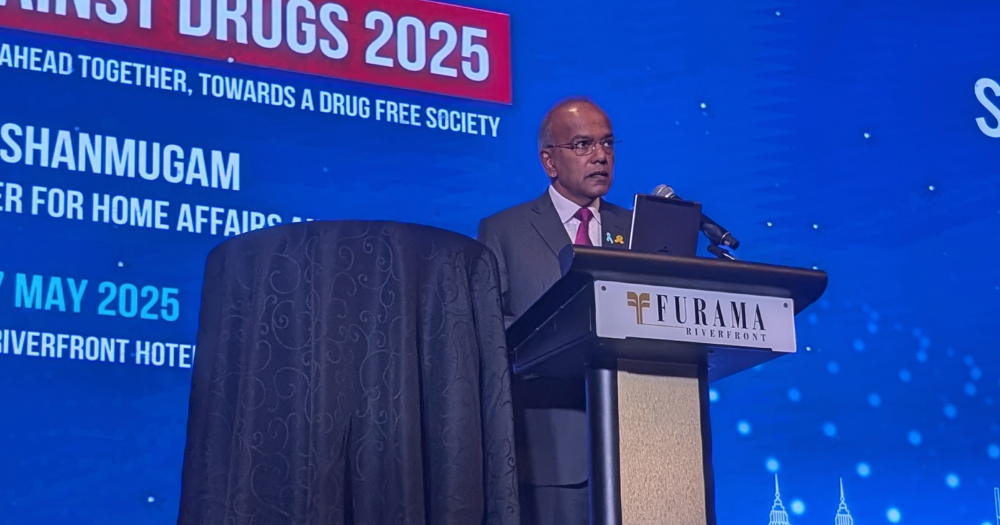
He was speaking at the opening address of the Asia Pacific Forum against Drugs (APFAD) 2025 on May 15.
The idea that cannabis is a "safe drug", Shannugam said, is a "false narrative...largely driven by commercial entities".
He pointed out that admissions for cannabis-related psychotic disorders have gone up four times worldwide between 2000 and 2018.
"We in Singapore are determined to maintain a tough stance against drugs," he said.
"The government believes that our people have a right to live in a drug-free society, even if that might be termed as not progressive.
...
As I never tire of saying, any lady in the room, any young child, can go out at any time of the day or night in Singapore and not feel threatened...And that, I think, is a very important human right."
Death penalty is part of comprehensive strategy against drugs
Shanmugam also spoke about Singapore's death penalty, used most often with convicted drug traffickers.
This is because "we treat drug traffickers as people who ply death...they want to make money out of the death and misery of others," he said.
He added that people who criticise the death penalty and hold candlelight vigils for sentenced criminals "ignore the victims" of drugs.
That's where Drug Victims Remembrance Day—commemorated on the third Friday of May in Singapore, or May 16 this year—comes in.
"Drug Victims Remembrance Day helps us remember the people around the world in Singapore, who are victims of drugs, and what drug traffickers do to all these people," he said.
The death penalty is part of the comprehensive harm prevention approach that Singapore takes in the fight against drugs, which includes enforcing tough laws like the death penalty, providing public eduation, and tapping on community and civil society support,
Formation of regional coalition of NGOs
Howeer, no country can tackle the global problem of drugs alone, said the minister who took the opportunity to announce the formation of a regional coalition of NGOs, called the Asia-Pacific Confederation against Drugs (APCD).
This coalition has six founding members from five jurisdictions:
- SANA (Singapore)
- Green Crescent (Malaysia)
- National Movement Against Narcotics (GRANAT) (Indonesia)
- Assistance and Empowerment Foundation for Papuan and West Papuan Community (YP2MP) (Indonesia)
- Association of Anti-Drug Abuse Coalitions of Philippines (Philippines)
- Society for the Aid and Rehabilitation of Drug Abusers (Hong Kong)
Aside from strengthening regional cooperation and sharing best practices in the ongoing fight against drugs, members of the APCD aim to "speak up against the rising tide of liberal policies and misinformation on drugs" at international platforms like the United Nations.
As such, Singapore hopes to work with non-governmental organisations and civil society organisations from different countries to "amplify the messages to our respective countries".
"So we welcome ideas," Shanmugam said. "Singapore stands ready to work with each one of you, and I mean that very seriously."
Top image by Mothership